Yoruba Pentecostalism and Child Witchcraft Accusations
Regular price
$130.00
Save $-130.00
An exploration of Yoruba Pentecostalism's role in child witchcraft accusations, examining migration, leadership, and collective responsibility to address faith-based child abuse globally.
What drives communities to accuse children of witchcraft, and how do religious beliefs and leadership dynamics perpetuate this phenomenon across borders? Claire Ayelotan delves into the involvement of Yoruba (Nigerian) Pentecostal leaders in accusations of child witchcraft in Nigeria and the UK. Using a multidisciplinary approach, her research examines the theological, cultural, socioeconomic, and legal influences that drive such behaviours. Ethnographic studies and interviews with pastors and practitioners reveal how power dynamics, gender roles, and international migration intersect to perpetuate these harmful beliefs. The book uncovers gaps in current literature and presents original insights on the collective responsibility, shared beliefs, and complexities of Pentecostal leadership in this context. By focusing on the global aspects of child witchcraft accusations, it sheds new light on how migration impacts these practices and the negative consequences they have on vulnerable children.
An important read for academics, policymakers, and child welfare professionals, this book challenges assumptions and urges immediate action to combat faith-based child abuse in all its manifestations.
Whites and Democracy in South Africa
Regular price
$36.95
Save $-36.95
Key book in Whiteness Studies that engages with the different ways in which the last white minority in Africa to give way to majority rule has adjusted to the arrival of democracy and the different modes of transition from "settlers" to "citizens".
How have whites adjusted to, contributed to and detracted from democracy in South Africa since 1994? Engaging with the literature on 'whiteness' and the current trope that the democratic settlement has failed, this book provides a study of how whites in the last bastion of 'white minority rule' in Africa have adapted to the sweeping political changes they have encountered. It examines the historical context of white supremacy and minority rule, in the past, and the white withdrawal from elsewhere on the African continent. Drawing on focus groups held across the country, Southall explores the difficult issue of 'memory', how whites seek to grapple with the history of apartheid, and how this shapes their reactions to political equality. He argues that whites cannot be regarded as a homogeneous political grouping concluding that while the overwhelming majority of white South Africans feared the coming of democracy during the years of late apartheid, they recognised its inevitability. Many of their fears were, in effect, to be recognised by the Constitution, which embedded individual rights, including those to property and private schooling, alongside the important principle of proportionality of political representation. While a small minority of whites chose to emigrate, the large majority had little choice but to adjust to the democratic settlement which, on the whole, they have done - and in different ways. It was only a small right wing which sought to actively resist; others have sought to withdraw from democracy into social enclaves; but others have embraced democracy actively, either enthusiastically welcoming its freedoms or engaging with its realities in defence of 'minority rights'. Whites may have been reluctant to accept democracy, but democrats - of a sort - they have become, and notwithstanding a significant racialisation of politics in post-apartheid South Africa, they remain an important segment of the "rainbow", although dangers lurk in the future unless present inequalities of both race and class are challenged head on.
African Sun Media: South Africa
Medical Texts in Anglo-Saxon Literary Culture
Regular price
$29.99
Save $-29.99
Winner of the Best First Monograph from the International Society for the Study of Early Medieval England (ISSEME) 2021.
An examination of the Old English medical collections, arguing that these texts are products of a learned intellectual culture.
Four complete medical collections survive from Anglo-Saxon England. These were first edited by Oswald Cockayne in the nineteenth century and came to be known by the names Bald's Leechbook, Leechbook III, the Lacnunga, and the Old English Pharmacopeia. Together these works represent the earliest complete collections of medical material in a western vernacular language. This book examines these texts as products of a learned literary culture. While earlier scholarship tended to emphasise the relationship of these works to folk belief or popular culture, this study suggests that all four extant collections were probably produced in major ecclesiastical centres. It examines the collections individually, emphasising their differences of content and purpose, while arguing that each consistently displays connections with an elite intellectual culture. The final chapter considers the fundamentally positive depiction of doctors and medicine found within literary and ecclesiastical works from the period and suggests that the high esteem for medicine in literate circles may have favoured the study and translation of medical texts.
A Companion to Latin American Literature
Regular price
$36.95
Save $-36.95
The evolution of Latin American literature.
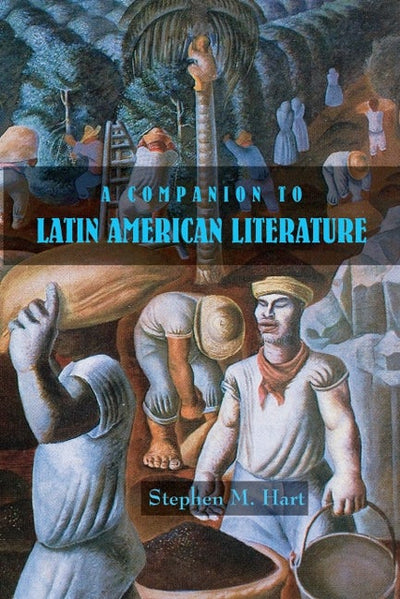
A Companion to Latin American Literature offers a lively and informative introduction to the most significant literary works produced in Latin America from the fifteenth century until the present day. It shows how the press, and its product the printed word, functioned as the common denominator binding together, in different ways over time, the complex and variable relationship between the writer, the reader and the state. The meandering story of the evolution of Latin American literature - from the letters of discovery written by Christopher Columbus and Vaz de Caminha, via the Republican era at the end of the nineteenth century when writers in Rio de Janeiro as much as inBuenos Aires were beginning to live off their pens as journalists and serial novelists, until the 1960s when writers of the quality of Clarice Lispector in Brazil and García Márquez in Colombia suddenly burst onto the world stage- is traced chronologically in six chapters which introduce the main writers in the main genres of poetry, prose, the novel, drama, and the essay. A final chapter evaluates the post-boom novel, testimonio, Latino and Brazuca literature, gay, Afro-Hispanic and Afro-Brazilian literature, along with the Novel of the New Millennium. This study also offers suggestions for further reading.
STEPHEN M. HART is Professor of Hispanic Studies, UniversityCollege London, and Profesor Honorario, Universidad de San Marcos, Lima
The Catalan Expedition to the East
Regular price
$22.95
Save $-22.95
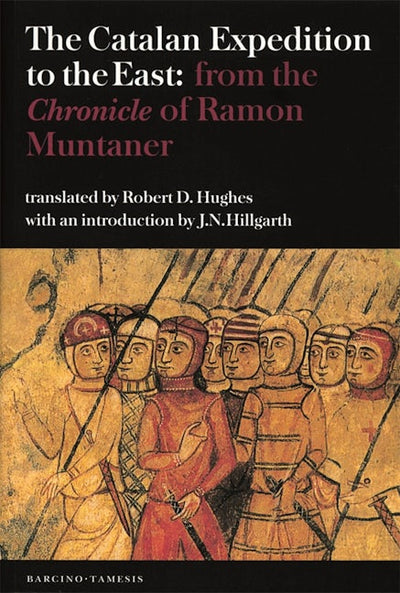
Ramon Muntaner's account of the bloody adventures of the Almogaver army under Roger of Flor in the eastern Mediterranean in the early fourteenth century, one of the most spellbinding narratives of medieval European literature.
Before its definitive fall into Turkish hands, the Byzantine Empire was the target of adventurers of many nations. Outstanding among these groups was the Almogaver army led by Roger of Flor, composed of mercenaries hardened in thewar between the Catalan and Angevin dynasties for domination of Sicily. The Catalan presence in Constantinople aroused suspicion among the Greek nobility who assassinated Roger of Flor and tried to exterminate his men. The devastating reaction of those who escaped the slaughter led to Catalan control of broad swathes of the Empire, including Athens. Ramon Muntaner, one of the ringleaders of the expedition, recounted the adventures of the Almogaver army inthe eastern Mediterranean in the fascinating section of his Chronicle translated here. The preface is by N. D. Hillgarth.
Dr. Robert D. Hughes is a translator and researcher with particular expertise in the fields of fine art, the history of ideas and Catalan culture.