You may also like
The American Yawp
Regular price $25.00 Save $-25.00"I too am not a bit tamed—I too am untranslatable / I sound my barbaric yawp over the roofs of the world."—Walt Whitman, "Song of Myself," Leaves of Grass
The American Yawp is a free, online, collaboratively built American history textbook. Over 300 historians joined together to create the book they wanted for their own students—an accessible, synthetic narrative that reflects the best of recent historical scholarship and provides a jumping-off point for discussions in the U.S. history classroom and beyond.
Long before Whitman and long after, Americans have sung something collectively amid the deafening roar of their many individual voices. The Yawp highlights the dynamism and conflict inherent in the history of the United States, while also looking for the common threads that help us make sense of the past. Without losing sight of politics and power, The American Yawp incorporates transnational perspectives, integrates diverse voices, recovers narratives of resistance, and explores the complex process of cultural creation. It looks for America in crowded slave cabins, bustling markets, congested tenements, and marbled halls. It navigates between maternity wards, prisons, streets, bars, and boardrooms.
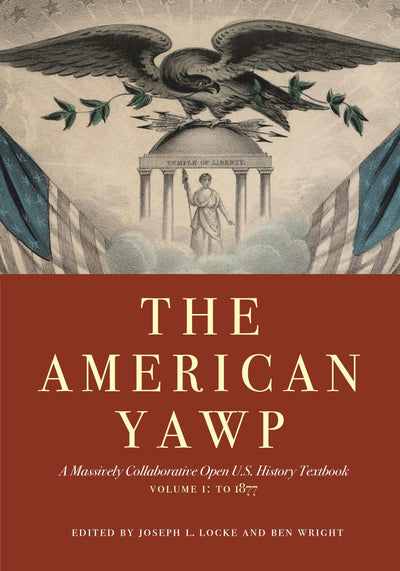
The fully peer-reviewed edition of The American Yawp will be available in two print volumes designed for the U.S. history survey. Volume I begins with the indigenous people who called the Americas home before chronicling the collision of Native Americans, Europeans, and Africans.The American Yawp traces the development of colonial society in the context of the larger Atlantic World and investigates the origins and ruptures of slavery, the American Revolution, and the new nation's development and rebirth through the Civil War and Reconstruction.
Rather than asserting a fixed narrative of American progress, The American Yawp gives students a starting point for asking their own questions about how the past informs the problems and opportunities that we confront today.

The American Yawp
Regular price $25.00 Save $-25.00"I too am not a bit tamed—I too am untranslatable / I sound my barbaric yawp over the roofs of the world."—Walt Whitman, "Song of Myself," Leaves of Grass
The American Yawp is a free, online, collaboratively built American history textbook. Over 300 historians joined together to create the book they wanted for their own students—an accessible, synthetic narrative that reflects the best of recent historical scholarship and provides a jumping-off point for discussions in the U.S. history classroom and beyond.
Long before Whitman and long after, Americans have sung something collectively amid the deafening roar of their many individual voices. The Yawp highlights the dynamism and conflict inherent in the history of the United States, while also looking for the common threads that help us make sense of the past. Without losing sight of politics and power, The American Yawp incorporates transnational perspectives, integrates diverse voices, recovers narratives of resistance, and explores the complex process of cultural creation. It looks for America in crowded slave cabins, bustling markets, congested tenements, and marbled halls. It navigates between maternity wards, prisons, streets, bars, and boardrooms.
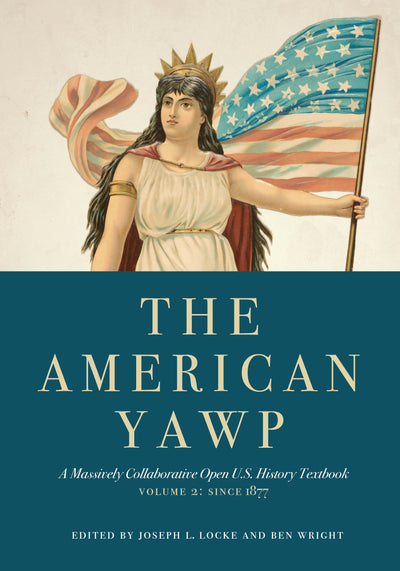
The fully peer-reviewed edition of The American Yawp will be available in two print volumes designed for the U.S. history survey. Volume II opens in the Gilded Age, before moving through the twentieth century as the country reckoned with economic crises, world wars, and social, cultural, and political upheaval at home. Bringing the narrative up to the present,The American Yawp enables students to ask their own questions about how the past informs the problems and opportunities we confront today.
Performing Chinatown
Regular price $28.00 Save $-28.00In 1938, China City opened near downtown Los Angeles. Featuring a recreation of the House of Wang set from MGM's The Good Earth, this new Chinatown employed many of the same Chinese Americans who performed as background extras in the 1937 film. Chinatown and Hollywood represented the two primary sites where Chinese Americans performed racial difference for popular audiences during the Chinese exclusion era. In Performing Chinatown, historian William Gow argues that Chinese Americans in Los Angeles used these performances in Hollywood films and in Chinatown for tourists to shape widely held understandings of race and national belonging during this pivotal chapter in U.S. history.
Performing Chinatown conceives of these racial representations as intimately connected to the restrictive immigration laws that limited Chinese entry into the U.S. beginning with the 1875 Page Act and continuing until the passage of the Immigration and Nationality Act of 1965. At the heart of this argument are the voices of everyday people including Chinese American movie extras, street performers, and merchants. Drawing on more than 40 oral history interviews as well as research in more than a dozen archival and family collections, this book retells the long-overlooked history of the ways that Los Angeles Chinatown shaped Hollywood and how Hollywood, in turn, shaped perceptions of Asian American identity.
The Worst Trickster Story Ever Told
Regular price $30.00 Save $-30.00When did the federal government's self-appointed, essentially limitless authority over Native America become constitutional?
The story they have chosen to tell is wrong. It is time to tell a better story. Thus begins Keith Richotte's playful, unconventional look at Native American and Supreme Court history. At the center of his account is the mystery of a massive federal authority called plenary power.
When the Supreme Court first embraced plenary power in the 1880s it did not bother to seek any legal justification for the decision – it was simply rooted in racist ideas about tribal nations. By the 21st century, however, the Supreme Court was telling a different story, with opinions crediting the U.S. Constitution as the explicit source of federal plenary power.
So, when did the Supreme Court change its story? Just as importantly, why did it change its story? And what does this change mean for Native America, the Supreme Court, and the rule of law? In a unique twist on legal and Native history, Richotte uses the genre of trickster stories to uncover the answers to these questions and offer an alternative understanding.
The Worst Trickster Story Ever Told provides an irreverent, entertaining synthesis of Native American legal history across more than 100 years, reflecting on race, power, and sovereignty along the way. By embracing the subtle, winking wisdom of trickster stories, and centering the Indigenous perspective, Richotte opens up new avenues for understanding this history. We are able, then, to imagine a future that is more just, equitable, and that better fulfills the text and the spirit of the Constitution.
Cemetery Citizens
Regular price $28.00 Save $-28.00Across the United States, groups of grassroots volunteers gather in overgrown, systemically neglected cemeteries. As they rake, clean headstones, and research silenced histories, they offer care to individuals who were denied basic rights and forms of belonging in life and in death. Cemetery Citizens is the first book-length study of this emerging form of social justice work. It focuses on how racial disparities shape the fates of the dead, and asks what kinds of repair are still possible. Drawing on interviews, activist anthropology, poems, and drawings, Adam Rosenblatt takes us to gravesite reclamation efforts in three prominent American cities.
Cemetery Citizens dives into the ethical quandaries and practical complexities of cemetery reclamation, showing how volunteers build community across social boundaries, craft new ideas about citizenship and ancestry, and expose injustices that would otherwise be suppressed. Ultimately, Rosenblatt argues that an ethic of reclamation must honor the presence of the dead—treating them as fellow cemetery citizens who share our histories, landscapes, and need for care.