You may also like
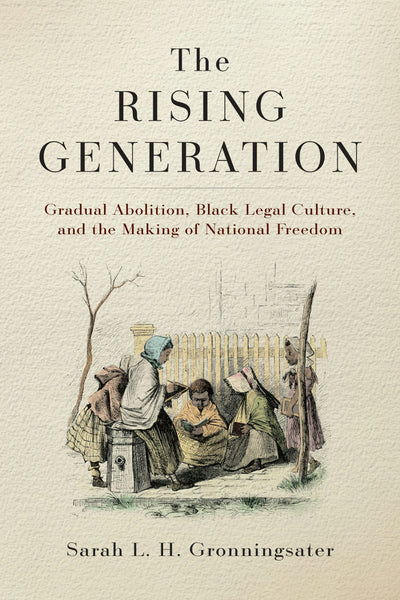
The Rising Generation
Regular price $69.95 Save $-69.95Chronicles the history of emancipation through the cradle-to-grave experiences of a remarkable generation of black northerners
The Rising Generation chronicles the long history of emancipation in the United States through the cradle-to-grave experiences of a generation of black New Yorkers. Born into precarious freedom after the American Revolution and reaching adulthood in the lead-up to the Civil War, this remarkable generation ultimately played an outsized role in political and legal conflicts over slavery’s future, influencing both the nation’s path to the Civil War and changes to the US Constitution.
Through exhaustive research in archives across New York State, where the largest enslaved population in the North resided at the time of the American Revolution, Sarah L. H. Gronningsater begins by exploring how English colonial laws shaped late eighteenth-century gradual abolition acts that freed children born to enslaved mothers. The boys and girls affected by these laws were born into a quasi-free legal status. They were technically not enslaved but were nonetheless required to labor as servants until they reached adulthood. Parents, teachers, and mentors of these “children of gradual abolition” found multiple ways to protect and nurture the boys and girls in their midst. They supported and founded schools, formed ties with white lawyers and abolitionists, petitioned local and state officials for better laws, guarded against kidnapping and cruelty, and shaped New York’s evolving identity as a free state. Black fathers used their votes during annual state elections in the early 1800s to influence legislative antislavery efforts. After many but not all black men in the state were disfranchised by a race-based property requirement in 1822, black citizens across New York organized to regain equal suffrage and to expand and protect other crucial, non-gendered features of state citizenship. Women and children were critical participants in these efforts.
Gronningsater shows how, as the children of gradual abolition reached adulthood, they took the lessons of their youth into midcentury campaigns for legal equality, political inclusion, equitable common school education, and the expansion of freedom across the nation.
Speculation Nation
Regular price $39.95 Save $-39.95During the first quarter-century after its founding, the United States was swept by a wave of land speculation so unprecedented in intensity and scale that contemporaries and historians alike have dubbed it a “mania.” In Speculation Nation, Michael A. Blaakman uncovers the revolutionary origins of this real-estate bonanza—a story of ambition, corruption, capitalism, and statecraft that stretched across millions of acres from Maine to the Mississippi and Georgia to the Great Lakes.
Patriot leaders staked the success of their revolution on the seizure and public sale of Native American territory. Initially, they hoped that fledgling state and national governments could pay the hefty costs of the War for Independence and extend a republican society of propertied citizens by selling expropriated land directly to white farmers. But those democratic plans quickly ran aground of a series of obstacles, including an economic depression and the ability of many Native nations to repel U.S. invasion. Wily merchants, lawyers, planters, and financiers rushed into the breach. Scrambling to profit off future expansion, they lobbied governments to convey massive tracts for pennies an acre, hounded revolutionary veterans to sell their land bounties for a pittance, and marketed the rustic ideal of a yeoman’s republic—the early American dream—while waiting for land values to rise.
When the land business crashed in the late 1790s, scores of “land mad” speculators found themselves imprisoned for debt or declaring bankruptcy. But through their visionary schemes and corrupt machinations, U.S. speculators and statesmen had spawned a distinctive and enduring form of settler colonialism: a financialized frontier, which transformed vast swaths of contested land into abstract commodities. Speculation Nation reveals how the era of land mania made Native dispossession a founding premise of the American republic and ultimately rooted the United States’ “empire of liberty” in speculative capitalism.
Belonging
Regular price $39.95 Save $-39.95Explores how Black New Englanders maintained a sense of belonging among their kin in the face of slavery
As winter turned to spring in the year 1699, Sebastian and Jane embarked on a campaign of persuasion. The two wished to marry, and they sought the backing of their community in Boston. Nothing, however, could induce Jane’s enslaver to consent. Only after her death did Sebastian and Jane manage to wed, forming a long-lasting union even though husband and wife were not always able to live in the same household.
New England is often considered a cradle of liberty in American history, but this snippet of Jane and Sebastian’s story reminds us that it was also a cradle of slavery. From the earliest years of colonization, New Englanders bought and sold people, most of whom were of African descent. In Belonging, Gloria McCahon Whiting tells the region’s early history from the perspective of the people, like Jane and Sebastian, who belonged to others and who struggled to maintain a sense of belonging among their kin. Through a series of meticulously reconstructed family narratives, Whiting traces the contours of enslaved people’s intimate lives in early New England, where they often lived with those who bound them but apart from kin. Enslaved spouses rarely were able to cohabit; fathers and their offspring routinely were separated by inheritance practices; children could be removed from their mothers at an enslaver’s whim; and people in bondage had only partial control of their movement through the region, which made more difficult the task of maintaining distant relationships.
But Belonging does more than lay bare the obstacles to family stability for those in bondage. Whiting also charts Afro-New Englanders’ persistent demands for intimacy throughout the century and a half stretching from New England’s founding to the American Revolution. And she shows how the work of making and maintaining relationships influenced the region’s law, religion, society, and politics. Ultimately, the actions taken by people in bondage to fortify their families played a pivotal role in bringing about the collapse of slavery in New England’s most populous state, Massachusetts.
Coffee Nation
Regular price $45.00 Save $-45.00A fascinating look at how coffee tied the economic future of the early United States to the wider Atlantic world
Coffee is among the most common goods traded and consumed worldwide, and so omnipresent its popularity is often taken for granted. But even everyday habits have a history. When and why coffee become part of North American daily life is at the center of Coffee Nation. Using a wide range of archival, quantitative, and material evidence, Michelle Craig McDonald follows coffee from the slavery-based plantations of the Caribbean and South America, through the balance sheets of Atlantic world merchants, into the coffeehouses, stores, and homes of colonial North Americans, and ultimately to the growing import/export businesses of the early nineteenth-century United States that rebranded this exotic good as an American staple. The result is a sweeping history that explores how coffee shaped the lives of enslaved laborers and farmers, merchants and retailers, consumers and advertisers.
Coffee Nation also challenges traditional interpretations of the American Revolution, as coffee’s spectacular profitability in US markets and popularity on the new nation’s tables by the mid-nineteenth century was the antithesis of independence. From its beginnings as a colonial commodity in the early eighteenth century, coffee’s popularity soared to become a leading global economy by the 1830s. The United States dominated this growth, by importing ever-increasing amounts of the commodity for drinkers at home and developing a lucrative re-export trade to buyers overseas. But while income generated from coffee sales made up an expanding portion of US trade revenue, the market always depended on reliable access to a commodity that the nation could not grow for itself. By any measure, the coffee industry was a financial success story, but one that runs counter to the dominant narrative of national autonomy. Distribution, not production, lay at the heart of North America’s coffee business, and its profitability and expansion relied on securing and maintaining ties first with the Caribbean and then Latin America.

The Great Power of Small Nations
Regular price $29.95 Save $-29.95A fresh examination of the formidable and resilient Native nations who helped shape the modern Gulf South
In The Great Power of Small Nations, Elizabeth N. Ellis (Peoria) tells the stories of the many smaller Native American nations that shaped the development of the Gulf South. Based on extensive archival research and oral histories, Ellis’s narrative chronicles how diverse Indigenous peoples—including Biloxis, Choctaws, Chitimachas, Chickasaws, Houmas, Mobilians, and Tunicas—influenced and often challenged the growth of colonial Louisiana. The book centers on questions of Native nation-building and international diplomacy, and it argues that Native American migration and practices of offering refuge to migrants in crisis enabled Native nations to survive the violence of colonization.
Indeed, these practices also made them powerful. When European settlers began to arrive in Indigenous homelands at the turn of the eighteenth century, these small nations, or petites nations as the French called them, pulled colonists into their political and social systems, thereby steering the development of early Louisiana. In some cases, the same practices that helped Native peoples withstand colonization in the eighteenth century, including frequent migration, living alongside foreign nations, and welcoming outsiders into their lands, have made it difficult for their contemporary descendants to achieve federal acknowledgment and full rights as Native American peoples.
The Great Power of Small Nations tackles questions of Native power past and present and provides a fresh examination of the formidable and resilient Native nations who helped shape the modern Gulf South.