You may also like
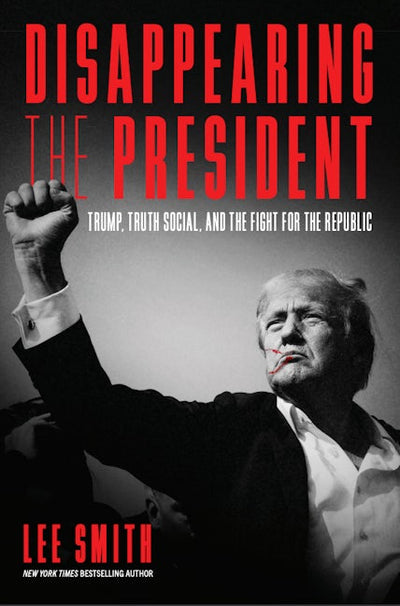
Disappearing the President
Regular price $32.99 Save $-32.99"Lee Smith is a great American patriot who has understood, from the very beginning, that the radical left is the true THREAT TO DEMOCRACY."
—Donald Trump, former president of the United States
From Lee Smith, bestselling author of, The Permanent Coup and The Plot Against the President, comes another riveting exposé of the secret war against President Trump and American democracy.
Even before a would-be killer tried to murder President Trump in Butler, Pennsylvania, a clique of political assassins set about eliminating him from public life entirely.
In Disappearing the President, New York Times bestselling author Lee Smith exposes how a shadow network of powerful partisan activists has waged a years-long, scorched-earth war to eradicate President Trump and any vestige of his influence.
Resorting to an unprecedented campaign of domestic spying, election rigging, brute-force censorship, and political violence, anti-Trump zealots have undermined the federal government and sabotaged countless other vital institutions in their relentless quest to crush the former president.
In this alarming book, Lee Smith reveals:
How U.S. intelligence services, trained to sabotage foreign governments and leaders, have turned their expertise against Americans.
How the Shadow Network exploited Covid to censor dissidents and rig the 2020 election.
Why Big Tech firms hired hundreds of former intelligence officials after 2018.
How Barack Obama, widely viewed as a benign elder statesman, created and leads the anti-Trump operation.
Finally, Smith shows how censorship of Trump supporters has provoked a free-speech backlash.
The hour is late, and the stakes are high. Including exclusive interviews with President Trump, Devin Nunes, Dan Bongino, and many others, Disappearing the President is an unsettling expose of a rogue cabal that will pay any price to annihilate the one man who threatens their agenda.

Arabella
Regular price $32.99 Save $-32.99Exposes Arabella Advisors as a major "dark money" operation that channels billions into progressive causes through opaque networks and deceptive grassroots groups, revealing its significant influence on U.S. politics and its far-reaching impact on issues from Supreme Court nominations to election manipulation.
"Ever heard of Arabella Advisors? Probably not. And that’s strange, since they’ve done a lot to destroy the world you grew up in. You should know, so read this book."
—Tucker Carlson
While billionaires like George Soros, Bill Gates, and Warren Buffett are well known as left-wing megadonors transforming the country’s politics, few Americans know about Arabella Advisors, a “dark money” operation that channels much of this money into particular causes via pop-up groups designed to look like grassroots outfits. Citizens across the spectrum will be shocked to learn how Arabella’s empire secretly operates using arrangements that produce the darkest of “dark money.”
Thanks to the author and his colleagues at the Capital Research Center, which first exposed Arabella, even the mainstream press have begun to report on this scandalous story. As this book reveals, Arabella is a major player in battles over Supreme Court nominations, environmentalism, abortion, Medicare for All, fake local news outlets, “Zuck Bucks” that manipulate election offices, lawsuits brought by Democratic super-lawyer (and Steele dossier booster) Marc Elias, and much more.
The money is staggering. In the 2018 election cycle, Arabella’s nonprofits took in $1.2 billion, more than double the fundraising of the Democratic National Committee and the Republican National Committee combined. In the 2020 election cycle, Arabella’s fundraising spiked to $2.4 billion.
This mountain of money explains why the left-leaning major media are alarmed. Arabella is “the indisputable heavyweight of Democratic dark money,” warns the Atlantic. A “dark-money behemoth,” says Politico. An “opaque network,” says the New York Times, that funnels “hundreds of millions of dollars through a daisy chain of groups supporting Democrats and progressive causes.”
Elastic Empire
Regular price $28.00 Save $-28.00The United States integrated counterterrorism mandates into its aid flows in the West Bank and Gaza Strip during the early years of the global war on terror. Some two decades later, this securitized model of aid has become normalized across donor intervention in Palestine. Elastic Empire traces how foreign aid, on which much of the Palestinian population is dependent, has multiplied the sites and means through which Palestinian life is regulated, surveilled, and policed—this book tells the story of how aid has also become war.
Drawing on extensive research conducted in Palestine, Elastic Empire offers a novel accounting of the US security state. The US war chronicled here is not one of tanks, grenades, and guns, but a quieter one waged through the interlacing of aid and law. It emerges in the infrastructures of daily life—in a greenhouse and library, in the collection of personal information and mapping of land plots, in the halls of municipal councils and in local elections—and indelibly transfigures lives. Situated in a landscape where the lines between humanitarianism and the global war on terror are increasingly blurred, Elastic Empire reveals the shape-shifting nature of contemporary imperial formations, their realignments and reformulations, their haunted sites, and their obscured but intimate forms.
The Russian Way of Deterrence
Regular price $26.00 Save $-26.00Selected among Foreign Affairs's "Best of Books 2024"
From a globally renowned expert on Russian military strategy and national security, The Russian Way of Deterrence investigates Russia's approach to coercion (both deterrence and compellence), comparing and contrasting it with the Western conceptualization of this strategy. Strategic deterrence, or what Dmitry (Dima) Adamsky calls deterrence à la Russe, is one of the main tools of Russian statecraft. Adamsky deftly describes the genealogy of the Russian approach to coercion and highlights the cultural, ideational, and historical factors that have shaped it in the nuclear, conventional, and informational domains. Drawing on extensive research on Russian strategic culture, Adamsky highlights several empirical and theoretical peculiarities of the Russian coercion strategy, including how this strategy relates to the war in Ukraine. Exploring the evolution of strategic deterrence, along with its sources and prospective avenues of development, Adamsky provides a comprehensive intellectual history that makes it possible to understand the deep mechanics of this Russian stratagem, the current and prospective patterns of the Kremlin's coercive conduct, and the implications for policymakers on both sides of the Atlantic.
Reversing the Rivers
Regular price $39.95 Save $-39.95From 1994 to 2006, William F. Schulz headed Amnesty International USA. During this time, he and the organization confronted some of the greatest challenges to human rights, including genocides in Rwanda, Bosnia, and Sudan; controversies over the prison camp at Guantanamo Bay, Cuba, and the use of torture by the United States after 9/11; as well as growing concern about inequities in the American justice system, from police misconduct to the death penalty. Drawing upon his encounters with tyrants, the inspiration of brave human rights heroes, and collaborations with celebrities ranging from Patrick Stewart to Salma Hayek, Schulz uses poignant narrative and amusing anecdotes to discuss the day-to-day realities of struggling with life-and-death human rights crises. In the process he ducks an assassination threat in Liberia; brings tears to the eyes of the Prime Minister of Northern Ireland; and bests America’s self-described “toughest sheriff” on Bill Maher’s Politically Incorrect.
Full of reflection as well as action, Reversing the Rivers provides Schulz with the opportunity to address profound philosophical questions, such as “What is the nature of evil?”; “How do we foster the ‘better angels of our nature’?” “When may we use force to stop people from using force?” “Is the prohibition on torture as simple as it seems?” and “What’s wrong with an eye for an eye?” Most important, in an eloquent concluding chapter, he answers the quandary most frequently posed to him during his years at Amnesty, “Given all the horrors in the world you see day after day, how do you retain any hope at all in humanity?”