You may also like
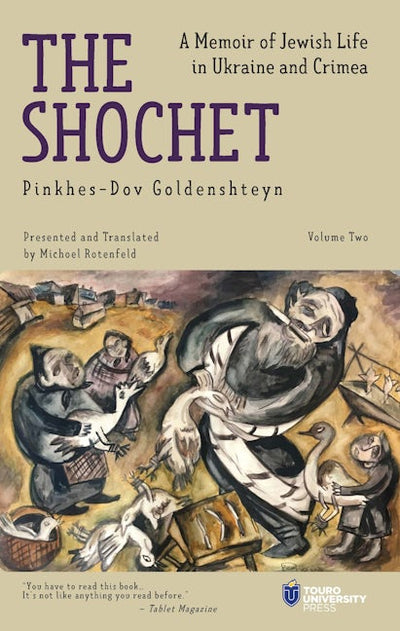
The Shochet (Vol. 2)
Regular price $44.95 Save $-44.95“A fitting conclusion to a well-researched and meticulously edited memoir translation.” — Kirkus Reviews
“You have to read this book… It’s not like anything you read before.” — Tablet Magazine
Set in Ukraine, Crimea, and Israel, this unique two-volume autobiography offers a fascinating, detailed picture of life in Tsarist Russia and Israel during the late 19th and early 20th centuries. Goldenshteyn (1848-1930), a traditional Jew who was orphaned as a young boy and became a shochet (kosher slaughterer) as a young man, is a master storyteller. Folksy, funny, streetwise, and self-confident, he is a keen observer of his surroundings. His accounts are vivid and readable, sometimes stunning in their intensity.
The memoir is brimming with information. Goldenshteyn’s adventures shed light on communal life, persecution, family relationships, religious practices and beliefs, social classes, local politics, interactions between Jews and other religious communities, epidemics, poverty, competition for resources, migration, war, technology, modernity and secularization. In chronicling his own life, Goldenshteyn inadvertently tells a bigger story—the story of how a small, oppressed people, among other minority groups, struggled for survival in the massive Russian Empire and in the Land of Israel.
Volume two begins in 1873, when Goldenshteyn obtains his first position as a shochet in Slobodze, and it follows him to the Crimea, where he endures 34 years of vicissitudes. In 1913, he fulfills a dream of immigrating to the Land of Israel, hoping to find tranquility in his old age. Instead, he is met with the turbulence of the First World War, as battles rage between the retreating Ottoman Turks and the advancing British forces.
Informed by research in Ukrainian, Israeli and American archives and personal interviews with the few surviving individuals who knew Goldenshteyn personally, The Shochet is a magnificent new contribution to Jewish and Eastern European history.

The Maternal Genetic Lineages of Ashkenazic Jews
Regular price $29.95 Save $-29.95
Bridge Builder
Regular price $39.95 Save $-39.95The fourth and final volume of the highly-acclaimed autobiographical cycle of Jewish memoir and history.
Bridge Builder: My Life Since the Holocaust is the fourth and final volume of Shimon Redlich’s autobiographical cycle, which began with Together and Apart in Brezany (2002), a description of relations among Poles, Ukrainians and Jews in his native town and his survival during the Holocaust. It continued with Life in Transit (2010), an account of his family’s resettlement in postwar Lodz and a new life in Israel. A New Life in Israel (2018) portrayed his adjustment to life on a kibbutz and service in the Israel Defense Forces. In Bridge Builder, Redlich recounts his life since the late fifties. It features his academic journey from student in Jerusalem and the US to professor at Ben-Gurion University, his friendships, his encounters with Jews and non-Jews in Eastern Europe, and his unconventional approach to controversial topics. As in previous volumes, in Bridge Builder Redlich’s own memories are supported and enriched by meticulous historical research.
The Filmmaker’s Philosopher
Regular price $40.00 Save $-40.00
Knowledge and the Ends of Empire
Regular price $29.00 Save $-29.00ENG:
This book investigates the connections between knowledge production and policy formation on the Kazak steppes of the Russian Empire. Tsarist officials were desperate to obtain reliable information about the unfamiliar environment and population of the steppe. This thirst for knowledge created opportunities for Kazak intermediaries to represent themselves and their environment to the tsarist state. Because tsarist officials were uncertain of what the steppe was, and disagreed on what could be made of it, Kazaks were able to be part of these debates, at times influencing the policies that were pursued. By the early 20 th century, though, the tsarist state’s pursuit of a policy of mass peasant colonization of the steppe region closed this space for debate. The same local knowledge that Kazak intermediaries had used to negotiate tsarist rule became, with this, a language of resistance.RUS:
Огромная Российская империя всегда испытывала проблему при получении актуальных и полных знаний о своих подданных, особенно если речь шла о фронтире, населенном Другими. Историк Ян Кэмпбелл рисует картину взаимоотношений между центром и степной казахской периферией и показывает, что эта часть света была настолько непонятна царским чиновникам, а знания о регионе были столь необходимы империи, что помощь местных посредников оказалась незаменимой. Порой эти посредники оказывались способными даже влиять на всю политику русской колонизации. В других случаях империя была полностью уверена в контроле ситуации и в результате принимала губительные решения с далеко идущими негативными последствиями. Обо всех перипетиях этих сложных взаимоотношений окраины и центра — в новой книге известного американского историка.