


Some error occured while loading the Quick View. Please close the Quick View and try reloading the page.
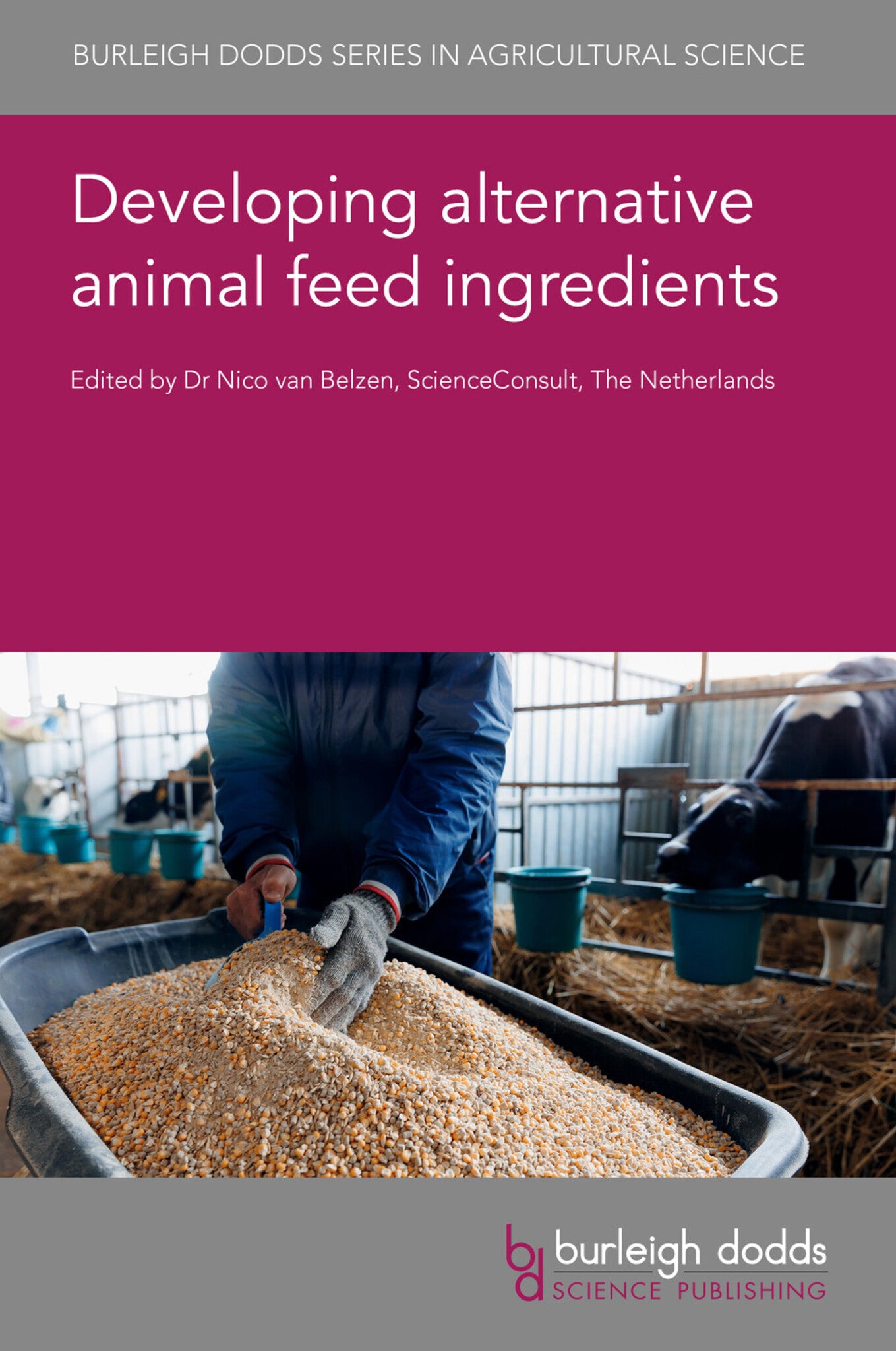
Global consumption of meat and other animal-derived products has risen drastically in the last 50 years. At the same time, the livestock sector has come under scrutiny for its reliance on feed sources which carry a significant environmental impact. Alternative animal feed ingredients are seen as an increasingly popular option to meet this growing demand, whilst also ensuring that food is produced more sustainably.
Developing alternative animal feed ingredients provides a comprehensive overview of the key groups of alternative animal feed ingredients, from cereal grains and oil seeds, to animal by-products and single-cell proteins. The book also considers the key issues and challenges that must be addressed by the animal feed sector during the development of alternative animal feed ingredients, such as the need for new products to meet nutritional quality, sustainability, safety and other regulatory requirements.


Dr Nico van Belzen is Director General at ScienceConsult, The Netherlands. He is also former Director General of the International Dairy Federation (IDF), Belgium. He has occupied senior roles in both industry and research organisations, both as Head of the Research and Analysis department at the ingredients division of Campina and as Executive Director of the European Branch of the International Life Sciences Institute (ILSI). Dr van Belzen is editor of two earlier Burleigh Dodds Science volumes: Achieving sustainable production of milk Volume 1: Safety, quality and sustainability and Achieving sustainable production of milk Volume 2: Milk composition, genetics and breeding (both published in 2017).
Part 1 Nutritional quality, safety, sustainability and potential of alternative feed ingredients
- 1.Key challenges for increased uptake of alternative livestock feed sources: Anton van den Brink, European Feed Manufacturers' Association (FEFAC), Belgium;
- 2.Plant-based alternative feed: sustainability, safety and regulatory innovation: Zhengxia Dou and Sarah Rassler, University of Pennsylvania, USA;
- 3.Key challenges in the sustainability of alternative feed sources: life cycle assessment methods for co-products in animal nutrition: Prince Agyemang and Ebenezer M. Kwofie, McGill University, Canada; and Greg Thoma, Colorado State University, USA;
- 4.Processing techniques for alternative feed ingredients: Emily Burton, Nottingham Trent University, UK;
- 5.Techniques for assessing the nutritional content and quality of alternative feed products: Kieran David Robertson, Kayley Barnes, Azadeh Dabiri, Glesni Pugh and Katerina Theodoridou, Institute for Global Food Security – Queen’s University Belfast, UK;
- 6.The potential of alternative feed ingredients in pig feed: Elizabeth A. Hines, formerly The Pennsylvania State University, USA;
- 7.Potential of alternative feed ingredients in fish feed: Valeria Caltzontzin-Rabell and María de la Luz Sánchez-Estrada, Autonomous University of Queretaro, Mexico;
Part 2 Plant co-products as alternative feed ingredients: cereal grains
- 8.Wheat co-products as alternative feed ingredients for livestock animals: Elijah G. Kiarie, University of Guelph, Canada and North-West University, South Africa; and Youngji Rho, Ontario Ministry of Agriculture, Food and Agribusiness, Canada;
- 9.Distillers dried grains with solubles co-products as alternative feed ingredients: Stephen Boyle, The Ohio State University, USA;
- 10.Oat co-products as alternative feed ingredients: Dawn Scholey, Nottingham Trent University, UK;
Part 3 Plant co-products as alternative feed ingredients: oil seeds
- 11.Soybean co-products as alternative feed ingredients: Warren Rusche, South Dakota State University, USA; Cassidy Ross, University of Saskatchewan, Canada; and Zachary Smith, South Dakota State University, USA;
- 12.The use of canola/rapeseed meal as an alternative feed ingredient for monogastric animals: Vetriselvi Sampath and In Ho Kim, Dankook University, South Korea;
- 13.Linseed co-products as alternative feed ingredients: Vincenzo Tufarelli, University of Bari Aldo Moro, Italy;
- 14.Potato co-products as alternative feed ingredients in livestock production: Huawei Su, Changxiao Shi and Naying Li, China Agricultural University, China;
- 15.Citrus pulp as an alternative feed ingredient: Ratchaneewan Khiaosa-ard, University of Veterinary Medicine Vienna and University of Natural Resources and Life Sciences Vienna (BOKU), Austria;
Part 4 Other sources of alternative feed ingredients
- 16.Upcycling food loss and waste into animal feed: Gerald C. Shurson, University of Minnesota, USA;
- 17.Animal by-products as alternative feed ingredient: Marie-Caroline Lecrenier, Walloon Agricultural Research Centre, Belgium; Ikram Belghit, Institute of Marine Research, Norway; Alessandro Gatto, Wageningen University & Research, The Netherlands; Hermann Broll, Federal Institute for Risk Assessment, Germany; Anne-Catrin Adam and Pauline Wischhusen, Institute of Marine Research, Norway; Sebastian Broll and Cristiano Garino, Federal Institute for Risk Assessment, Germany; Abigaël Anselmo and Aline Marien, Walloon Agricultural Research Centre, Belgium; Mariève Dallaire-Lamontagne, Laval University, Canada; and Vincent Baeten, Walloon Agricultural Research Centre, Belgium;
- 18.Fish co-products as an alternative feed ingredients: Øystein Sæle, Institute of Marine Research and University of Bergen, Norway; Pauline Wischhusen, Institute of Marine Research, Norway; and Brett Glencross, The Marine Ingredients Organisation (IFFO) and University of Stirling, UK;
- 19.Seaweed and algae as an alternative feed ingredients: Maria Hayes, Teagasc Food Research Centre and Technological University Dublin, Ireland;
- 20.Single-cell proteins (SCP) as an alternative feed ingredients: Nnabueze Darlington Nnaji, University of Birmingham, UK and University of Nigeria, Nigeria; Chiemerie Theresea Ekwueme, Teesside University, UK; and Helen Onyeaka, University of Birmingham, UK;
- 21.Lanolin as an alternative feed ingredient: Clodagh Weingart, LanoTech Ltd, UK; Salvatore Galgano and Jos G. M. Houdijk, Scotland’s Rural College (SRUC), UK; and Kenton J. Hart, Institute of Biological, Environmental and Rural Sciences (IBERS), Aberystwyth University, UK;