


Some error occured while loading the Quick View. Please close the Quick View and try reloading the page.
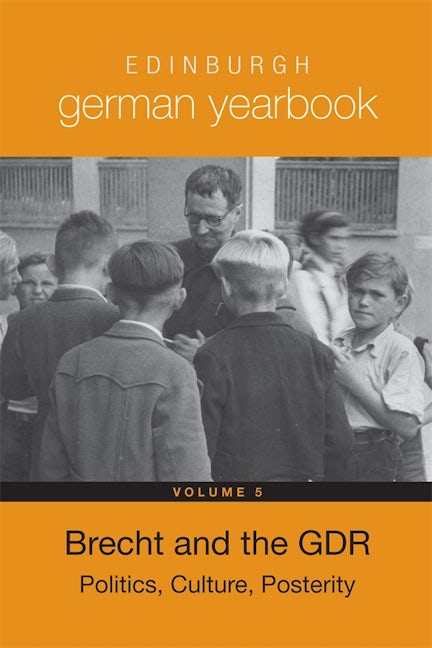
Brecht's activities in the GDR, the regime's marginalizing response and posthumous appropriation of his legacy, and creative responses in the GDR and after.
The avant-garde writer and director Bertolt Brecht left the West for good in 1949, returning to East Berlin and founding the Berliner Ensemble. While he quickly became identified internationally as the cultural figurehead of the young socialist state, his relationship with the authorities was always complex, and he was increasingly marginalized by restrictive and authoritarian structures of power. It was only after his death that the regime sought to elevate him as a socialist classic - a shift that entailed the selective appropriation of his legacy and the development of authorized modes of interpretation and performance. Poets, theorists, dramatists, and directors soon reacted against what they saw as the stagnation of Brecht's critical impetus: they began to subject his work to his own treatment, using his texts as a source of material and taking his methods to more radical conclusions. EGYB 5 explores the multiple, contradictory impulses behind these broad paradigm shifts and behind Brecht's activities in the GDR. It investigates the tensions engendered by his co-option as a socialist classic, and the range of creative responses his works have inspired, both in the GDR itself and in reaction to its demise.
Contributors: David Barnett, Laura Bradley, Joy Calico, Paula Hanssen, Patrick Harkin, Loren Kruger, Karen Leeder, Moray McGowan, Stephen Parker, David Robb, Erdmut Wizisla. Laura Bradley is Senior Lecturer in German at the University of Edinburgh. Karen Leeder is Professor of Modern German Literature and a Fellow of New College, University of Oxford.
The avant-garde writer and director Bertolt Brecht left the West for good in 1949, returning to East Berlin and founding the Berliner Ensemble. While he quickly became identified internationally as the cultural figurehead of the young socialist state, his relationship with the authorities was always complex, and he was increasingly marginalized by restrictive and authoritarian structures of power. It was only after his death that the regime sought to elevate him as a socialist classic - a shift that entailed the selective appropriation of his legacy and the development of authorized modes of interpretation and performance. Poets, theorists, dramatists, and directors soon reacted against what they saw as the stagnation of Brecht's critical impetus: they began to subject his work to his own treatment, using his texts as a source of material and taking his methods to more radical conclusions. EGYB 5 explores the multiple, contradictory impulses behind these broad paradigm shifts and behind Brecht's activities in the GDR. It investigates the tensions engendered by his co-option as a socialist classic, and the range of creative responses his works have inspired, both in the GDR itself and in reaction to its demise.
Contributors: David Barnett, Laura Bradley, Joy Calico, Paula Hanssen, Patrick Harkin, Loren Kruger, Karen Leeder, Moray McGowan, Stephen Parker, David Robb, Erdmut Wizisla. Laura Bradley is Senior Lecturer in German at the University of Edinburgh. Karen Leeder is Professor of Modern German Literature and a Fellow of New College, University of Oxford.

Price: $120.00
Pages: 250
Publisher: Boydell & Brewer Inc.
Imprint: Camden House
Publication Date:
17 October 2011
Trim Size: 9.00 X 6.00 in
ISBN: 9781571134929
Format: Hardcover
BISACs:
LITERARY CRITICISM / European / German, Literature: history and criticism, LITERARY CRITICISM / Comparative Literature, Comparative literature

Bradley and Leeder have done an admirable job of organizing the essays into a comprehensive and cohesive overview of Brecht's life and legacy in East Germany. . . . [T]his work makes a compelling case for the lasting importance of Brecht's contributions to German culture, not only during the prime of his career, but in its sometimes ambiguous twilight as well.
Introduction
Undogmatic Marxism: Brecht Rehearses at the Berliner Ensemble
Lateness and Late Style in Brecht's Last Poetry
A Life's Work Curtailed? The Ailing Brecht's Struggle with the SED Leadership over GDR Cultural Policy
Brecht and 17 June 1953: A Reassessment
Private or Public? The Bertolt Brecht Archive as an Object of Desire
Remembering Brecht: Anniversaries at the Berliner Ensemble
Brecht's Dependable Disciple in the GDR: Elisabeth Hauptmann
Musical Threnodies for Brecht
The Legacy of Brecht in East German Political Song
Fatzer's Footprints: Brecht's Fatzer and the GDR Theater
Reviving Saint Joan of the Stockyards: Speculation and Solidarity in the Era of Capitalism Resurgent
Undogmatic Marxism: Brecht Rehearses at the Berliner Ensemble
Lateness and Late Style in Brecht's Last Poetry
A Life's Work Curtailed? The Ailing Brecht's Struggle with the SED Leadership over GDR Cultural Policy
Brecht and 17 June 1953: A Reassessment
Private or Public? The Bertolt Brecht Archive as an Object of Desire
Remembering Brecht: Anniversaries at the Berliner Ensemble
Brecht's Dependable Disciple in the GDR: Elisabeth Hauptmann
Musical Threnodies for Brecht
The Legacy of Brecht in East German Political Song
Fatzer's Footprints: Brecht's Fatzer and the GDR Theater
Reviving Saint Joan of the Stockyards: Speculation and Solidarity in the Era of Capitalism Resurgent