


Some error occured while loading the Quick View. Please close the Quick View and try reloading the page.
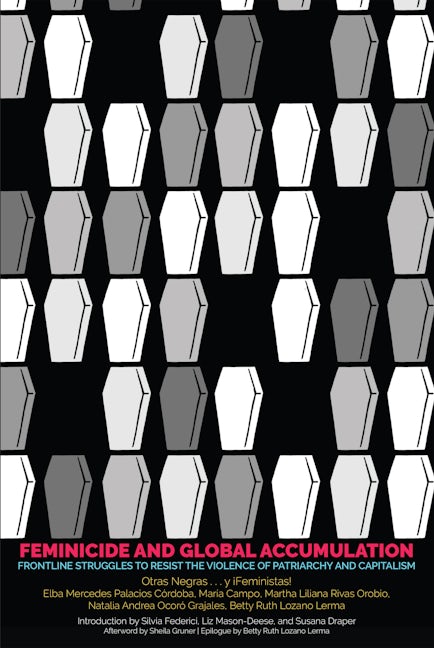
Feminicide and Global Accumulation brings us to the frontlines of an international movement of Black, Indigenous, popular, and mestiza women’s organizations fighting against violence—interpersonal, state sanctioned, and economic—that is both endemic to the global economy and the contemporary devalued status of racialized women, trans, and gender non-conforming communities in the Global South.
These struggles against racism, capitalism, and patriarchy show how crucially linked the land, water, and other resource extraction projects that criss-cross the planet are to devaluing labor and nature and how central Black and Indigeneous women and trans leadership is to its resistance.
The book is based on the first ever International Forum on Feminicide among ethnicized and racialized groups—which brought together activists and researchers from Colombia, Guatemala, Italy, Brazil, Iran, Guinea Bissau, Bolivia, Canada, the U.S., Ecuador, Spain, Mexico, among other countries in the world to represent different social movements and share concrete stories, memories, experiences and knowledge of their struggles against racism, capitalism and patriarchy.
Feminicide and Global Accumulation reflects, in a collective fabric, the communitarian and enraged struggles of women, trans, and gender non-conforming communities who commit themselves to the transformation of their communities by directly challenging the murder and assassination of women and violence in all its forms.


"Theorizing feminicide as the key epistemic violence at the heart of patriarchal, colonial, and capitalist relations of rule, this powerful text documents Black, Brown, and Indigenous trans and cis women’s ongoing resistance and insurgent dreams of bodily integrity and freedom. Weaving together memories, poetry, stories, analysis, art, and activist praxis, Feminicide and Global Accumulation charts a new and irresistible future for anticapitalist feminist struggle. A book that belongs on the bookshelves of all progressive, left, decolonial scholar-activists.”—Chandra Talpade Mohanty, author of Feminism Without Borders: Decolonizing Theory, Practicing Solidarity
"Feminicide and Global Accumulation tells stories of women reclaiming their histories, their dreams, their lives, and their bodies. It is a view from the ground up of the limitless greed of global corporations who want the last farm, the last seed, and the last mineral. Most importantly, it shows how violence against the Earth and violence against women are interconnected, and how feminicide and ecocide are intrinsic to the structures of global accumulation. Transforming the pain of feminicide into a fight for justice, women are showing how we can create new economies from the ground up, putting people and planet at the center to create buen vivir, the good life for all.”—Vandana Shiva, author of Staying Alive: Women, Ecology and Development and Earth Democracy: Justice, Sustainability, and Peace
"Drawing on concrete experiences and processes, Feminicide and Global Accumulation explains why feminicide is a political category. It shows why social movements are the ones that have made feminicide into a term for naming patriarchal violence in relation to the capitalist and colonial system as a machine of exploitation and cruelty over certain bodies and territories; why struggles have installed the term in the media and in legal classifications at the same time as they use it to denounce patriarchal justice and counter-insurgent strategies. Speaking of feminicide and transfeminicide in relation to global processes of accumulation, as Feminicide and Global Accumulation proposes, makes it possible both to grieve and to refuse its normalization, to create a systematic account of how violence explodes and extracts collective wealth, as well as to connect sexual violence to histories of conquest and genocide.
Feminicide and Global Accumulation arises from a collective encounter in Colombia in 2016 that has been vital for conceptualizing and sharing experiences from voices across Abya Yala, of Black, Indigenous, Afro-descendant and Afro-Indigenous women, and non-heteronormative bodies. Thus it is a book that is heard and written in many tongues. It is theory produced in the thickness of a poem, concepts woven into conversation, lines of argument that echo inherited histories, philosophies that carry memories. The effort of its translation and publication in English does justice to the task of introducing a vocabulary that emerges from the struggles of body-territories in their untiring strategies of re-existence.”—Verónica Gago, author of Feminist International: How to Change Everything
“Feminicide and Global Accumulation is a timely and necessary book on one of the most urgent issues facing trans and cis women globally. Centering the voices of Black and Indigenous women, this collection presents rare and much needed insight into the ways that racial capitalism and heterosexism exacerbate the politics of violence against women transnationally. From Colombia to Guinea-Bissau, these reflections dialogically, poetically and passionately demonstrate why Black and Indigenous women matter and why we must do everything in our power to stop racialized gender violence now.”—Christen A. Smith, author of Afro-Paradise: Blackness, Violence and Performance in Brazil
"Feminicide and Global Accumulation is a searing, unflinching indictment and analysis of gender-based violence and its embeddedness in extant structures of colonialism, modern patriarchy, racism, and capital accumulation. In their own riveting words and voices, Black, Afro-descendant, trans, and Indigenous women, activists, and researchers from across the Americas and the Global South offer stories and theories of the living experiences and memories of the racist, feminicidal violence they and their communities have endured and resisted, and never forgotten, despite the imposed silence of dominant histories. Through them we see the monstrous and intimate scales of the punitive powers women face. But we also see the enormous powers women themselves wield—powers of rebellion, resistance, and re-existence—which are the radical capacities for transformation we can put our hopes in.
Harrowing and heartening, moving, humbling, and inspiriting, these are powerful and empowering calls for collective resistance and joy, and renewed life-making against the pedagogies of cruelty directed against the truth of women’s rebellion. This book is more than a glimpse of what it will take to remake the world. It shows us that those who now defend life, land, culture, and community are who will lead us into a different future."—Neferti X. M. Tadiar, author of Things Fall Away: Philippine Historical Experience and the Makings of Globalization
Otras Negras … y ¡Feministas! (editor) is a Black Afrodescendent feminist women’s collective from Cali, Colombia. Members include Elba Mercedes Palacios Córdoba, María Campo, Martha Liliana Rivas Orobio, Natalia Andrea Ocoró Grajales, and Betty Ruth Lozano Lerma.
Silvia Federici (contributor, translator) is a lauded feminist, Marxist theorist and author of Caliban and the Witch, Revolution at Point Zero, Witches, Witch-Hunting, and Women among others.
Liz Mason-Deese (contributor, translator) is an editor of Viewpoint Magazine and a long-time participant and translator of women’s movements in Latin America. She is based in Buenos Aires, Argentina.
Susana Draper (contributor, translator) is Associate Professor of Comparative Literature at Princeton University and author of Afterlives of Confinement: Spatial Transitions in Post-Dictatorship Latin America (2012, 2012) and 1968 Mexico: Constellations of Freedom and Democracy (2018). Her current projects include a book on Marxist Women and Philosophies of Liberation, that reconstructs a history of key figures and moments in women’s critical heterodox expressions of Marxism, mostly focused on Latin America and the United States throughout the 20th century.
Acknowledgments
Preface
Colectivos Otras negras… y¡Feministas!
Introduction
Silvia Federici, Liz Mason-Deese, Susana Draper
Chapter 1: Horizon of Reflection: Context and conceptualization of femicide
Evoking our ancestors: Homage to our maroon heritage
Asociación Casa Cultural El Chontaduro
Victims of development, Afro-urban communities and dynamics of re-existence in Buenaventura
Danelly Estupiñán Valencia
Chapter 2: Pedagogies of cruelty
Gender and violence in the apocalyptic phase of capital: New reflections in light of the historical transformations of our time.
Rita Segato
The female body and the territorial body
Alejandra Rangel and Valentina García; Clemencia Fory and Catherine Loboa; María Mercedes Campo and Betty Ruth Lozano
The Uncertainty of femicides in transwomen: Approaches to transgenocides in racialized women
Alejandra Rangel Oliveros and Valentina García Marín
Mobilization of Black women for the care of life and the ancestral territories of the north of Cauca
Clemencia Fory Banguero and Katherine Loboa
Pumpkin, squash, each for her home
María Mercedes Campo, Colectivos Otras negras… y¡Feministas! and Sentipensar Afrodiaspórico
Conquest of territories and subjectivities
Betty Ruth Lozano, Colectivos Otras negras… y¡Feministas!
Sexual violence in the genocide against the Mayan People of Guatemala
Aura Cumes
Violence, women, accumulation and racism: Canada and colonialism to Colombia
Sheila Gruner
Chapter 3: A Re-inventory of Pedagogies
Memories of violence: Women, resistance and identity construction in Guinea Bissau
Patricia Godinho Gomes
Strategies for “re-existence” among violence (National Panel)
Blanca Astrid Secué and Isaura Sauce; Vicenta Moreno and Ofir Muñoz and Elba Mercedes Palacios Córdoba
Transforming the pain of femicide into a fight for justice
Helen Álvarez
Women facing the violence of imperialism and fundamentalism in the Middle East
Shahrzad Mojab
Chapter 4: Strategies to face femicide
Globalization, capital accumulation and violence against women: An international and historical perspective
Silvia Federici
Experiences and difficulties in accessing and demanding rights (National panel)
Natalia Ocoró, Danny Ramírez and Alejandra Cárdenas
Difficulties and impossibilities of access to justice by Black women in Colombia.
Natalia Ocoró Grajales, Colectivos Otras negras… y¡Feministas!
Perspective of femicides in Buenaventura
Danny Ramírez, activist of the National Conference of Afro-Colombian Organizations (CNOA)
Obstacles to accessing justice in Colombia
María Alejandra Cárdenas, Legal Director of Women's Link Worldwide
Chapter 5: Working tables between women
International cooperation, violence against women, and neocolonization processes
Organizations and social movements: facing or reproducing violence against women
Configuration of femicides from the urban in an ethnic perspective: processes of impoverishment, exile and domestic service
Peace process, post-Agreement and reparation to women and their racialized ethnic communities
“Reexistence” and transitions towards good living: Women's struggle for a different peace from Afro-Ubuntuism in the diaspora
Appendix
Cultural House Song El Chontaduro
Alabao to mining. COCOMACIA Gender Commission
Declaration of the International Forum on Feminicides in Ethnic-Racialized Groups: Murder of women and global accumulation. (Buenaventura, Colombia. April 25–28, 2016)