


Some error occured while loading the Quick View. Please close the Quick View and try reloading the page.
"Frieze Frame is a lucidly brilliant, learned read that wears its learning lightly, inviting the reader into a coterie of artists and intellectuals, traced and uncovered with a poet's touch."
—Times Literary Supplement
"Highly entertaining."
—The Spectator
“[A] compact, original book. . . . Whether they are shown in London or Athens, the Marbles will always be one of history’s singular Rorschach tests. Keats saw beauty; Byron saw tragedy; in Frieze Frame, readers may see some version of themselves.”
—Wall Street Journal
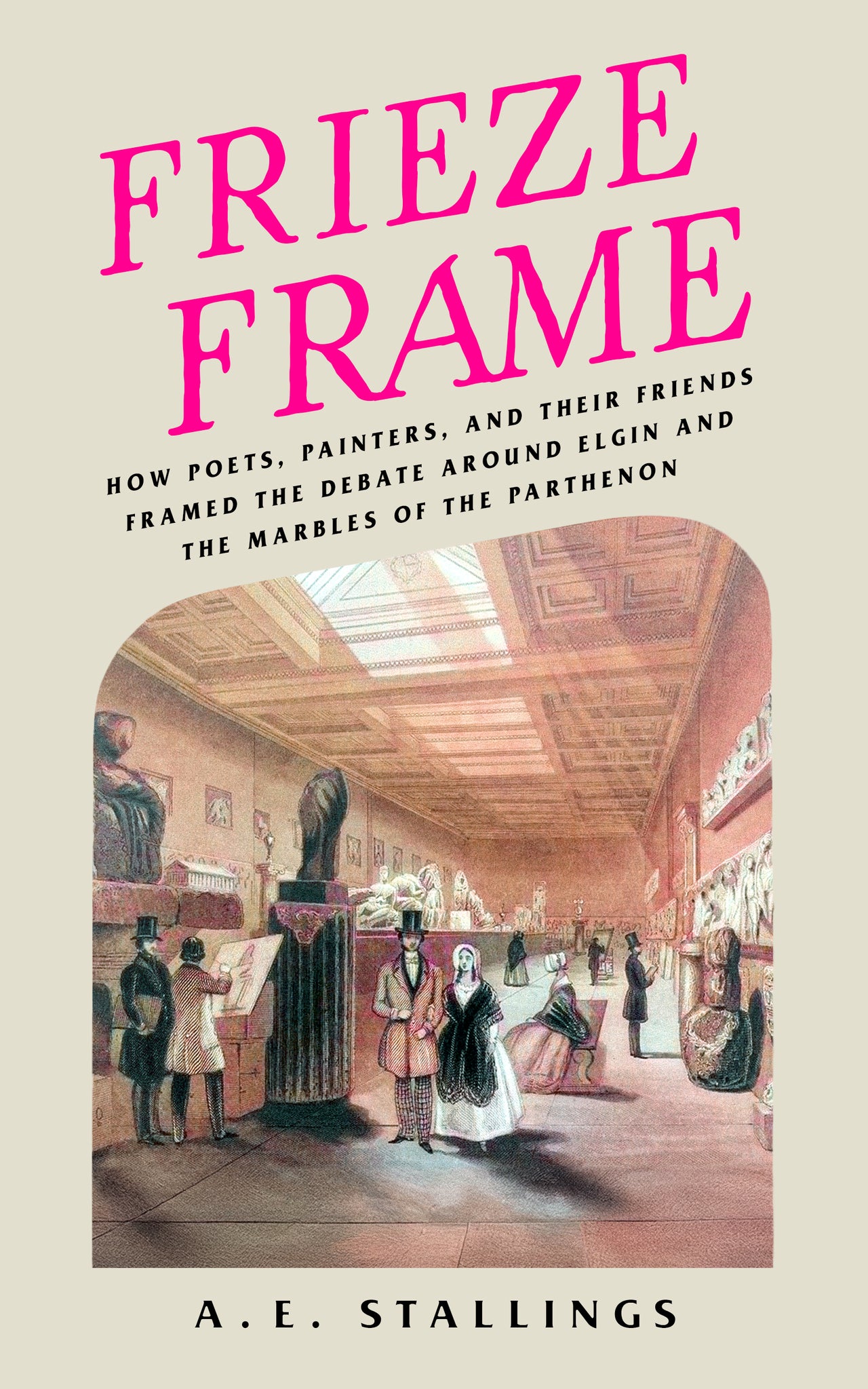
In this deliciously detailed and gossipy history of the Parthenon (AKA, Elgin) Marbles, award-winning poet and writer A. E. Stallings discusses the removal of the Marbles from the Athenian Acropolis, their misadventures before and after installation in the British Museum (from shipwreck to boxing matches), and the debate over their future and possible reunion in Greece.
Bringing fresh air to a stale debate, Frieze Frame explores the effect the Marbles have had on poets, writers, painters, actors, architects, and vice versa—how poets and painters, for instance, have framed the Marbles' place in art and culture. The poets Keats, Byron, and Cavafy, as well as an aristocrat who loses his nose and his fortune, a bad painter who commits suicide, and a general who takes his cat into battle, are among the cast of characters. In the author’s own words, “I am, to a certain extent, as interested in the strange stories and people surrounding the stones as the controversy [of their removal] and their fate.” Key for Stallings is the creative world of the Marbles, the ways that they appear in nineteenth (and twentieth) century writing and art, race theory and beyond, and the influence they have exerted in our society: cultural figures, maybe even characters, in their own right.


"In the cheekily titled Frieze Frame, [Stallings'] first prose volume, she brings to the Elgin Marbles story a deep appreciation of the stones and their very different meanings for Greece and for England, as revealed in the writings of poets and aesthetes in both countries . . . Frieze Frame illustrates the power of beauty to inspire both the noblest effusions and the pettiest efforts at acquisition and ownership . . . [A] lively, ingenious, humane set of essays."
—New York Review of Books
Frieze Frame is a lucidly brilliant, learned read that wears its learning lightly, inviting the reader into a coterie of artists and intellectuals, traced and uncovered with a poet's touch."
—Times Literary Supplement
“[A] compact, original book. . . . Whether they are shown in London or Athens, the Marbles will always be one of history’s singular Rorschach tests. Keats saw beauty; Byron saw tragedy; in Frieze Frame, readers may see some version of themselves.
—Wall Street Journal
"Highly entertaining . . . The anecdotal style of Frieze Frame works wonderfully for a story driven by a few characters and their mad antics. It shows us that the debate around the Marbles has always been a strange projection of our own desires – from poets finding their own principles modelled in the friezes, to modern politicians using the controversy to score points. But no one tops Lord Elgin, whose desires were straight-forwardly decorative. Like a figure in Greek myth, he plundered the temple of Athena and sorely paid the price."
—The Spectator
"[A]s Stallings notes with only slight exaggeration, 'the Marbles touch on nearly every topic of the long nineteenth century,' a claim that Frieze Frame unpacks in a highly entertaining manner, tracking the responses to the Marbles through Regency and Victorian England, a newly independent Greece, and into the 20th century. The result is a brilliant riot of characters, personalities, and voices that jostle together across continents and centuries . . . Stallings is first and foremost a consummate poet, and she is at her best when delivering honed readings of poems that have responded to the Marbles over time, in both English and Greek."
—The Nation
"I relished every page. Stallings packs so much into her account—so many interesting people, such a wealth of incident—yet does so with ease. Her book is at once compact and compendious . . ."
—John Wilson in First Things
"Stallings captures both the intense excitement the marbles caused in artistic and literary circles in England and also the sense of loss the site of the Parthenon represented for Greek writers of the 19th and 20th centuries. In placing imaginative responses to the marbles above arguments based on property rights, Stallings makes a powerful case for giving these masterpieces from 5th-century Athens a much-needed new lease of cultural life."
—Apollo magazine
Part I
Shadows and Magnitude
Rock and Ruin
As Poetical in Piccadilly
Imperishable Columns, Immortal Dinner
In-valuable
Another Painter
“Characteristics . . . of an Intellectual European.”
“The More Beautiful the Whiter It Is.”
Part II
“It Gives the Dirt a Polish.”
Mountain and Monument
Duveen’s Deep Clean
Lost in Translation
Shanghaied to Bloomsbury
On the Tack of Caring for Greek Sculpture
Greek Poets and the Marbles
Enchanted Bodies
A Centaur at the Wedding
The Temple of the Cari—Something
Part III
Eyewitnesses
Carrots and Sticks
Regretted by All
Turks and Greeks
A Light-Filled Mosque
Turks, Travelers, and Time
“Detached Heads.”
Interlude: Washed Away
Mercouri
“Memorably to Camera.”
Losing the Marbles
The White Line
Part IV
Bullets, Again
An Intellectual Clockwork
Polarizing Celebrities
Ringing the Changes
A Tale of Two Cities, Two Museums
A Creative Act?
Divided Narratives
Begging the Question
A Breakthrough?
Room 19
“Scattered to the Light”
Would It Be Permissible to Speak of a Caryatid?