


Some error occured while loading the Quick View. Please close the Quick View and try reloading the page.
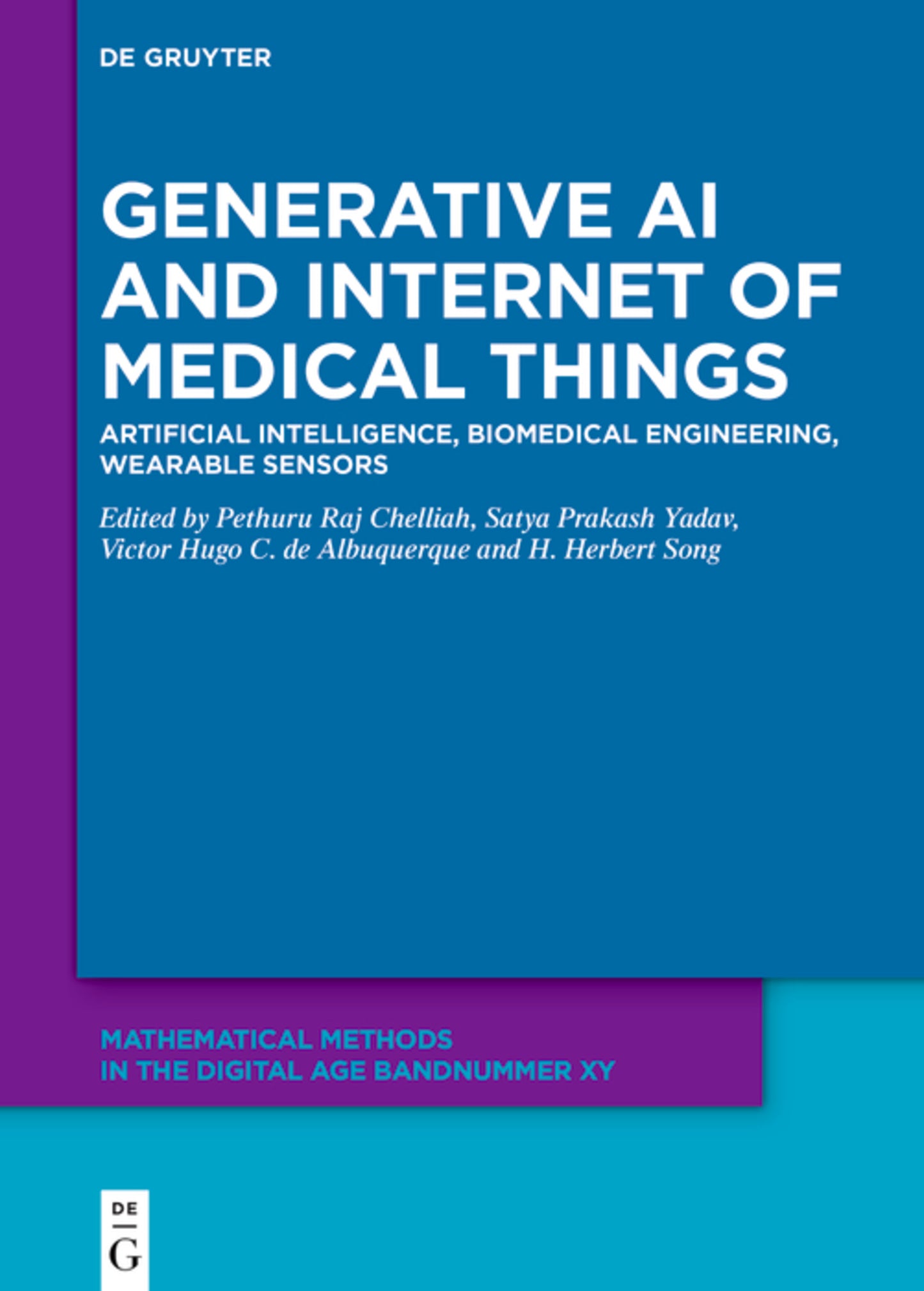
The Internet of Medical Things (IoMT) paradigm focuses on digitizing medical electronics and instruments in hospital environments, connecting them to cloud-hosted healthcare-related content, data, services, and applications through the Internet communication infrastructure. This book also illustrates how such a technological empowerment makes healthcare devices and equipment intelligently autonomous in their decisions, actions, and reactions. It elucidates the latest trends and transitions in the field of IoMT for medical doctors, surgeons, specialists, caregivers, and patients. It covers algorithms used in machine learning, deep learning, reinforcement learning and ensemble learning, as well as the individual steps involved in AI model development, and explains how to analyse healthcare data effectively. Additionally, generative AI tools -including large, small, vision, and multimodal language models -are useful for envisioning and implementing expert decision science, question/answer (Q/A) systems, and conversational AI chatbots to support medical professionals in their work. This book is a handholding guide for healthcare service providers and consumers, AI engineers, 5G, edge computing and IoT architects.


Dr Pethuru Raj, PhD SMIEEE, is the chief architect in the Edge AI division of Reliance Jio Platforms Ltd., Bangalore, India. He focuses on emerging technologies such as the Internet of Things (IoT), Artificial Intelligence (AI) Model Optimization, Big and Streaming Data Analytics, Blockchain, Digital Twins, Cloud-native, Serverless and Edge Computing, Reliability Engineering, Microservices architecture (MSA), Event-driven Architecture (EDA), 5G/6G and Metaverse. He previously worked at IBM Global Cloud Center of Excellence (CoE), Wipro Consulting Services (WCS), and Robert Bosch Corporate Research (CR). He has published over thirty research papers in peer-reviewed journals, authored and edited forty-two books, and contributed fifty-four book chapters. He is a professional member of ACM. He received his PhD degree from Anna University, Chennai, India. He did his postdoctoral research in computer science and automation (CSA) at the Indian Institute of Science, Bangalore, the Nagoya Institute of Technology, Kyoto University, and the University of Tsukuba, Japan.
Dr. Satya Prakash Yadav, PhD SMIEEE, is currently the Associate Professor of the School of Computer Science Engineering and Technology, Bennett University, Greater Noida (India) and has completed a Postdoctoral Research Fellow from Federal Institute of Education, Science and Technology of Ceará, Brazil. He was awarded his PhD from Dr A.P.J. Abdul Kalam Technical University (AKTU) (formerly UPTU). Currently, six students are working on their Ph.D. under his guidance.
Prof. Dr. Victor Hugo C. de Albuquerque (Senior Member of IEEE) is currently a Professor and Senior Researcher at the Department of Teleinformatics Engineering (DETI)/Graduate Program in Teleinformatics Engineering (PPGETI) at the Federal University of Ceará (UFC), Brazil. He earned a PhD in Mechanical Engineering from the Federal University of Paraíba (UFPB, 2010) and an MSc in Teleinformatics Engineering from the PPGETI/UFC (UFC, 2007). He completed a BSE in Mechatronics Engineering at the Federal Center of Technological Education of Ceará (CEFETCE, 2006). He has experience in Biomedical Science and Engineering, mainly in the research fields of Applied Computing, Intelligent Systems, Visualization, and Interaction, with a specific interest in Pattern Recognition, Artificial Intelligence, Image Processing, and Analysis, as well as Automation concerning biological signal/image processing, biomedical circuits and human/brain-machine interaction, including Augmented and Virtual Reality Simulation Modeling for animals and humans. Prof. Victor is a Brazilian Society of Biomedical Engineering (SBEB) member.
Prof. (Dr.) Housing Herbert Song, PhD, is an Associate Professor whose research interests include cyber-physical systems/internet of things, cybersecurity and privacy, and AI/machine learning/big data analytics. His research has been sponsored by federal agencies (including the National Science Foundation, the US Department of Transportation, and the Federal Aviation Administration, among others.) He is the Director of the NSF Center for Aviation Big Data Analytics (Planning), the Associate Director for Leadership of the DOT Transportation Cybersecurity Center for Advanced Research and Education (Tier 1 Center) and the Director of the Security and Optimization for Networked Globe Laboratory, SONG Lab, at UMBC. He serves as an Associate Editor for IEEE Transactions on Artificial Intelligence, IEEE Internet of Things Journal, IEEE Transactions on Intelligent Transportation Systems, and IEEE Journal on Miniaturization for Air and Space Systems. He received his Ph.D. degree in electrical engineering from the University of Virginia.