


Some error occured while loading the Quick View. Please close the Quick View and try reloading the page.
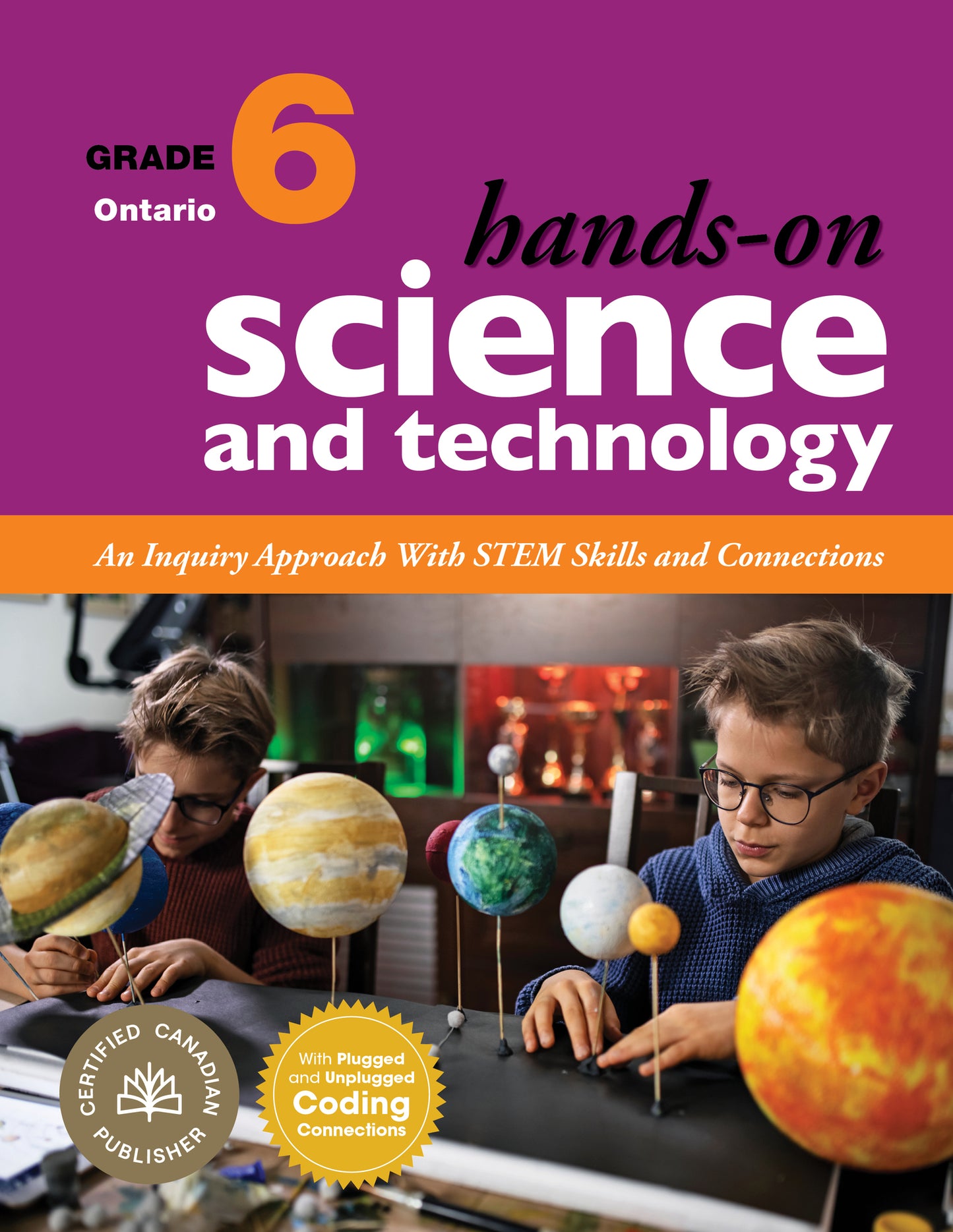
Hands-On Science and Technology for Ontario, Grade 6 is an all year, easy-to-use resource for teaching the five strands of the Ontario science and technology (2022) curriculum:
- STEM Skills and Connections
- Life Systems: Biodiversity
- Matter and Energy: Electricity and Electrical Devices
- Structures and Mechanisms: Flight
- Earth and Space Systems: Space
Hands-On Science and Technology for Ontario, Grade 6 encourages students’ natural curiosity about science and the world around them as they participate in hands-on activities and explore their environment. Using the inquiry approach, this comprehensive resource
- fosters students’ understanding of STEM (science, technology, engineering, and mathematics) skills
- makes coding and emerging technologies approachable for both teachers and students
- emphasizes personalized learning using a four-part instructional process: activate, action, consolidate and debrief, enhance
- relates science and technology to sustainability and our changing world, including society, the economy, and the environment
- focuses on practical applications of the engineering design process as students work on solutions to real-life problems
- builds understanding of Indigenous knowledge and perspectives specific to Ontario
- explores contributions to science and technology by people with diverse lived experiences
Using proven Hands-On features, this book provides resources for both teachers and students including background information on the science topics; complete, easy-to-follow lesson plans; materials lists; and digital image banks and reproducibles (find download instructions in the Appendix of the book).
Innovative elements developed specifically for the Ontario curriculum include the following:
- plugged and unplugged coding activities in nearly every lesson
- land-based learning activities
- opportunities for students to use guided research, hands-on inquiry, and the engineering design process
- a fully developed assessment plan to guide assessment for, as, and of learning
- ideas and prompts for STEM Makerspace projects.


Introduction to Hands-On Science and Technology for Ontario, Grade 6 1
- Introduction to Hands-On Science and Technology 2
- Program Introduction 2
- The Inquiry Approach to Science and Technology 2
- 21st Century Teaching and Learning 3
- The Goals of the Science and Technology Program 3
- Hands-On Science and Technology Strands and Expectations 4
- Hands-On Science and Technology Fundamental Concepts and Big Ideas 4
- Hands-On Science and Technology Program Principles 5
- Infusing Indigenous Perspectives 5
- Cultural Connections 7
- Land-Based Learning 7
- Technology 7
- Sustainability 7
- Program Implementation 8
- Program Resources 8
- Classroom Environment 11
- Planning Units—Timelines 12
- Classroom Management 12
- Classroom Safety 12
- Scientific Inquiry Skills: Guidelines for Teachers 12
- Observing 12
- Questioning 13
- Exploring 13
- Classifying 13
- Measuring 14
- Communicating, Analyzing, and Interpreting 14
- Predicting 16
- Inferring 17
- Inquiry Through Investigation and Experiments 17
- Inquiry Through Research 17
- Online Considerations 18
- Addressing Students’ Literacy Needs 18
- Technological Problem Solving 19
- Makerspace 19
The Hands-On Science and Technology Assessment Plan 22
- Assessment for Learning 23
- Assessment as Learning 23
- Assessment of Learning 24
- Performance Assessment 25
- Portfolios 25
- Evidence of Student Achievement Levels for Evaluation 26
- Important Note to Teachers 26
- References 27
- Assessment Reproducibles 28
- Achievement Chart for Science & Technology 43
Unit 1: Biodiversity 45
- Introduction 46
- Unit Overview 50
- Curriculum Correlation 51
- Resources for Students 52
- 1 What Do We Know About the Diversity of Living Things? 55
- 2 How Can We Show Classification Systems in Different Ways? 60
- 3 How Is the Animal Kingdom Organized? 65
- 4 How Can We Compare and Contrast Animals? 71.
- 5 What Can We Learn by Investigating an Arthropod Colony? 78
- 6 What Are Characteristics of Organisms in the Plant Kingdom? 84
- 7 How Do Living Things Adapt to Survive in Their Environment? 88
- 8 What Can We Learn About Organisms Through a Pond Study? 92
- 9 What Are Bacteria? 99
- 10 What Is a Fungus? 103
- 11 What Are Some Benefits and Issues Related to Biodiversity? 107
- 12 Inquiry Project: How Can I Use Technological Problem-Solving Skills to Explore the Diversity of Living Things? 112
Unit 2: Flight 115
- Introduction 116
- Unit Overview 119
- Curriculum Correlation 120
- Resources for Students 121
- 1 How Do Organisms and Other Objects Move Through Air? 124
- 2 What Are the Properties of Air? 130
- 3 What Are the Features of Lighter-Than-Air Flying Devices? 138
- 4 What Is Bernoulli’s Principle? 144
- 5 How Is Bernoulli’s Principle Used in the Design of Airplane Wings? 150
- 6 What Are the Forces Affecting Flight? 155
- 7 How Are Unbalanced Forces Used to Steer Flying Devices? 163
- 8 How Is Pneumatic Power Used in Flight? 169
- 9 How Can We Design and Construct Model Aircraft to Meet Certain Criteria? 173
- 10 Inquiry Project: What Is the Environmental Impact of Aviation Technology? 177
Unit 3: Electricity and Electrical Devices 181
- Introduction 182
- Unit Overview 185
- Curriculum Correlation 186
- Resources for Students 187
- 1 What Do We Know About Electricity? 190
- 2 What Is Static Electricity? 194
- 3 What Is Current Electricity? 201
- 4 How Do We Get Electricity From Chemical Sources? 205
- 5 How Do Electric Circuits Work? 211
- 6 What Are Electrical Conductors and Insulators? 215
- 7 How Do Electrical Switches Work? 219
- 8 What Do We Know About Parallel and Series Circuits? 222
- 9 How Can We Design and Construct an Electrical Device to Perform a Useful Function? 228
- 10 How Can We Construct an Electromagnet? 231
- 11 How Do Motors and Generators Transform Energy? 235
- 12 What Is the Environmental Impact of Using Electricity? 241
- 13 How Can We Reduce the Environmental Impact of Using Electricity? 247
- 14 Inquiry Project: What More Do I Want to Know About Electricity? 253
Unit 4: Space 257
- Introduction 258
- Unit Overview 262
- Curriculum Correlation 263
- Resources for Students 264
- 1 What Do We Know About Space? 268
- 2 What Are the Features of Our Solar System? 272
- 3 What Are the Characteristics of the Planets in Our Solar System? 277
- 4 What Are the Characteristics of the Sun? 283
- 5 Why Do We Have a Day/Night Cycle? 287
- 6 Why Do We Have a Year Cycle? 291
- 7 How Can We Use the Sun to Tell Time? 295
- 8 What Is the Surface of the Moon Like? 299
- 9 What Are Gravity, Mass, and Weight? 303
- 10 What Are the Phases of the Moon? 308
- 11 What Is a Lunar Eclipse? 312
- 12 What Are Constellations? 315
- 13 What Can We Learn About Space Exploration? 319
- 14 How Have Canadians Contributed to Space Science and Technology? 323
- 15 How Has Space Exploration Contributed to Daily Life on Earth? 327
- 16 What Are the Advantages and Disadvantages of Space Exploration? 331
- 17 Inquiry Project: What More Do I Want to Know About Space? 335
- References 339
Appendix: Image Banks 341
About the Contributors 352