


Some error occured while loading the Quick View. Please close the Quick View and try reloading the page.
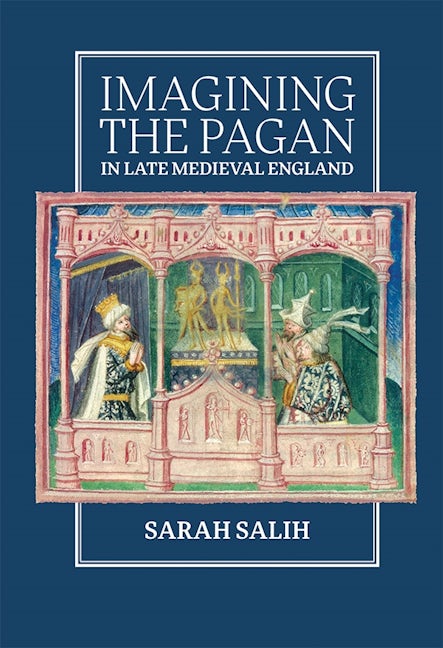
Reads the imagined history of the long term relationship between pagan and Christian through quasi-factual fifteenth-century Middle English writings, from Lydgate's Troy Book to the hagiographies of Bokenham, Barclay and Capgrave and Mandeville's Travels.
SHORTLISTED for the 2020 Katharine Briggs Award.
Late medieval English culture was fascinated by the figure of the pagan, the ancestor whose religious difference must be negotiated, and by the pagan's idol, an animate artefact. In romances, histories and hagiographies medieval Christians told the story of the pagans, focussing on the absence or presence of pagan material culture in the medieval world to ask whether the pagan era had completely ended or whether it might persist into the Christian present.
This book reads the imagined history of the long term relationship between pagan and Christian through quasi-factual fifteenth-century Middle English writings. John Lydgate's Troy Book describes the foundation of a Troy that is at once London's ancestor and a vision for its future; he, John Capgrave and Reginald Pecock consider how pagans were able to build idols that attracted spirits to inhabit them. The hagiographies of Osbern Bokenham, Alexander Barclay, Capgrave and Lydgate describe the confrontation of saint and idol, and the saint's appropriation for Christians of the city the pagans built. Traces of the pagan appeared in the medieval present: Capgrave, Lydgateand John Metham contemplated both extant and lost artefacts; Lollards and orthodox writers disputed whether Christian devotional practice had pagan aspects; and Mandeville's Travels sympathetically imagined how pagans mightexplain themselves.
Dr SARAH SALIH is Senior Lecturer in Medieval English, King's College London.
SHORTLISTED for the 2020 Katharine Briggs Award.
Late medieval English culture was fascinated by the figure of the pagan, the ancestor whose religious difference must be negotiated, and by the pagan's idol, an animate artefact. In romances, histories and hagiographies medieval Christians told the story of the pagans, focussing on the absence or presence of pagan material culture in the medieval world to ask whether the pagan era had completely ended or whether it might persist into the Christian present.
This book reads the imagined history of the long term relationship between pagan and Christian through quasi-factual fifteenth-century Middle English writings. John Lydgate's Troy Book describes the foundation of a Troy that is at once London's ancestor and a vision for its future; he, John Capgrave and Reginald Pecock consider how pagans were able to build idols that attracted spirits to inhabit them. The hagiographies of Osbern Bokenham, Alexander Barclay, Capgrave and Lydgate describe the confrontation of saint and idol, and the saint's appropriation for Christians of the city the pagans built. Traces of the pagan appeared in the medieval present: Capgrave, Lydgateand John Metham contemplated both extant and lost artefacts; Lollards and orthodox writers disputed whether Christian devotional practice had pagan aspects; and Mandeville's Travels sympathetically imagined how pagans mightexplain themselves.
Dr SARAH SALIH is Senior Lecturer in Medieval English, King's College London.

Price: $120.00
Pages: 221
Publisher: Boydell & Brewer Inc.
Imprint: D.S.Brewer
Publication Date:
16 August 2019
Trim Size: 9.21 X 6.14 in
ISBN: 9781843845409
Format: Hardcover
BISACs:
LITERARY CRITICISM / Medieval, Literary studies: ancient, classical and medieval, ART / European, History of art, European history

This is a fine study de nos jours, densely yet elegantly written, with much information enthusiastically packed into a short book. Incisive analysis of well chosen passages is supported by exegesis of arresting manuscript illuminations, sharply reproduced and sharply discussed. [...] Here is a must-read for anyone with an interest in fifteenth-century England.
Introduction
Origins: Building Cities, Making Idols
Encounters: The City Converted, the Fallen Idols
The Present: Traces, Recurrences, Survivals
Coda: The Future
Bibliography
Origins: Building Cities, Making Idols
Encounters: The City Converted, the Fallen Idols
The Present: Traces, Recurrences, Survivals
Coda: The Future
Bibliography