


Some error occured while loading the Quick View. Please close the Quick View and try reloading the page.
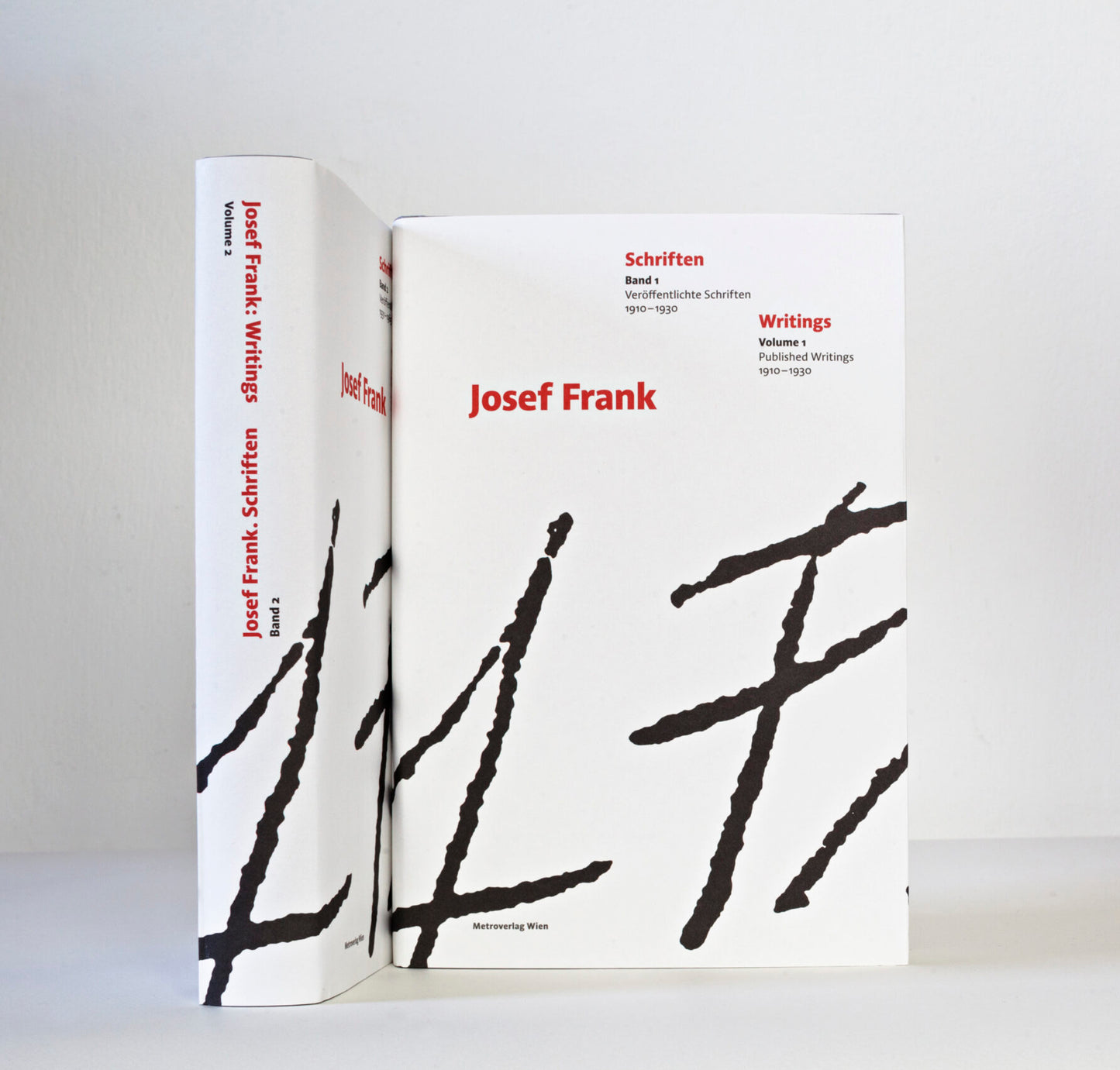
A two-volume compendium of Josef Frank’s culturally critical, often witty and biting texts on modernism and architecture, offered for the first time in a complete bilingual edition alongside many of the original illustrations.
For more than five decades, from the 1910s to the early 1960s, Josef Frank was one of the leading figures of Modernism and, at the same time, one of its sharpest critics. In his many essays and articles, as well as in his book Architecture as Symbol, Frank sought to expose the layers of meaning—and the flaws—of Modernism, its underlying assumptions, and what he viewed as its often misguided implementations. Above all, this internationally renowned architect strove to reclaim for modern design some of the freedom it had lost through its dogmatization.
Editors Tano Bojankin, Christopher Long, and Iris Meder, along with award-winning Austrian designer Peter Duniecki, have compiled all available published texts by Josef Frank on these subjects into a beautiful, highly readable, collectible German/English two-volume set. Introduced by one of America's leading architects, Denise Scott Brown, the extensive written oeuvre of Josef Frank is made accessible to both bibliophiles and a wider public interested in modernism, architecture, and one of its most influential critics.


"Few individual designers have such an enduring legacy as Josef Frank, who fled from his native Austria to Sweden in the 1930s and became involved with the now-iconic homewares shop Svenskt Tenn not long after it was founded. The fabrics he designed for the shop are instantly recognisable: each design in the vast collection is characterised by a distinctive combination of eclectic colour schemes and bold floral prints. It's hard to imagine how unusual they were at the time, as the clean lines and understated forms of modernism dominated the design world. Frank's work received lukewarm reviews from the press in Sweden when it first came out, but went on to become a defining element of Swedish culture."
—House & Garden, May 2, 2025
"Frank's Stockholm years shaped an approach that rejected 'total design', the Gesamtkunstwerk ideal of complete, controlled unity, in favor of something that centered humans and social life. He cheekily coined the term 'Accidentism', petitioning designers to leave room for spontaneity in their work. To understand the quiet radicalism of Frank’s philosophy, it helps to remember the world he was working against. In Vienna in the 1930s, modernism had hardened into dogma –rational to the point of austerity, obsessed with purity and control. Adolf Loos declared ‘ornament’ as ‘crime.’ Frank, a Jewish architect and designer in a climate hostile to both his identity and his ideas, stood apart. His clients, often fellow outsiders, sought homes that referenced design from places and times separate from their increasingly inhospitable context. In response, Frank cultivated a pluralistic approach. He filled residences with pattern, color, and personal artifacts not as decoration, but as small acts of resistance. His layered interiors were a deliberate defiance of rigidity -- arguing that comfort, individuality, history and contradiction had a rightful place in modern life. —Commune Post, November 14, 2025
"Frank was interested in liveability, and the idea of a humanistic architecture that grew with its inhabitants. His thinking on design was insightful, human-centered and extremely relevant for our times."—Ilse Crawford
"Frank brought something to Sweden that we didn't have. His work makes you happy." —Maria Wiberg, Curator, Millesgården Museum
Josef Frank (15 July 1885 – 8 January 1967) was an Austrian and later Swedish, architect, artist, and designer. Together with Oskar Strnad, he created a concept of Modern houses, architecture, and interior design style based on comfort and ease. Known for his large colorful patterns and cozy interiors, Frank was a critic of Le Corbusier and the steel and glass modernism of the Bauhaus. After leaving Austria due to rising antisemitism, Josef Frank started working at Swedish interior design store Svenskt Tenn in 1934, where he became a key figure in shaping the company's design identity. During World War II, with the threat of Germany invading Sweden, Frank fled to New York, where he lived and taught at The New School between 1941–1945. He is today considered one of the most important Swedish designers. Beyond his pioneering architectural work, Frank was a cultural design critic, whose pragmatic approach to design and living highlighted the social experience as much as the aesthetic one. His works were prized and collected by Prince Eugen of Sweden and are presently featured throughout many prominent public art collections, including at The Metropolitan Museum of Art in New York, the Victoria & Albert Museum in London, the MAK in Vienna, the Röhsska museet in Göteborg, Sweden, and many others. His influence continues to be felt around the world.
Tano Bojankin, born in 1969 in Vienna, grew up in Josef Frank’s Villa Beer on Wenzgasse. He is the founder of the private Institut für Posttayloristische Studien (Institute for Posttaylorist Studies, or IPTS) and a noted researcher — both in classic archive research and OSINT research. His numerous works include various biographical accounts, economic history, and studies of criminality.
Christopher Long is a Professor in the Architectural History program at The University of Texas at Austin School of Architecture. He studied at the universities of Graz, Munich, and Vienna, and received his doctoral degree at The University of Texas at Austin in 1993. Among his many honors, Long was named as an American Collegiates Schools of Architecture Distinguished Professor in 2016, and he was awarded an honorary doctorate at the Academy of Arts, Architecture and Design, Prague, in 2022.
Iris Meder (1965–2018) was a Vienna-based art historian. Meder studied art history at universities in Stuttgart and Vienna, where she settled permanently in 1990. She was a member of the board of the Austrian Society for Architecture (ÖGFA), a collaborator with the Jewish Museum in Vienna, and primarily the author of numerous publications and exhibitions on Central European modern and contemporary architecture. In her publications, lectures, and exhibitions, she focused on the works of Josef Frank, Oskar Strnad, Otto Wagner, Josef Hoffmann, and Adolf Loos.
Denise Scott Brown is an American architect, planner, writer and educator. She is known for her contributions to architectural theory, urban design, and postmodern architecture, as well as for her joint work with her husband architect Robert Venturi. Scott Brown has taught at several universities, and has received numerous honors for her contributions to architecture and urbanism, including the Jane Drew Prize and the Soane Medal.
Peter Duniecki is an award-winning book designer and graphic designer who lives and works in Vienna, Austria. His design studio PETER DUNIECKI DESIGN was established in 2006. He frequently collaborates with artists, architects, and architecture historians. He is the designer for all seven volumes of Josef Frank’s collected writings.
Preface
Reclaiming Frank's Seat at the Table by Denise Scott Brown
On the Original Form of the Religious Builds of Leone Battista Alberti: Dissertation
Bibliography and Index
40 Articles from 1919 to 1930
Contents | Volume 2
Architecture as Symbol: Elements of the German New Building
31 Articles from 1931 to 1965
Bibliography, Index, Editors