


Some error occured while loading the Quick View. Please close the Quick View and try reloading the page.
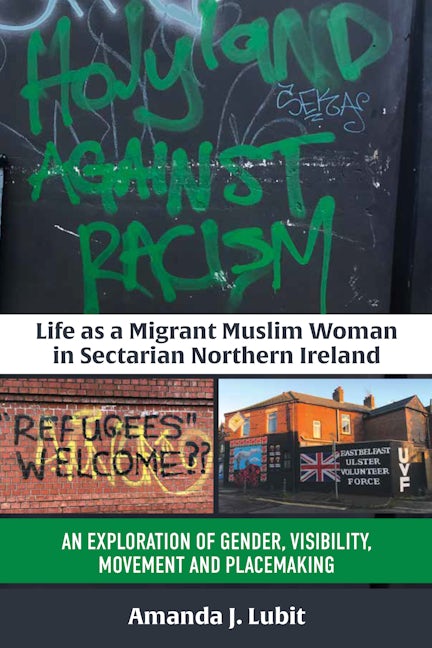
The lives of migrant Muslim women in divided, post-conflict Northern Ireland, both before and after the pandemic, are full of diverse stories and experiences of belonging. This book explores how women strive to belong and create a home despite pervasive hatred, sexism and racism. Under these circumstances, women employ various strategies to connect with people and places around them. Using personal stories, this book considers the relationships migrant Muslim women develop, the places they spend time and the activities they engage with. These stories are used to demonstrate the interconnectedness of gender, visibility, movement and placemaking as analytical concepts.


“Lubit’s meticulous attention to Migrant women’s everyday practices of resistance to systemic racism and discrimination offers an important corrective to dominant orientalist representations of powerless Muslim women in need of rescue." • Julie Billaud, Geneva Graduate Institite
“It is a rather original work … the topic and approach are innovative, focusing on the experiences of Muslim woman in Northern Ireland.” • Julius-Cezar Macarie, University College Cork
“This book represents a valuable, necessary and long overdue contribution to the sociology and social anthropology of contemporary Northern Ireland.” • David O’Kane, Nelson Mandela University
Amanda J. Lubit is currently a Marie Skłodowska-Curie (MSCA) Post-Doctoral Fellow at Dublin City University. She is also engaged at the Max Planck Institute for the Study of Religious and Ethnic Diversity. In 2022 she was awarded the Human Rights Defender Award by the Society for Applied Anthropology.
List of Illustrations
Preface
Acknowledgements
Introduction: Who Are the Muslim women of Northern Ireland?
Chapter 1. The Northern Ireland Context: Impacts upon Migration and Gender
Chapter 2. Northern Ireland’s Migrant Muslim Population
Chapter 3. The Role of Islamic Clothing in Visibility
Chapter 4. The Intentional Invisibility of Islamic Women’s Spaces
Chapter 5. The Institutional Nature of Sectarianism: Shaping Sexism, Racism and Islamophobia
Chapter 6. ‘Maybe I Make Mistake Coming to Northern Ireland’: Navigating Housing Competition and Neighbourhood Aggression
Chapter 7. ‘Don’t Fit in Anywhere’: Social Exclusion and Barriers to Belonging
Chapter 8. A Harnessing the Creative Power of Care to Achieve Belonging and Emplacement
Chapter 9. Women-Only Spaces within the Islamic Centre
Chapter 10. Sadiqa: A Women-Only Space for Asylum-Seekers and Refugees
Chapter 11. Spatial, Temporal, Material and Social Realities of Seeking Asylum
Chapter 12. Creating Sadiqa Women’s Space: Transforming Place as a Tactic for Managing Life in Asylum
Chapter 13. A Time of Confinement: Reconfiguring Life in Online Spaces during COVID-19
Chapter 14. Connection in the Face of Northern Ireland’s Digital Divide
Conclusion: Exploring the Connections between Visibility, Movement, Placemaking and Empowerment