


Some error occured while loading the Quick View. Please close the Quick View and try reloading the page.
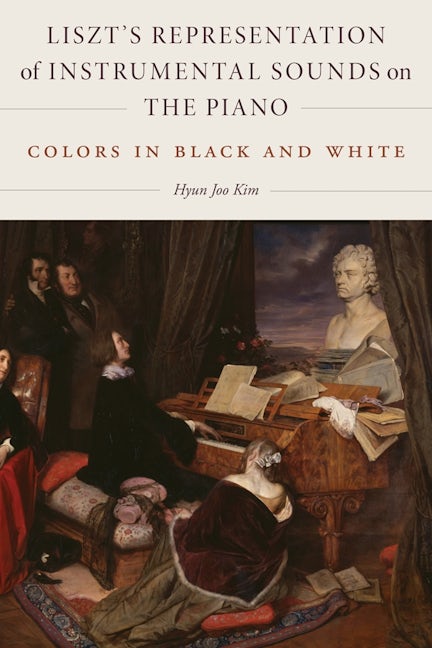
Examines Liszt's piano arrangements of music originally created for other instruments, especially the symphony orchestra and the Hungarian Gypsy band.
Liszt's adaptation of existing music is staggering in its quantity, scope, and variety of technique. He often viewed the model work as a source that he strove to improve, rival, and even surpass. Liszt's Representation of Instrumental Sounds on the Piano: Colors in Black and White provides a comprehensive survey of Liszt's reworking of instrumental music on the piano, particularly his emulation of tone colors and idiomatic gestures. The book relatesLiszt's sonic reproductions to the widespread nineteenth-century interest in visual-art reproduction. Hyun Joo Kim illustrates Liszt's diverse approaches to the integrity of the music in a detailed, vivid, and insightful manner through close study of his arrangements of Beethoven's symphonies and Rossini's Guillaume Tell Overture, his two-piano arrangements of his own symphonic poems such as Mazeppa and Hunnenschlacht, and his Hungarian Rhapsodies. By examining orchestral music and Hungarian Gypsy-style music as sources of Liszt's sound representations, this book reveals Liszt's musical discourse as straddling the musical, cultural, and aesthetic divides between mainstream and peripheral, art and folk, serious and popular.
HYUN JOO KIM holds a PhD from Indiana University and is an independent scholar in Seoul, South Korea.
Liszt's adaptation of existing music is staggering in its quantity, scope, and variety of technique. He often viewed the model work as a source that he strove to improve, rival, and even surpass. Liszt's Representation of Instrumental Sounds on the Piano: Colors in Black and White provides a comprehensive survey of Liszt's reworking of instrumental music on the piano, particularly his emulation of tone colors and idiomatic gestures. The book relatesLiszt's sonic reproductions to the widespread nineteenth-century interest in visual-art reproduction. Hyun Joo Kim illustrates Liszt's diverse approaches to the integrity of the music in a detailed, vivid, and insightful manner through close study of his arrangements of Beethoven's symphonies and Rossini's Guillaume Tell Overture, his two-piano arrangements of his own symphonic poems such as Mazeppa and Hunnenschlacht, and his Hungarian Rhapsodies. By examining orchestral music and Hungarian Gypsy-style music as sources of Liszt's sound representations, this book reveals Liszt's musical discourse as straddling the musical, cultural, and aesthetic divides between mainstream and peripheral, art and folk, serious and popular.
HYUN JOO KIM holds a PhD from Indiana University and is an independent scholar in Seoul, South Korea.

Price: $120.00
Pages: 238
Publisher: Boydell & Brewer Inc.
Imprint: University of Rochester Press
Publication Date:
15 March 2019
Trim Size: 9.00 X 6.00 in
ISBN: 9781580469463
Format: Hardcover
BISACs:
MUSIC / Individual Composer & Musician, Composers and songwriters, MUSIC / Musical Instruments / Piano & Keyboard, ART / Color Theory, Musicians, singers, bands and groups, Keyboard instruments

[Kim d]raws on an astounding range of sources for her analysis, always rooted in historical sources (art criticism, music reviews, Liszt's correspondence and notes, and more) and convincing theoretical analysis. Chapter 5 is most interesting to me, because it adds to the ever-present scholarly discussion about folk music['s influence on composers]. Kim offers a valuable discussion of the cimbalom and its similarities to the fortepiano's sound. Even more valuable, Kim's analysis suggests that 'folk' and 'art' overlapped often. This chapter will help people performing Liszt's Hungarian Rhapsodies on the piano. There are a lot of pictures and musical examples that make it easier to follow along.
Introduction
Approaching the Reproductive Arts
"Partitions de Piano"
Between "Text" and "Event": Liszt's Guillaume Tell Overture
Translating the Orchestra: Liszt's Two-Piano Arrangements of His Symphonic Poems
Interpretive Fidelity to Gypsy Creativity: Representations of Hungarian-Gypsy Cimbalom Playing
Conclusions: Recurring Techniques and Aesthetics
Appendix: Liszt's Preface to his Piano Arrangements of Beethoven's Fifth and Sixth Symphonies in the Breitkopf & Härtel's edition, 1840
Bibliography
Approaching the Reproductive Arts
"Partitions de Piano"
Between "Text" and "Event": Liszt's Guillaume Tell Overture
Translating the Orchestra: Liszt's Two-Piano Arrangements of His Symphonic Poems
Interpretive Fidelity to Gypsy Creativity: Representations of Hungarian-Gypsy Cimbalom Playing
Conclusions: Recurring Techniques and Aesthetics
Appendix: Liszt's Preface to his Piano Arrangements of Beethoven's Fifth and Sixth Symphonies in the Breitkopf & Härtel's edition, 1840
Bibliography