


Some error occured while loading the Quick View. Please close the Quick View and try reloading the page.
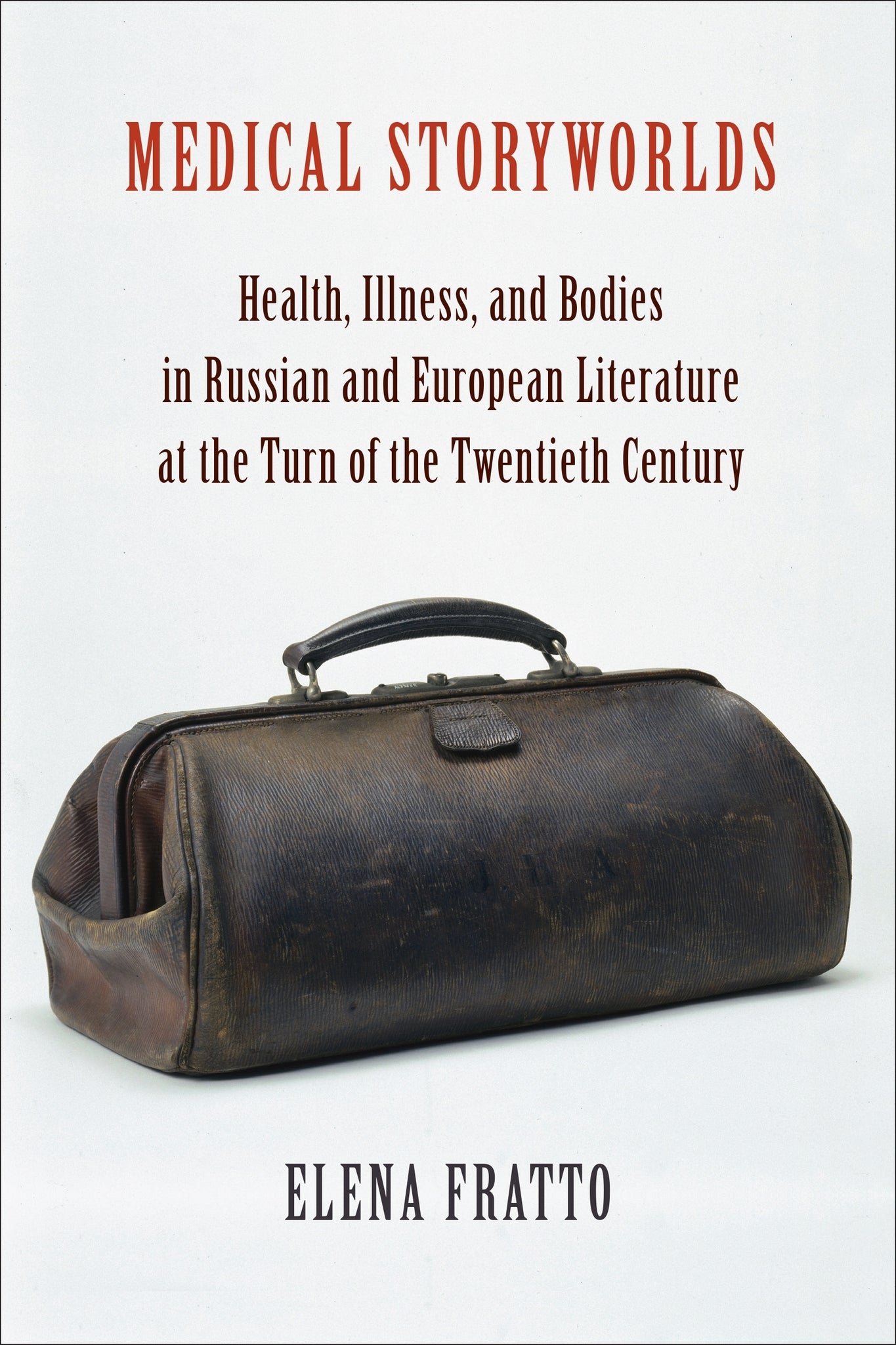
Though often seen as scientific or objective, medicine has a fundamentally narrative aspect. Much like how an author constructs meaning around fictional events, a doctor or patient narrates the course of an illness and treatment. In what ways have literary and medical storytelling intersected with and shaped each other?
In Medical Storyworlds, Elena Fratto examines the relationship between literature and medicine at the turn of the twentieth century—a period when novelists were experimenting with narrative form and the modern medical establishment was taking shape. She traces how Russian writers such as Dostoevsky, Tolstoy, and Bulgakov responded to contemporary medical and public health prescriptions, placing them in dialogue with French and Italian authors including Romains and Svevo and such texts as treatises by Paul Broca and Cesare Lombroso. In nuanced readings of these works, Fratto reveals how authors and characters question the rhetoric and authority of medicine and public health in telling stories of mortality, illness, and well-being. In so doing, she argues, they provide alternative ways of thinking about the limits and possibilities of human agency and free will. Bridging the medical humanities, European literary studies, and Slavic studies, Medical Storyworlds shows how narrative theory and canonical literary texts offer a new lens on today’s debates in medical ethics and bioethics.


— Julia Vaingurt, coeditor of The Human Reimagined: Posthumanism in Russia
Moving fluidly between modern medicine and Russian literature, Fratto explores a vital question: Who authors medical narratives? Focused on questions of plot and agency, her subtle analyses reveal how physicians develop their ideas about disease, entrepreneurs market meanings of health, and patients assert their voices to narrate their own medical storylines.
— David S. Jones, author of Broken Hearts: The Tangled History of Cardiac Care
This elegant book stages nothing less than a Slavic studies intervention in medical humanities—and vice versa. In the process, Fratto draws myriad revelatory connections between the writings of Tolstoy, Dostoevsky, and Bulgakov, among others, and such present-day concerns as medical ethics, disability, posthumanism, and the Covid-19 pandemic. In short, Medical Storyworlds is a triumph.
— José Alaniz, author of Death, Disability, and the Superhero: The Silver Age and Beyond
An original and thought-provoking study . . . Fratto’s lively book provides compelling new interpretations of canonical works of Russian literature, and it manages to put the discipline of Slavic Studies into a productive dialogue with contemporary Medical Humanities.
[A] fascinating, very well-written, and timely book.
[A] nuanced and richly interdisciplinary study.
Fratto’s expansive source base, including Russian, French, and Italian texts, along with her command of the theoretical literature, gives us a new platform from which the medical humanities can continue to develop.
Fratto’s absorbing, timely study will be invaluable for scholars, the general reader, and anyone who is interested not only in Russian and European literatures, but also, in the nuanced ways medical narratives shape human lives, and vice versa.
This book will be useful to anyone interested in medical discourse, as well as to students of the medical humanities, a field that reaffirms the need to pay attention to patient narratives, as well as to sickness-related fiction as a whole.
Scholars of Russian and European literature, theoretically-oriented comparatists, and those working in the medical humanities will find Medical Storyworlds an excellent starting point for rich discussions of narrative and medicine.
Acknowledgments
Introduction
1. The Grand Finale: Death as the Revelatory Ending
2. End of Story: Temporality and the Prospect of the Ending in Ivan Ilych, Anna Karenina, and (Potential) Cancer Patients
3. Medical Enlightenment in the Early 1920s: Rhetoric and Diffused Authorship in Jules Romains’s Knock and Soviet Public-Health Campaigns
4. Time, Agency, and Bodily Glands: Metabolic Storytelling in Italo Svevo and Mikhail Bulgakov
Afterword
Notes
Bibliography
Index