


Some error occured while loading the Quick View. Please close the Quick View and try reloading the page.
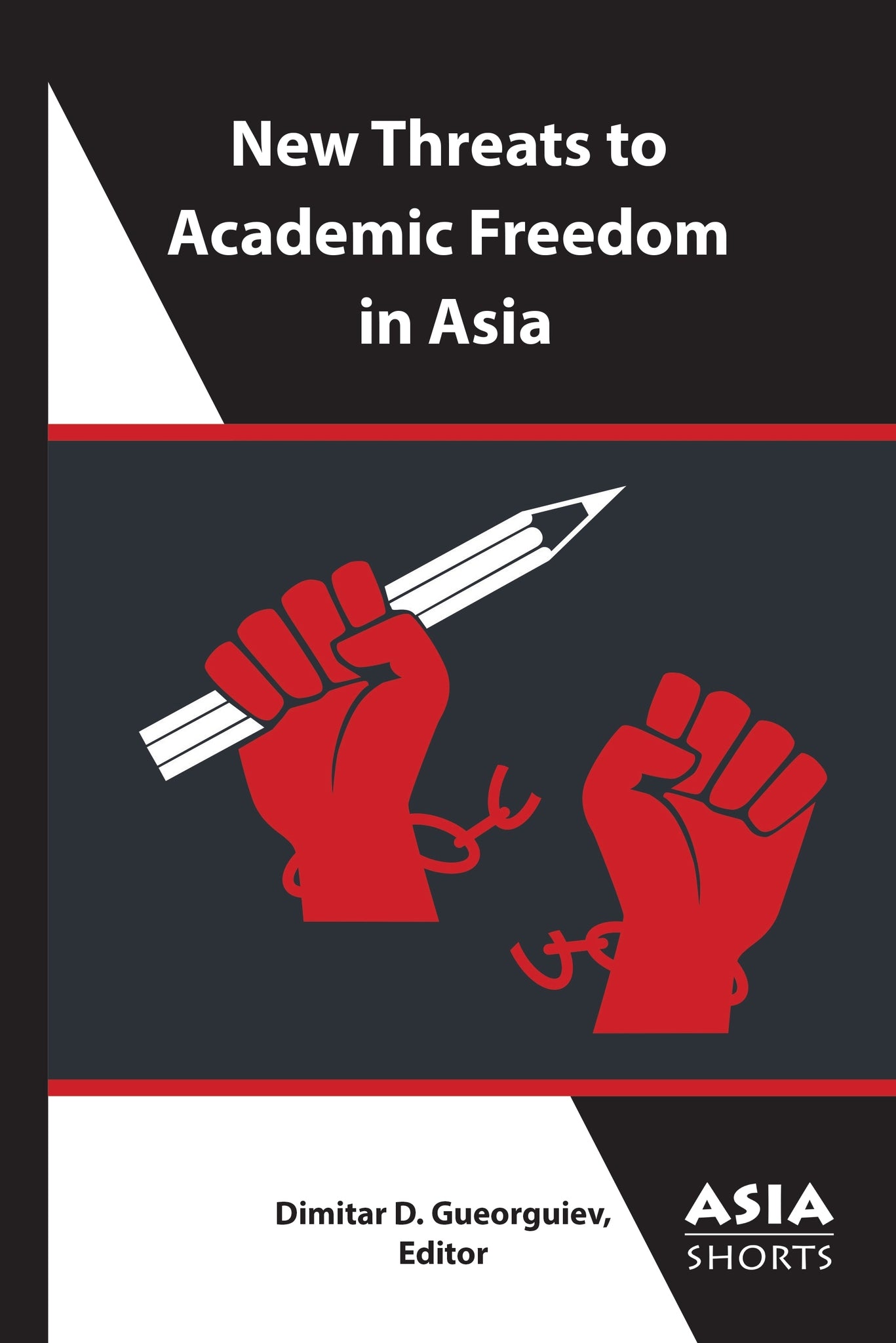
New Threats to Academic Freedom in Asia examines the increasingly dire state of academic freedom in Asia. Using cross-national data and in-depth case studies, the authors shed light on the multifaceted nature of academic censorship and provide reference points to those working in restrictive academic environments.

Price: $25.00
Pages: 202
Publisher: Association for Asian Studies
Imprint: Association for Asian Studies
Series: Asia Shorts
Publication Date:
03 January 2023
Trim Size: 9.00 X 6.00 in
ISBN: 9781952636318
Format: Paperback
BISACs:
POLITICAL SCIENCE / Censorship, POLITICAL SCIENCE / Civil Rights, HISTORY / Asia / General

This short book by an international and interdisciplinary set of scholars covers a lot of ground in illuminating ways. Through a combination of tightly focused case studies and sections that place threats to academic freedom in different parts of Asia into comparative and global perspective, it offers a valuable window onto a multifaceted issue of pressing concern.
— Jeffrey Wasserstrom, author of Vigil: Hong Kong on the Brink and former editor of The Journal of Asian Studies
Where freedom of inquiry stops, other fundamental rights also suffer. Academic freedom, in that sense, is a fortress for free societies that value the pursuit of truth and unbiased knowledge. This book is a collection of excellent research that gives an alarming call to all scholars, researchers, and concerned individuals. It tells us that academic freedom is being increasingly threatened in many Asian societies, even in places where it has been taken for granted.
— Ji Yeon Hong, Associate Professor of Political Science and Korea Foundation Professor of Korean Studies, University of Michigan
I have long been searching for an answer to the conundrum of how authoritarian regimes aim to combine high global rankings with diminished academic freedoms. This insightful volume focused on Asia as a region of great ambition and increasing restrictions, provides the answer to this question and many others. A very valuable contribution to the literature on academic freedom globally.
— Nandini Sundar, Professor of Sociology, Delhi School of Economics
Nuanced and thoroughly researched, this volume offers new data to shed light on the state of academic freedom in Asia. An important and timely contribution.
— Risa J. Toha, Assistant Professor of Political Science, Wake Forest University
The case studies in this volume illuminate how tensions among traditional “strong states” in Asia, facing growing civil society, intellectual space, and geopolitical competition, resort to interference in academic institutions. It is an insightful comparative study that speaks beyond the Asian particulars, casting light on the vulnerability of the intellectual endeavor elsewhere as well.
— Haruko Satoh, Osaka School of International Public Policy, Osaka University
This is an excellent and profoundly disturbing volume; it is a warning to Anglosphere scholars and universities that they cannot be complacent about academic freedom abroad, or at home.
— Shaun O’Dwyer, Kyushu University
— Jeffrey Wasserstrom, author of Vigil: Hong Kong on the Brink and former editor of The Journal of Asian Studies
Where freedom of inquiry stops, other fundamental rights also suffer. Academic freedom, in that sense, is a fortress for free societies that value the pursuit of truth and unbiased knowledge. This book is a collection of excellent research that gives an alarming call to all scholars, researchers, and concerned individuals. It tells us that academic freedom is being increasingly threatened in many Asian societies, even in places where it has been taken for granted.
— Ji Yeon Hong, Associate Professor of Political Science and Korea Foundation Professor of Korean Studies, University of Michigan
I have long been searching for an answer to the conundrum of how authoritarian regimes aim to combine high global rankings with diminished academic freedoms. This insightful volume focused on Asia as a region of great ambition and increasing restrictions, provides the answer to this question and many others. A very valuable contribution to the literature on academic freedom globally.
— Nandini Sundar, Professor of Sociology, Delhi School of Economics
Nuanced and thoroughly researched, this volume offers new data to shed light on the state of academic freedom in Asia. An important and timely contribution.
— Risa J. Toha, Assistant Professor of Political Science, Wake Forest University
The case studies in this volume illuminate how tensions among traditional “strong states” in Asia, facing growing civil society, intellectual space, and geopolitical competition, resort to interference in academic institutions. It is an insightful comparative study that speaks beyond the Asian particulars, casting light on the vulnerability of the intellectual endeavor elsewhere as well.
— Haruko Satoh, Osaka School of International Public Policy, Osaka University
This is an excellent and profoundly disturbing volume; it is a warning to Anglosphere scholars and universities that they cannot be complacent about academic freedom abroad, or at home.
— Shaun O’Dwyer, Kyushu University
Dimitar D. Gueorguiev is Associate Professor of Political Science in the Maxwell School of Citizenship Public Affairs and Chinese Studies Director at Syracuse University. Gueorguiev specializes in Chinese politics. Gueorguiev’s newest book, Retrofitting Leninism (Oxford, 2021), explores the limits and opportunities of non-democratic participation and digital control in China. Gueorguiev is also co-author of China’s Governance Puzzle (Cambridge, 2017).