


Some error occured while loading the Quick View. Please close the Quick View and try reloading the page.
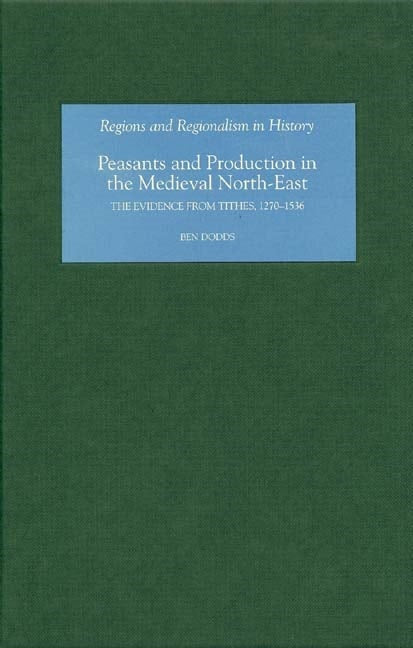
Evidence from unused sources sheds much light on the peasant economy of the later middle ages.
The peasant economy in north-east England, and indeed throughout the country as a whole, underwent many changes during the later Middle Ages, but owing to the lack of evidence it has been difficult to come to definite conclusions.This pioneering survey uses previously unexploited sources, principally from tithe data, to offer new interpretations of the patterns for change and the scope for adaptability. The author argues that the peasant economy in this region of England was profoundly affected by war in the early fourteenth century and then disease with the arrival of the Black Death in 1349, calling into question the orthodox theories of overpopulation in explaining the "crisis"of the late Middle Ages: even at its medieval peak, the population of northeast England was sparse by comparison with areas further south. Nor did the availability of land and improved living standards lead to demographic recovery in the fifteenth and early sixteenth centuries. He also shows that despite their vulnerability to crises, peasant cultivators were highly responsive to change. Far from being primitive subsistence farmers oblivious to the marketand its signals, medieval peasants in the Durham region were subtle and successful decision-makers regarding the production and marketing of their output.
BEN DODDS is Lecturer in History at the University of Tallahassee.
The peasant economy in north-east England, and indeed throughout the country as a whole, underwent many changes during the later Middle Ages, but owing to the lack of evidence it has been difficult to come to definite conclusions.This pioneering survey uses previously unexploited sources, principally from tithe data, to offer new interpretations of the patterns for change and the scope for adaptability. The author argues that the peasant economy in this region of England was profoundly affected by war in the early fourteenth century and then disease with the arrival of the Black Death in 1349, calling into question the orthodox theories of overpopulation in explaining the "crisis"of the late Middle Ages: even at its medieval peak, the population of northeast England was sparse by comparison with areas further south. Nor did the availability of land and improved living standards lead to demographic recovery in the fifteenth and early sixteenth centuries. He also shows that despite their vulnerability to crises, peasant cultivators were highly responsive to change. Far from being primitive subsistence farmers oblivious to the marketand its signals, medieval peasants in the Durham region were subtle and successful decision-makers regarding the production and marketing of their output.
BEN DODDS is Lecturer in History at the University of Tallahassee.

Price: $120.00
Pages: 220
Publisher: Boydell & Brewer Inc.
Imprint: Boydell Press
Series: Regions and Regionalism in History
Publication Date:
19 April 2007
Trim Size: 9.21 X 6.14 in
ISBN: 9781843832874
Format: Hardcover
BISACs:
HISTORY / Europe / Medieval, European history: medieval period, middle ages

Anyone working on the medieval English agrarian economy, particularly that of the northeast, will find this book a valuable contribution to the field, and one looks forward to more from this promising scholar.
Tithe and history
The Tyne Tees region
War and weather, 1270-1348
Pestilence, 1349-c.1440
Non-recovery, c. 1440-1536
Production strategies
Tithe buyers
Conclusion
The Tyne Tees region
War and weather, 1270-1348
Pestilence, 1349-c.1440
Non-recovery, c. 1440-1536
Production strategies
Tithe buyers
Conclusion