


Some error occured while loading the Quick View. Please close the Quick View and try reloading the page.
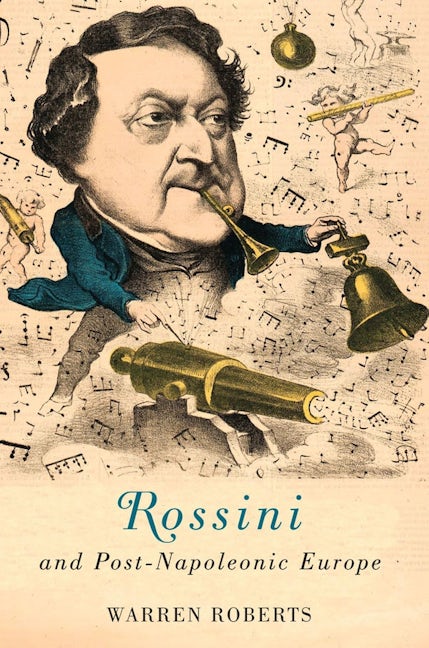
Warren Roberts has discovered a Rossini that others have not seen, a composer who commented ironically and satirically on religion and politics in Post-Napoleonic Europe.
This book examines Rossini within the context of his own time, one of Napoleonic domination of Italy, restoration of the Bourbon monarchy in Naples in 1815, and the 1830 Revolution in Paris. Using the techniques of the historian,and reading librettos as texts, the author analyzes the five operas treated in detail in the book (Il barbiere di Siviglia, Cenerentola, La gazza ladra, Matilde di Shabran, and Il viaggio a Reims) as responses, each in its own way, to the history that the composer experienced. Roberts shows that Rossini made probing commentaries on politics and religion in a time of reaction and revolution, and that the composer was well-informed on post-Napoleonic politics. Rossini's comic writing served very serious purposes, exposing the problems and complications of an age that he observed with striking clarity.
Warren Roberts is Professor Emeritusof History at the University at Albany, SUNY, and has published extensively on eighteenth-century French culture.
This book examines Rossini within the context of his own time, one of Napoleonic domination of Italy, restoration of the Bourbon monarchy in Naples in 1815, and the 1830 Revolution in Paris. Using the techniques of the historian,and reading librettos as texts, the author analyzes the five operas treated in detail in the book (Il barbiere di Siviglia, Cenerentola, La gazza ladra, Matilde di Shabran, and Il viaggio a Reims) as responses, each in its own way, to the history that the composer experienced. Roberts shows that Rossini made probing commentaries on politics and religion in a time of reaction and revolution, and that the composer was well-informed on post-Napoleonic politics. Rossini's comic writing served very serious purposes, exposing the problems and complications of an age that he observed with striking clarity.
Warren Roberts is Professor Emeritusof History at the University at Albany, SUNY, and has published extensively on eighteenth-century French culture.

Price: $120.00
Pages: 254
Publisher: Boydell & Brewer Inc.
Imprint: University of Rochester Press
Publication Date:
20 October 2015
Trim Size: 9.00 X 6.00 in
ISBN: 9781580465304
Format: Hardcover
BISACs:
MUSIC / History & Criticism, History of music, MUSIC / Genres & Styles / Opera, HISTORY / Modern / 19th Century, Music reviews and criticism, Opera

Astounding...Unique in its historical approach, which, by confronting artistic creativity, contemporary historical developments, and socio-political contexts, provides a priceless key for anyone interested in analyzing the early-eighteenth-century milieu thanks to which Rossini became (as Stendhal put it) 'the Napoleon of a musical era.
Acknowledgments
Introduction
Setting the Stage: Opera Buffa and Comedy of Manners in an Age of Democratic Revolution
Rossini, Mozart, Paisiello, and the Barber of Seville
Jane Austen, Goya, Rossini, and the Post-Napoleonic Age: La Cenerentola
Rossini, Beethoven, and Rescue Opera: Fidelio and La gazza ladra
Rossini, Ferretti, Matilde di Shabran, and the Revolution of 1820-21
Stendhal and Rossini in Paris: Il viaggio a Reims, Le Comte Ory, and the July Revolution
Conclusion: Thinking about Rossini
Notes
Bibliography
Index
Introduction
Setting the Stage: Opera Buffa and Comedy of Manners in an Age of Democratic Revolution
Rossini, Mozart, Paisiello, and the Barber of Seville
Jane Austen, Goya, Rossini, and the Post-Napoleonic Age: La Cenerentola
Rossini, Beethoven, and Rescue Opera: Fidelio and La gazza ladra
Rossini, Ferretti, Matilde di Shabran, and the Revolution of 1820-21
Stendhal and Rossini in Paris: Il viaggio a Reims, Le Comte Ory, and the July Revolution
Conclusion: Thinking about Rossini
Notes
Bibliography
Index