


Some error occured while loading the Quick View. Please close the Quick View and try reloading the page.
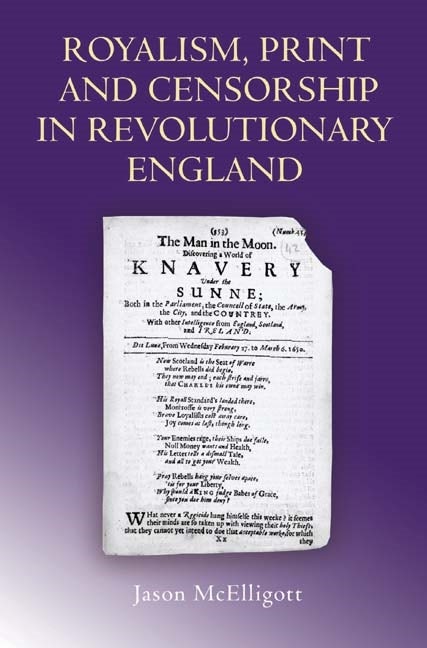
A study of the content and methods of royalist propaganda via newsbooks in the crucial period following the end of the first civil war.
This is a study of a remarkable set of royalist newsbooks produced in conditions of strict secrecy in London during the late 1640s. It uses these flimsy, ephemeral sheets of paper to rethink the nature of both royalism and Civil War allegiance. Royalism, Print and Censorship in Revolutionary England moves beyond the simple and simplistic dichotomies of 'absolutism' versus 'constitutionalism'. In doing so, it offers a nuanced, innovative and exciting visionof a strangely neglected aspect of the Civil Wars. Print has always been seen as a radical, destabilizing force: an agent of social change and revolution. Royalism, Print and Censorship in Revolutionary England demonstrates, bycontrast, how lively, vibrant and exciting the use of print as an agent of conservatism could be. It seeks to rescue the history of polemic in 1640s and 1650s England from an undue preoccupation with the factional squabbles of leading politicians. In doing so, it offers a fundamental reappraisal of the theory and practice of censorship in early-modern England, and of the way in which we should approach the history of books and print-culture. JASON McELLIGOTT is the J.P.R. Lyell Research Fellow in the History of the Early Modern Printed Book at Merton College, Oxford.
This is a study of a remarkable set of royalist newsbooks produced in conditions of strict secrecy in London during the late 1640s. It uses these flimsy, ephemeral sheets of paper to rethink the nature of both royalism and Civil War allegiance. Royalism, Print and Censorship in Revolutionary England moves beyond the simple and simplistic dichotomies of 'absolutism' versus 'constitutionalism'. In doing so, it offers a nuanced, innovative and exciting visionof a strangely neglected aspect of the Civil Wars. Print has always been seen as a radical, destabilizing force: an agent of social change and revolution. Royalism, Print and Censorship in Revolutionary England demonstrates, bycontrast, how lively, vibrant and exciting the use of print as an agent of conservatism could be. It seeks to rescue the history of polemic in 1640s and 1650s England from an undue preoccupation with the factional squabbles of leading politicians. In doing so, it offers a fundamental reappraisal of the theory and practice of censorship in early-modern England, and of the way in which we should approach the history of books and print-culture. JASON McELLIGOTT is the J.P.R. Lyell Research Fellow in the History of the Early Modern Printed Book at Merton College, Oxford.

Price: $130.00
Pages: 284
Publisher: Boydell & Brewer Inc.
Imprint: Boydell Press
Publication Date:
16 October 2007
Trim Size: 9.21 X 6.14 in
ISBN: 9781843833239
Format: Hardcover
BISACs:
HISTORY / Europe / Great Britain / General, European history

Makes a significant contribution to the ongoing dialogue on the nature and operation of Royalism during the English Civil Wars.
Introduction: Royalism and its Problems
Royalists and Polemic in the 1640s
The Politics of Sexual Libel
The Twists and Turns of Royalist Propaganda
Authors, Shifting Allegiances and the Nature of Royalism
Printers, Publishers and the Royalist Underground
Hunting the Royalist Press
The Theory and Practice of Censorship
A New Model of Press Censorship
Conclusion
Royalists and Polemic in the 1640s
The Politics of Sexual Libel
The Twists and Turns of Royalist Propaganda
Authors, Shifting Allegiances and the Nature of Royalism
Printers, Publishers and the Royalist Underground
Hunting the Royalist Press
The Theory and Practice of Censorship
A New Model of Press Censorship
Conclusion