


Some error occured while loading the Quick View. Please close the Quick View and try reloading the page.
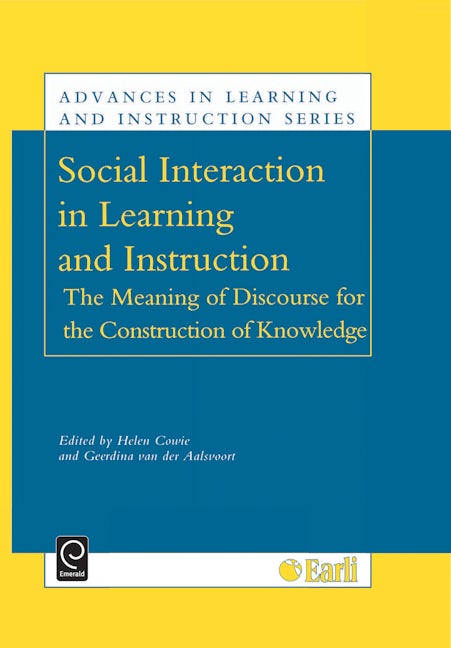
This exciting new text examines how knowledge is socially constructed and shared through discursive interactions within the classroom community. The contributors discuss the meaning of the cognitive, emotional and social discourses that exist between teachers and learners and suggest how teachers can create an effective learning partnership to stimulate children. The authors also consider how children, in turn, construe the curriculum and how they perceive the ground-rules and peer-relationships within the classroom community. By reporting findings from state-of-the-art studies in a range of Western cultural contexts, the authors are able to overview key theoretical perspectives and synthesise the methods currently being developed for measuring social interaction in learning and instruction.

Price: $166.99
Pages: 260
Publisher: Emerald Group Publishing Limited
Imprint: Elsevier Science Ltd
Series: Advances in Learning and Instruction Series
Publication Date:
13 September 2000
ISBN: 9780080435978
Format: Hardcover
BISACs:
EDUCATION / Educational Psychology, SOCIAL SCIENCE / General

Chapter headings: Introduction (H. Cowie, G.M. van der Aalsvoort). Studying social interaction in instruction and learning: methodological approaches and problems (G.M. van der Aalsvoort, F.J.H. Harinck). Institutional framings in thinking, learning and teaching (M. Grossen). Identity and social interaction in a community of inquiry (E. Elbers, L. Streefland). Collective argumentation: a sociocultural approach to reframing classroom teaching (R.A.J. Brown, P.D. Renshaw). The development of children's social representation of the primary school curriculum (G.M. Ivinson). Learning for communication skills and social processes of peer support: a case-study of good practice (P. Naylor, H. Cowie). Co-construction in kindergarteners' free play: effects of social, individual and didactic factors (P.P.M. Leseman et al.). Activity and interaction in pedagogical contexts (J. Ireson). Mapping the dynamics of peer group interaction: a method of analysis of socially shared learning processes (K. Kumpulainen, M. Mutanen). Deep processing in a collaborative learning environment (C. van Boxtel et al.). Language for thinking: a study of children solving reasoning test problems together (R. Wegerif, N. Mercer). Guided Participation, discourse and the construction of knowledge in Mexican classrooms (S. Rojas-Drummond). Overview and new perspectives (G.M. van der Aalsvoort et al.).