


Some error occured while loading the Quick View. Please close the Quick View and try reloading the page.
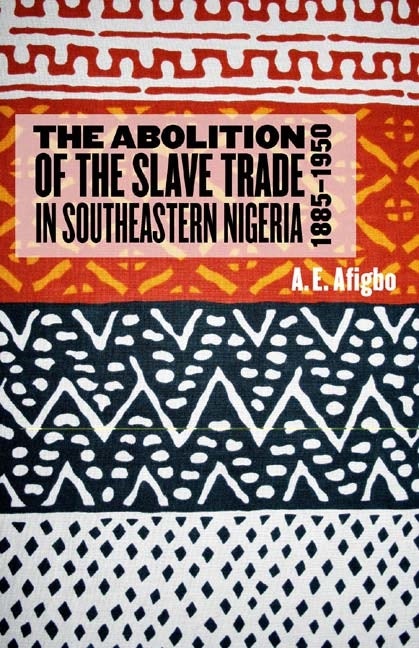
A historical reconstruction of the campaign to end the slave trade in Southeastern Nigeria.
The Abolition of the Slave Trade in Southeastern Nigeria, 1885-1950, is a history of the campaign waged by Great Britain in colonial Nigeria from approximately 1885 on, to abolish the internal slave trade in the Bight of Biafra and its hinterland, a region also known as Eastern Nigeria, Southeastern Nigeria, the Eastern Provinces, or the trans-Niger Provinces. It treats the internal slave trade and the war against it in this region and period as themes separate from the institution of slavery in the same area and the campaign to root it out generally known as emancipation. For this reason, and because slavery and the effort at emancipation have received more attention from scholars, this work concentrates entirely on that aspect of the slave trade and its fortunes under British colonial rule commonly known as abolition. In reconstructing the story of this important and protracted campaign, Adiele Afigbo sheds light on a dark corner of social history that has largely been neglected by historians.
Adiele Afigbo is Pofessor in the Department of History and International Relations at Ebonyi State University, Nigeria.
The Abolition of the Slave Trade in Southeastern Nigeria, 1885-1950, is a history of the campaign waged by Great Britain in colonial Nigeria from approximately 1885 on, to abolish the internal slave trade in the Bight of Biafra and its hinterland, a region also known as Eastern Nigeria, Southeastern Nigeria, the Eastern Provinces, or the trans-Niger Provinces. It treats the internal slave trade and the war against it in this region and period as themes separate from the institution of slavery in the same area and the campaign to root it out generally known as emancipation. For this reason, and because slavery and the effort at emancipation have received more attention from scholars, this work concentrates entirely on that aspect of the slave trade and its fortunes under British colonial rule commonly known as abolition. In reconstructing the story of this important and protracted campaign, Adiele Afigbo sheds light on a dark corner of social history that has largely been neglected by historians.
Adiele Afigbo is Pofessor in the Department of History and International Relations at Ebonyi State University, Nigeria.

Price: $120.00
Pages: 230
Publisher: Boydell & Brewer Inc.
Imprint: University of Rochester Press
Publication Date:
06 November 2006
Trim Size: 9.00 X 6.00 in
ISBN: 9781580462426
Format: Hardcover
BISACs:
LITERARY COLLECTIONS / African, Anthologies: general, HISTORY / Africa / West, POLITICAL SCIENCE / Colonialism & Post-Colonialism, African history

This book is a welcome addition to the growing corpus of studies of the suppression of slavery during the colonial period. It differs from others in its specific focus on the issue of slave-trading, rather than the institution of slavery. . . .Afigbo makes good use of records of prosecutions of alleged slave-dealers to illustrate the detailed workings of the trade, including the practice of concealing the aquisition and transfer of female slaves under the guise of marriage transactions, and the use of ritual sanctions to discourage escapes and ensure the silence of witnesses. JOURNAL OF AFRICAN HISTORY, 2008 [Robin Law]
List of Illustrations
List of Appendixes
Preface
1. Philanthropy and Humanitarianism Left Out in the Cold, 1830-84/85
2. The Coastal Phase, ca. 1885-1900
3. The Hinterland Phase I: Blood and Iron, 1900-1914
4. The Hinterland Phase II: Courts and Constables, 1900-1932
5. The Hinterland Phase III: Courts and Constables, 1933-50
Conclusion
Appendixes
Notes
Sources and Bibliography
Index
List of Appendixes
Preface
1. Philanthropy and Humanitarianism Left Out in the Cold, 1830-84/85
2. The Coastal Phase, ca. 1885-1900
3. The Hinterland Phase I: Blood and Iron, 1900-1914
4. The Hinterland Phase II: Courts and Constables, 1900-1932
5. The Hinterland Phase III: Courts and Constables, 1933-50
Conclusion
Appendixes
Notes
Sources and Bibliography
Index