


Some error occured while loading the Quick View. Please close the Quick View and try reloading the page.
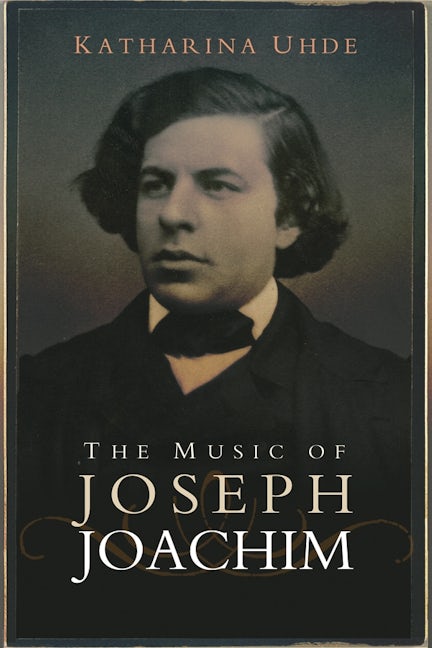
Joseph Joachim (1831-1907) was arguably the greatest violinist of the nineteenth century. But Joachim was also a composer of virtuoso pieces, violin concertos, orchestral overtures and chamber music works. Uhde's book will be thestandard work on the music of Joseph Joachim for many years to come.
Joseph Joachim (1831-1907), of Jewish-Hungarian descent, was arguably the greatest violinist of the nineteenth century. His performing career in Berlin transformed the aesthetics and interpretation of German music. But Joachim wasalso a composer of virtuoso pieces, violin concertos, orchestral overtures, and chamber music works, all written between 1847 and 1864 in one intense outpouring of creativity.
Katharina Uhde follows Joachim's compositionalpath through a changing cultural milieu. Joachim's compositions display intimate knowledge of the works of Mendelssohn, Wagner, Liszt, Schumann, and Brahms, yet he was no mere imitator. Joachim's style, classically conceived yetseasoned with a preference for dark, melancholy soundscapes and, in the earlier years, ciphers, virtuosity, and 'psychological' programmaticism, emerges as the product of various personal and socio-cultural currents: his search for national, religious, and cultural identity and a mature compositional style.
Joachim's music drew on a wealth of treasures accumulated in his process of 'enculturation', which began with Mendelssohn in Leipzig. Joachim'saesthetic evolved from a deeply subjective approach, not insignificantly inspired by his muse, Gisela von Arnim. Her circle - the von Arnim and Grimm families - became Joachim's cultural and literary haven. But unforeseen events also impacted his output, among them Schumann's death, the ascent of the young Brahms, and the 'War of the Romantics'. Joachim's music throws light onto a vibrant decade, colored by realism, naturalism, new visual technologies, andemerging academic disciplines including psychology. Uhde's book will be the standard work on the music of Joseph Joachim for many years to come.
KATHARINA UHDE is Assistant Professor for Violin and Musicology at Valparaiso University, IN.
Joseph Joachim (1831-1907), of Jewish-Hungarian descent, was arguably the greatest violinist of the nineteenth century. His performing career in Berlin transformed the aesthetics and interpretation of German music. But Joachim wasalso a composer of virtuoso pieces, violin concertos, orchestral overtures, and chamber music works, all written between 1847 and 1864 in one intense outpouring of creativity.
Katharina Uhde follows Joachim's compositionalpath through a changing cultural milieu. Joachim's compositions display intimate knowledge of the works of Mendelssohn, Wagner, Liszt, Schumann, and Brahms, yet he was no mere imitator. Joachim's style, classically conceived yetseasoned with a preference for dark, melancholy soundscapes and, in the earlier years, ciphers, virtuosity, and 'psychological' programmaticism, emerges as the product of various personal and socio-cultural currents: his search for national, religious, and cultural identity and a mature compositional style.
Joachim's music drew on a wealth of treasures accumulated in his process of 'enculturation', which began with Mendelssohn in Leipzig. Joachim'saesthetic evolved from a deeply subjective approach, not insignificantly inspired by his muse, Gisela von Arnim. Her circle - the von Arnim and Grimm families - became Joachim's cultural and literary haven. But unforeseen events also impacted his output, among them Schumann's death, the ascent of the young Brahms, and the 'War of the Romantics'. Joachim's music throws light onto a vibrant decade, colored by realism, naturalism, new visual technologies, andemerging academic disciplines including psychology. Uhde's book will be the standard work on the music of Joseph Joachim for many years to come.
KATHARINA UHDE is Assistant Professor for Violin and Musicology at Valparaiso University, IN.

Price: $85.00
Pages: 532
Publisher: Boydell & Brewer Inc.
Imprint: Boydell Press
Publication Date:
19 October 2018
Trim Size: 9.21 X 6.14 in
ISBN: 9781783272846
Format: Hardcover
BISACs:
BIOGRAPHY & AUTOBIOGRAPHY / Music, Biography: arts and entertainment, MUSIC / Genres & Styles / Classical, Composers and songwriters, Musicians, singers, bands and groups, Art music, orchestral and formal music

In the end, it seems that the conflicting binaries of nationality, of virtuoso performer vs. 'priestly' performer and of performer-interpreter vs. composer remained unresolved within Joachim himself. This book goes a long way towards illuminating these tensions and marks an important step towards opening up the topic for discussion.
Introduction: Approaching the Music of Joseph Joachim
Virtuosity Uncoiled: Two Fantasies Re-discovered
From Leipzig to Weimar
Between Uncoiled Virtuosity and Lisztian Temptations
Finding his Voice: Between Vergangenheitsmusik and Zukunftsmusik
Joachim Encoded, or, 'Psychological Music'
'Psychological Music' Experienced and Remembered: Joachim and the Demetrius Plot in 1854 and 1876
Resisting the Dark Butterfly
Joachim and the Art of Variation
Identities: The Hungarian Concerto and Hebrew Melodies
Gisela von Arnim and Compositional Memories, or Ciphers in Disguise
Cultural Objects in a Prussian Society
Conclusion: an Assessment of Joachim's Style
Appendix: Joachim Catalogue of Works
Bibliography
Virtuosity Uncoiled: Two Fantasies Re-discovered
From Leipzig to Weimar
Between Uncoiled Virtuosity and Lisztian Temptations
Finding his Voice: Between Vergangenheitsmusik and Zukunftsmusik
Joachim Encoded, or, 'Psychological Music'
'Psychological Music' Experienced and Remembered: Joachim and the Demetrius Plot in 1854 and 1876
Resisting the Dark Butterfly
Joachim and the Art of Variation
Identities: The Hungarian Concerto and Hebrew Melodies
Gisela von Arnim and Compositional Memories, or Ciphers in Disguise
Cultural Objects in a Prussian Society
Conclusion: an Assessment of Joachim's Style
Appendix: Joachim Catalogue of Works
Bibliography