


Some error occured while loading the Quick View. Please close the Quick View and try reloading the page.
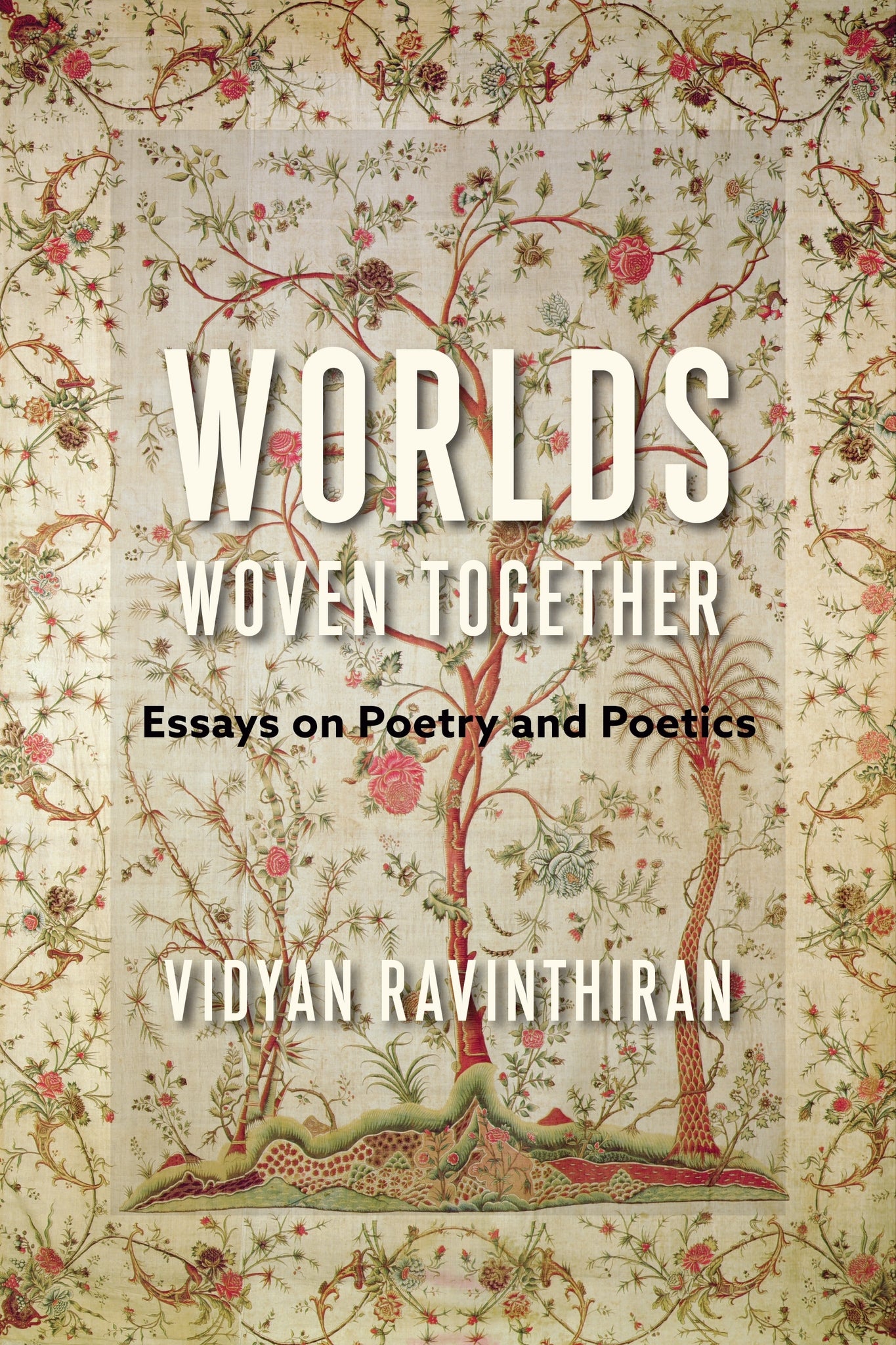
Writing about poetry follows models provided either by academic scholarship or literary journalism, each with its pitfalls. The former distances the reader from the poem and effaces the critic’s personality. In literary journalism, the critic is front and center, but the discussion is introductory and prioritizes value judgments. In either case, entrenched practices and patterns of privilege limit one’s perspective. The situation worsens when it comes to minoritized poets and poets from the Global South, where the focus is on restrictive notions of identity: the stylistic innovations of literary works get ousted by prefabricated historical narratives.
In Worlds Woven Together, the critic, poet, and scholar Vidyan Ravinthiran searches for alternatives, pursuing close, imaginative readings of a variety of writers. His essays are open-ended, attentive, and curious, unabashedly passionate and subjective yet keenly analytical and investigative. Discussing neglected authors and those well-known in the West, Ravinthiran sees politics as inseparable from literary form and is fascinated by the relation of the creative consciousness to the violences of history. The book features essays on writers including Mir Taqi Mir, Ana Blandiana, A. K. Ramanujan, Marianne Moore, Eunice de Souza, Czeslaw Milosz, Ted Hughes, Rae Armantrout, Arvind Krishna Mehrotra, Galway Kinnell, Dawn Lundy Martin, and Vahni Capildeo. Revealing serendipitous connections—between poems and cultures, between lines of verse and the lives we lead—Worlds Woven Together is for all readers fascinated by the mechanics and politics of poetry.


— Maureen N. McLane, author of My Poets
Ravinthiran is a rare critic: one whose deep-diving, finely wrought readings across multiple poetic traditions are dexterous as well as authoritative. He brings a poet’s enthusiasm for craft and language to a reevaluation of critical culture, speaking with great clarity and personality in a voice so capacious that we are compelled to listen, to learn.
— Sandeep Parmar, author of Reading Mina Loy's Autobiographies: Myth of the Modern Woman
Vidyan Ravinthiran writes with readerly passion and intellectual commitment about poetry he loves, at once deeply expert and finely attuned to the pleasures of literary language. The range of authors he celebrates is as impressive as the critical imagination with which he celebrates them. His is a distinctive and memorable voice which speaks eloquently to readers both within and without the academy.
— Seamus Perry, editor of Essays in Criticism
Vidyan Ravinthiran’s beautifully written, richly insightful collection is extraordinary in its geographic and cultural breadth, its incisive attention to form, its fusion of the strengths of journalistic and scholarly writing, and its chameleonic openness to, and close tracking of, the twists and turns of poetry. An eye-opening delight for poets and poetry readers.
— Jahan Ramazani, author of Poetry in a Global Age
Incisive, reflective, illuminating.
— Jeremy Noel-Tod
Ravinthiran is a rare critical mind whose sovereignty lies in an inextinguishable curiosity and drive to read more deeply. His critical writing is also inexorably beautiful.
— Sandeep Parmar
Probing and provoking, far-ranging but astringent, Ravinthiran would appear a natural successor to Michael Hofmann as a doyen of the long-form essay […] a steely and eye-opening book.
— David Wheatley
Provides astute readings in meticulously crafted prose that evinces a refined poetic sensibility...and it does so not by providing clear answers but by inviting and invigorating new conversations.
Acknowledgments
Introduction
“A slave and worshiper at love’s doorstep”: Mir Taqi Mir
Censorship and the Role of the Poet in the Work of Ana Blandiana
At Home or Nowhere: A. K. Ramanujan
Your Thorns Are the Best Part of You: Marianne Moore and Stevie Smith
Eunice de Souza and Indian Speech
“Emmental freedom”: Czesław Miłosz
“There must be something to say”: On Verse Sound
Elizabeth Bishop, Robert Penn Warren, and Cleanth Brooks, Communication, and Other People
Ted Hughes, Keith Sagar, and the Poetics of Letter Prose
Rae Armantrout’s Lonely Dream
Dreaming the World: Vinod Kumar Shukla’s Extraordinary Sentences
Srinivas Rayaprol and Gāmini Salgādo
You Can’t Close Your Eyes for a Sec: Arvind Krishna Mehrotra
Thom Gunn’s Shadows Hard as Board
Galway Kinnell, Trying to Become Winged
A. R. Ammons and “the political (read, human) world”
Postlyric and the Already Known: Dawn Lundy Martin
“I am not speaking of or as myself or for any/one”: Vahni (Anthony) Capildeo
Bibliography
Permissions
Index