


Some error occured while loading the Quick View. Please close the Quick View and try reloading the page.
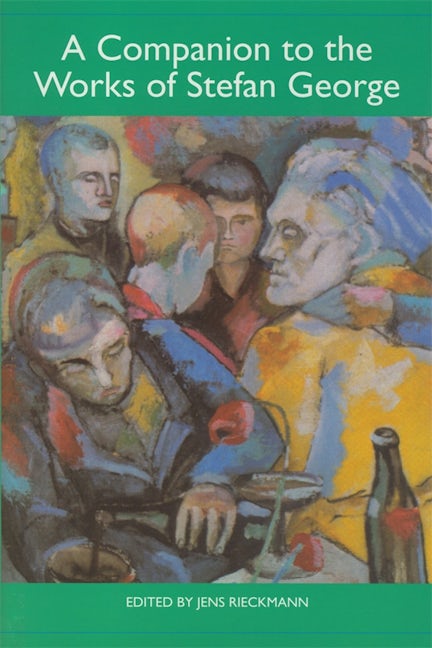
New, wide-ranging essays on the controversial poet, who was both a harbinger of Modernism and a critic of modernity.
Stefan George (1868-1933) is along with Hugo von Hofmannsthal and Rainer Maria Rilke one of the pre-eminent German poets of the twentieth century. He also had an important, albeit controversial and provocative role in German cultural history. It is generally agreed that he played a significant part in the transition of German literature to Modernism, particularly in poetry. At the same time he was an outspoken critic of modernity. He believed that only anall-encompassing cultural renewal could save modern man. Although George is often linked with the l'art pour l'art movement, and although his artistic consciousness was formed by European aestheticism, his poetry and the writings that emerged from the poets and intellectuals he gathered around him in the George Circle are above all a scathing commentary on the political, social, and cultural situation in Germany at the turn of the century.
George, who was imbued with the idea of the poet as a prophet and priest, saw himself as the Messiah of a New Hellenism and a New Reich led by an intellectual and aesthetic elite consisting of men who were bonded together through their allegiance to a charismatic leader. Some of the values that George proclaimed, among them a glorification of power, of heroism and self-sacrifice, were seized upon by the National Socialists, and subsequently his writings andthose of his circle were considered by some to be proto-fascist. It did not help his reputation that after the Second World War much of the criticism of his works was practiced by uncritical, hagiographic George worshippers. In recent years, however, there has been a renewed and unbiased interest among scholars and critics in George and his circle. The wide-ranging and original essays in this volume explore anew George's poetry and his contribution to Modernism, the relation between his vision of a New Reich and fascist ideology, and his importance as a cultural critic.
Jens Rieckmann is Professor of German at the University of California, Irvine.
Stefan George (1868-1933) is along with Hugo von Hofmannsthal and Rainer Maria Rilke one of the pre-eminent German poets of the twentieth century. He also had an important, albeit controversial and provocative role in German cultural history. It is generally agreed that he played a significant part in the transition of German literature to Modernism, particularly in poetry. At the same time he was an outspoken critic of modernity. He believed that only anall-encompassing cultural renewal could save modern man. Although George is often linked with the l'art pour l'art movement, and although his artistic consciousness was formed by European aestheticism, his poetry and the writings that emerged from the poets and intellectuals he gathered around him in the George Circle are above all a scathing commentary on the political, social, and cultural situation in Germany at the turn of the century.
George, who was imbued with the idea of the poet as a prophet and priest, saw himself as the Messiah of a New Hellenism and a New Reich led by an intellectual and aesthetic elite consisting of men who were bonded together through their allegiance to a charismatic leader. Some of the values that George proclaimed, among them a glorification of power, of heroism and self-sacrifice, were seized upon by the National Socialists, and subsequently his writings andthose of his circle were considered by some to be proto-fascist. It did not help his reputation that after the Second World War much of the criticism of his works was practiced by uncritical, hagiographic George worshippers. In recent years, however, there has been a renewed and unbiased interest among scholars and critics in George and his circle. The wide-ranging and original essays in this volume explore anew George's poetry and his contribution to Modernism, the relation between his vision of a New Reich and fascist ideology, and his importance as a cultural critic.
Jens Rieckmann is Professor of German at the University of California, Irvine.

Price: $36.95
Pages: 280
Publisher: Boydell & Brewer Inc.
Imprint: Camden House
Series: Studies in German Literature Linguistics and Culture
Publication Date:
01 June 2010
Trim Size: 9.00 X 6.00 in
ISBN: 9781571134561
Format: Paperback
BISACs:
LITERARY CRITICISM / European / German, Literature: history and criticism, LITERARY CRITICISM / Poetry, LITERARY CRITICISM / Comparative Literature, Literary studies: poetry and poets

The wise plan of the book is well realized: those who would like to be introduced to the world of Stefan George -- and not just in the Anglo-Saxon realm -- will find in the Companion a well-versed guide.
Introduction - Jens Rieckmann
Stefan George's Poetics - William Waters
Stefan George's Early Works 1890-1895 - Robert Vilain
In Praise of Illusion: Das Jahr der Seele and Der Teppich des Lebens - Karla L. Schultz
In Zeiten der Wirren: Stefan George's Later Works - Michael Metzger
Stefan George and Two Types of Aestheticism - Jeffrey Todd
Master and Disciple: The George Circle - Michael Winkler
Stefan George and the Munich Cosmologists - Paul Bishop
George, Nietzsche, and Nazism - Ritchie Robertson
Übergeschlechtliche Liebe: Stefan George's Concept of Love - Marita Keilson-Lauritz
Stefan George's Poetics - William Waters
Stefan George's Early Works 1890-1895 - Robert Vilain
In Praise of Illusion: Das Jahr der Seele and Der Teppich des Lebens - Karla L. Schultz
In Zeiten der Wirren: Stefan George's Later Works - Michael Metzger
Stefan George and Two Types of Aestheticism - Jeffrey Todd
Master and Disciple: The George Circle - Michael Winkler
Stefan George and the Munich Cosmologists - Paul Bishop
George, Nietzsche, and Nazism - Ritchie Robertson
Übergeschlechtliche Liebe: Stefan George's Concept of Love - Marita Keilson-Lauritz