


Some error occured while loading the Quick View. Please close the Quick View and try reloading the page.
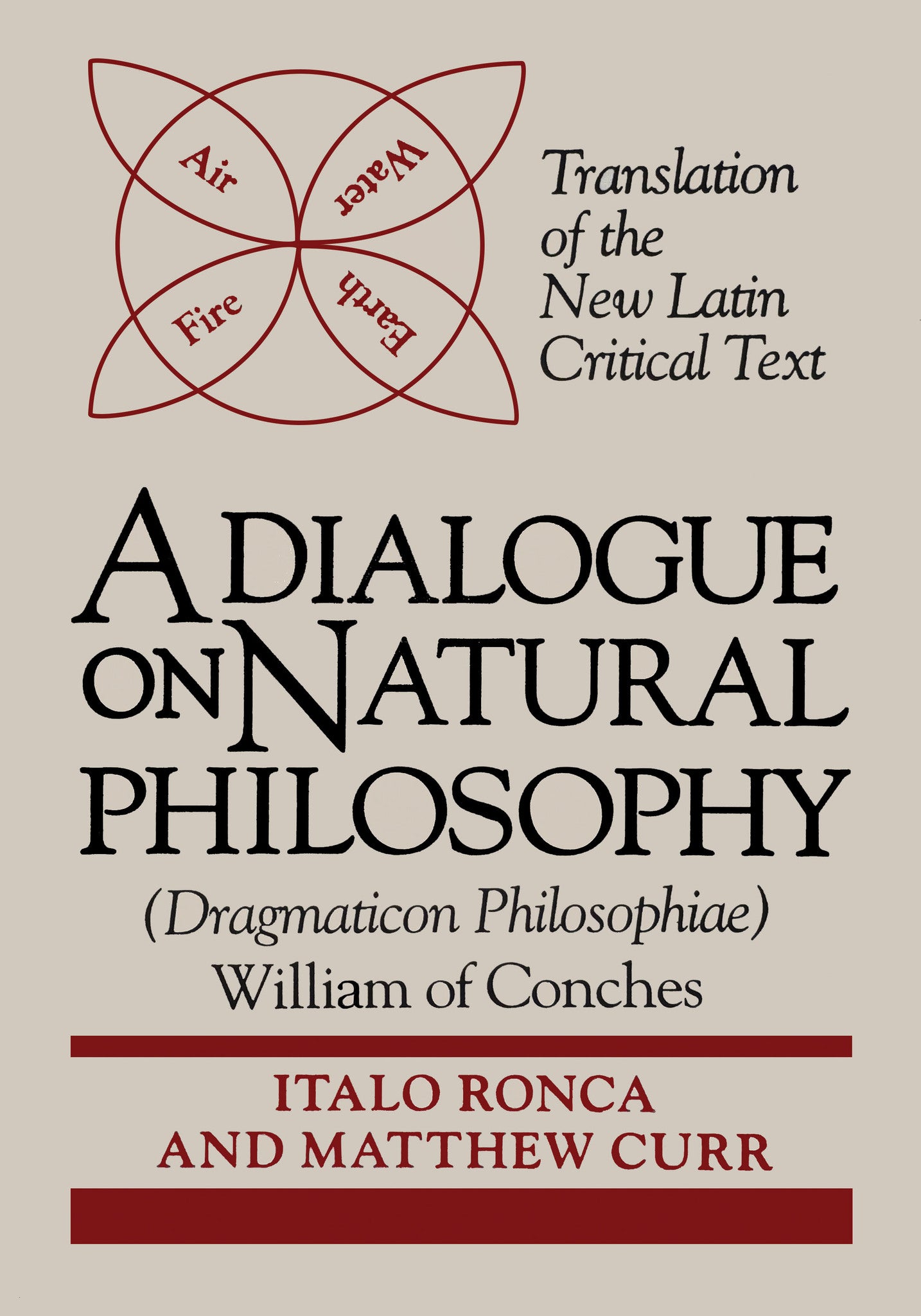
This long-awaited English translation of William of Conche’s Dragmaticon Philosophiae now makes available what is arguably the most original and systematic synthesis of western thought concerning the structure of the physical universe, as it was understood in the twelfth century.
The Dragmaticon represents the scientific thought of the philosopher of Conches (died ca. 1154). This major work deals with the structure of the known physical universe, starting from the 'macrocosm' (primeval chaos, stars, planets, atmospheric phenomena, the earth) and ending with the 'microcosm' (the human body, the four "humors" and related complexions, and the soul and its faculties).
The dialogue is divided into six parts, each corresponding to the six days of creation. It is purported to have taken place—in Platonic, Ciceronian, and Augustinian fashion—in six days at one of the castles of Geoffrey Plantagenet, Count of Anjou and Duke of Normandy (William's protector and father of King Henry II of England). The duke assumes the role of the questioner and sometimes that of the stern defensor fidei. William himself participates anonymously, answering all questions as a "philosopher without name" in order to circumvent the danger of being accused of heresy as he dares to explain the physical universe and its inherent order with arguments derived from reason and not from the church fathers or biblical authority.
William's text fills the scientific gap between late antiquity and Newton and has influenced the thought of countless writers and thinkers. Medievalists, theologians, and scholars working in the fields of philosophy and history of science will welcome this first-ever English translation of the Dragmaticon, especially for its systematic annotations and full references to doctrinal and literary sources.


"Until recently, this important text was only available in a garbled edition published by Gratarolo in 1567. Thanks to the Hurculean labours of Italo Ronca, we have now an edition which easily meets every scholarly standard." —Medium Ævum
"Ronca has performed a great service to his author, and to the study of twelfth century thought by making an important text, that deserves to be better known, available in an authoritative edition and a very serviceable translation." —International Journal of the Classical Tradition
William of Conches (1090–1154), historically sometimes anglicized as William Shelley, was a medieval Norman-French scholastic philosopher who sought to expand the bounds of Christian humanism by studying secular works of classical literature and fostering empirical science. He was a prominent Chartrain (member of the School of Chartres). John of Salisbury, a bishop of Chartres and former student of William's, refers to William as the most talented grammarian of the time, after his former teacher Bernard of Chartres.
Italo Ronca (1936-2013) was Emeritus Professor in Classics and Medieval Latin and Philosophy at two European universities.
Matthew Curr was Senior Lecturer in English at the University of South Africa.