


Some error occured while loading the Quick View. Please close the Quick View and try reloading the page.
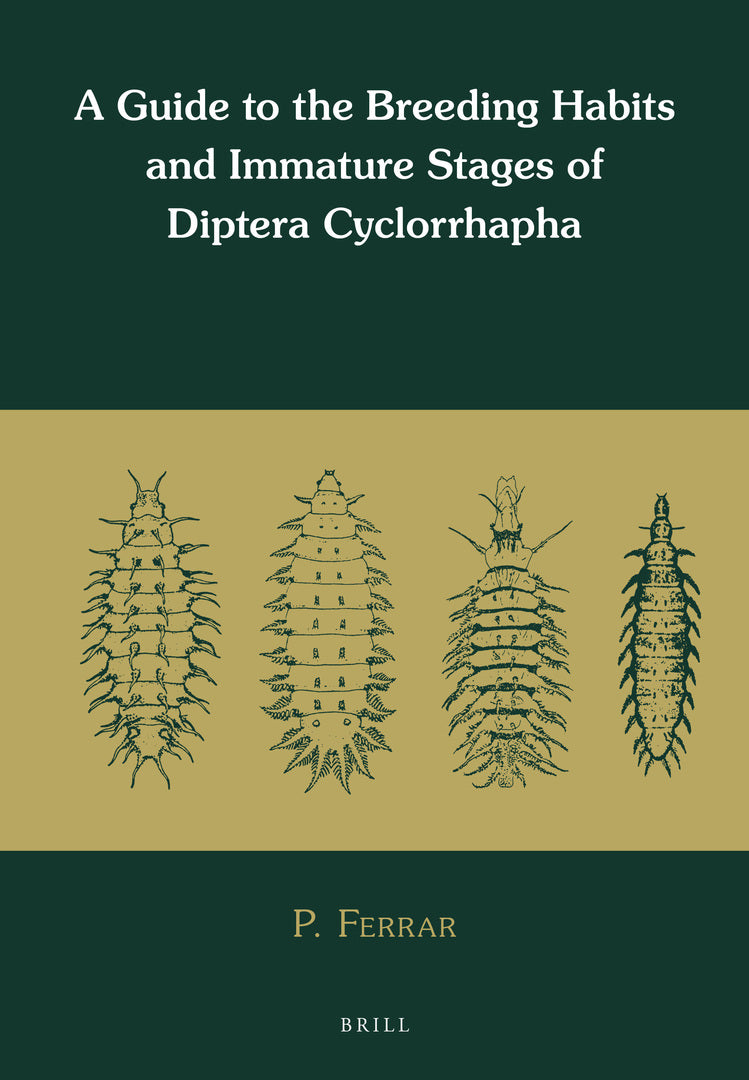
In A Guide to the Breeding Habits and Immature Stages of Diptera Cyclorrhapha P. Ferrar describes the wide variety of morphology and habits of cyclorrhaphous Diptera. The first volume contains all the text, the second contains detailed figures. With this paperback reprint this still relevant volume has been made available again.

Price: $389.00
Pages: 904
Publisher: Brill
Imprint: Brill
Publication Date:
17 July 2015
ISBN: 9789004299474
Format: Paperback

The work compiles the worldwide knowledge of the juvenile stages of Cyclorrhapha, available up to the copy deadline. The author refers to the three-volume treatment "Die Larvenformen der Dipteren" of W. Hennig (1948-1952) and makes use of the relevant publications of the following 35 years. The treatment of each family (in alphabetical order) follows a standardized order: 1. Scope and distribution. 2. Economic importance (benefit, harm). 3. Notes on literature. 4. Biology of the juvenile stages (mainly feeding and the belonging habitat), generally, and then regarding the several subfamilies, tribus and genera, additionally combined in tables. 5. Description of the morphology of eggs, larval instar I, II, II (habitus, anal segment and additional features, cephalopharyngeal skeleton, anterior and posterior spiracles) and of the pupa; partly the morphological features are also combined in tables. The introduction leads to general morphology and biology of juvenile Cyclorrhapha, followed by a larval key (III. instar) to the families. This key is updated by the key of Smith & Ferrar (2000). The key refers to more than 1100 figures (drawings) in part 2 of the work. The more than 4000 remaining figures belong to each family. The figures were taken from the literature; this iconography itself is unique; today, under the limiting copyright, it could hardly be realized. The publisher has to be thanked for the reprint, providing this plenty of information to the entomologists. Lauterbornia 80: 162, D-86424 Dinkelscherben, 2015-12-30 (Translated from German)