


Some error occured while loading the Quick View. Please close the Quick View and try reloading the page.
Featured on NPR's All Things Considered
“A fascinating exploration of the central role legumes have played in shaping civilizations and cultures throughout history.”—Julia Newberry, general manager of Rancho Gordo and co-author of the New York Times bestselling The Bean Book
From ancient empires to modern kitchens, discover how twelve humble beans have quietly changed the world in vast and unimaginable ways.
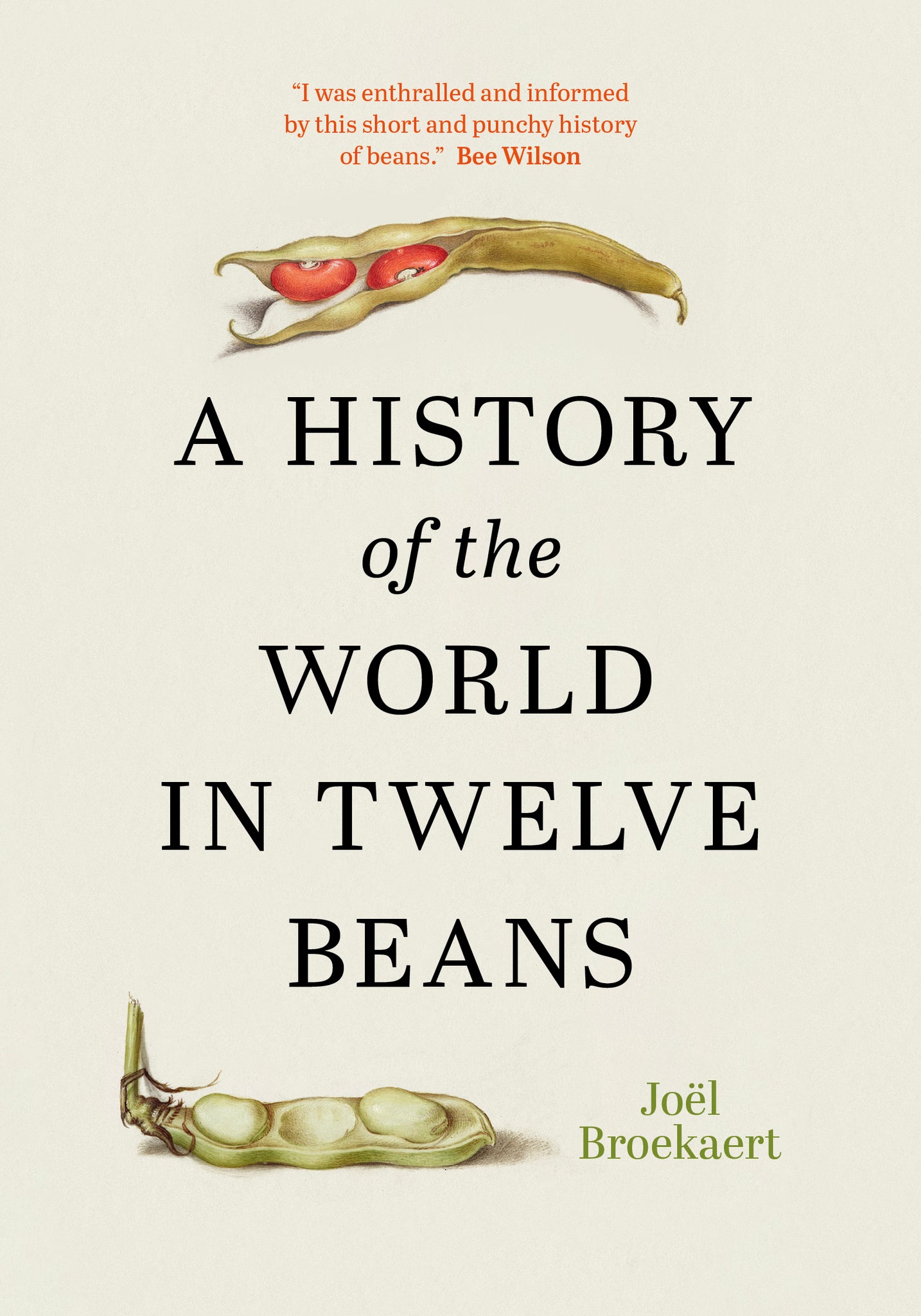
In A History of the World in Twelve Beans, food writer and history buff Joël Broekaert reveals how beans have profoundly shaped human history, culture, and society, through millennia and across continents.
Beans have been long dismissed as the “common person’s food”—a cheap and nutritious form of protein that replaces expensive meat—and are often the butt of jokes about flatulence (enough to make some Greek philosophers forbid their followers from eating them). But beans, as Broekaert shows, are surprisingly mighty. Fava beans helped pull medieval Europe out of the Dark Ages and fuel a population boom. While soy powered the Chinese empire, thanks to the culinary innovations that turned a nearly indigestible bean into delicious miso, soy sauce, and tofu.
The story of beans is also a story of colonialism, exploitation, and survival. The common bean, originating in the Americas and central to the diet of many Indigenous Peoples, crossed the Atlantic as part of the “Columbian exchange” of new foods—along with devastating diseases that decimated Indigenous populations. Cocoa and coffee beans became engines of colonial wealth, slavery, and revolution. Yet beans can also be a symbol of hope. Black-eyes peas, carried to the Americas with enslaved Africans, became a soul food staple and an emblem of Black emancipation. Today, beans are even being promoted as a solution to climate change and food insecurity, with high-tech meat substitutes made from lupin beans in the works.
Blending botany, anthropology, culture, economics, and environmental issues, A History of the World in Twelve Beans is a witty, surprising, and eye-opening tour of world history as told through legumes. As Broekaert shows, beans have not only shaped human civilization; they might be a key to a sustainable future, too.

Price: $22.95
Publisher: Greystone Books
Imprint: Greystone Books
Publication Date:
06 October 2026
ISBN: 9781778403552
Format: eBook
BISACs:
COOKING / History, Social & cultural history, HISTORY / Social History, SOCIAL SCIENCE / Agriculture & Food, NATURE / Cultural Botany, Agriculture, agribusiness & food production industries, Cultural studies: food & society, Cookery / food and drink / food writing / cookbooks

Featured on NPR's All Things Considered
“A History of the World in Twelve Beans is a fun, engaging read that will resonate with the Leguminati (as we affectionately call our customers) and anyone curious about the history of food and agriculture. It's a fascinating exploration of the central role legumes have played in shaping civilizations and cultures throughout history. I'll be keeping a copy on my bookshelf to revisit often.”
—Julia Newberry, general manager of Rancho Gordo and co-author of the New York Times bestselling The Bean Book
"Legume lovers will enjoy this informative ode to the unassuming food staple."
—Publishers Weekly
"Who knew that modern peas were ten times larger than their wild ancestor? Or that fava beans helped Europe survive the Dark Ages? I was enthralled and informed by this short and punchy history of beans which will open your eyes to some of the ways different beans have changed the course of history; and how they might again, in a future of climate change."
—Bee Wilson, author of The Secret of Cooking and The Heart-Shaped Tin
“A real page-turner packed with delightful, fascinating facts on all matters to do with beans of all shapes and sizes and their place in the story of civilization. Love ‘em or hate ‘em, after reading Joël’s book, you’ll understand just how amazing these simple seeds truly are.”
—Adam Alexander, author of The Seed Detective
“Overlooked, underappreciated, and often overcooked, the humble bean leaps to life in this fascinating history as Joël Broekaert spills the beans on the legume’s hidden role in two thousand years of wars, migrations, and conquests. A lively and entertaining read.”
—William Alexander, author of Ten Tomatoes That Changed the World
Joël Broekaert is a culinary journalist and restaurant critic, author, and television and podcast presenter with a background in history studies. He is the author of several books about food and a judge for the Dutch edition of Celebrity MasterChef. He lives in The Netherlands.
Michele Hutchison's translation work has won multiple prizes, including the International Booker. She was born in the UK, educated in the UK and France, and has lived in the Netherlands since 2004. Her translations for Greystone Books include Seaweed: An Enchanting Miscellany by Miek Zwamborn and Mushrooms And Company by Geert-Jan Roebers.
Introduction
1 The Pea and the Neolithic Revolution
2 Lentils and the Old Testament
3 The Fava Bean and Greek Philosophy
4 The Fava Bean and the Carolingian Renaissance
5 Soybeans and the Chinese Empire
6 The Common Bean and Pre-Columbian America
7 The Cocoa Bean and the Colonial Plantation Economy
8 Peanuts and the Dutch East Indies
9 The Coffee Bean and the Ideals of the Enlightenment
10 Canned Beans and the Industrial Revolution
11 The Black-Eyed Pea and Black American Emancipation
12 The Chickpea and the Most Contested Patch of Land on Earth
13 The Lupin Bean and the End Times
Acknowledgments
Notes
Selected Bibliography