


Some error occured while loading the Quick View. Please close the Quick View and try reloading the page.
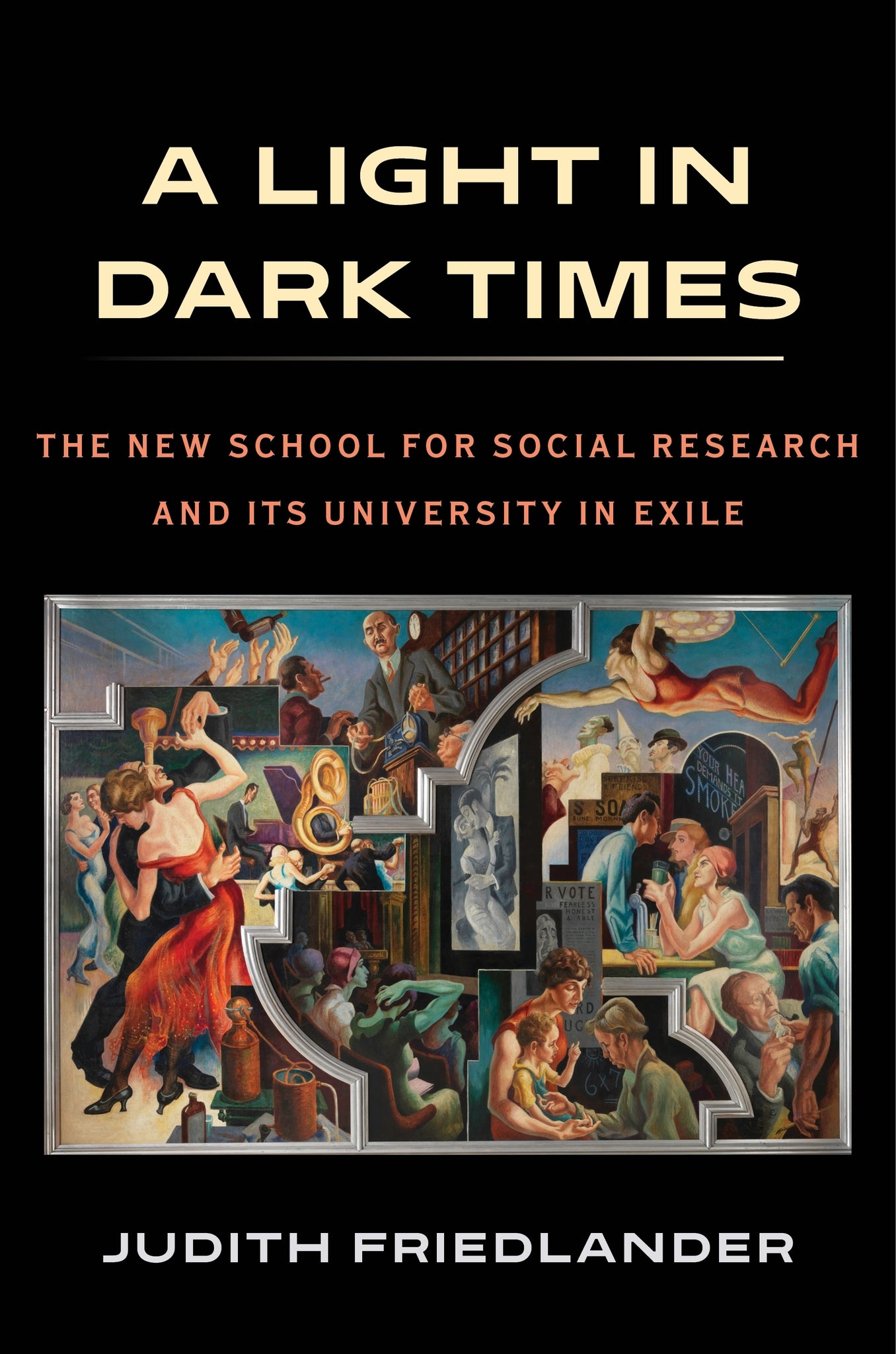
The New School for Social Research opened in 1919 as an act of protest. Founded in the name of academic freedom, it quickly emerged as a pioneer in adult education—providing what its first president, Alvin Johnson, liked to call “the continuing education of the educated.” By the mid-1920s, the New School had become the place to go to hear leading figures lecture on politics and the arts and recent developments in new fields of inquiry, such as anthropology and psychoanalysis. Then in 1933, after Hitler rose to power, Johnson created the University in Exile within the New School. Welcoming nearly two hundred refugees, Johnson, together with these exiled scholars, defiantly maintained the great traditions of Europe’s imperiled universities.
Judith Friedlander reconstructs the history of the New School in the context of ongoing debates over academic freedom and the role of education in liberal democracies. Against the backdrop of World War I and the first red scare, the rise of fascism and McCarthyism, the student uprisings during the Vietnam War and the downfall of communism in Eastern Europe, Friedlander tells a dramatic story of intellectual, political, and financial struggle through illuminating sketches of internationally renowned scholars and artists. These include, among others, Charles A. Beard, John Dewey, José Clemente Orozco, Robert Heilbroner, Hannah Arendt, and Ágnes Heller. Featured prominently as well are New School students, trustees, and academic leaders. As the New School prepares to celebrate its one-hundredth anniversary, A Light in Dark Times offers a timely reflection on the legacy of this unique institution, which has boldly defended dissident intellectuals and artists in the United States and overseas.


— Eva Hoffman, author of Exit Into History: A Journey Through the New Eastern Europe and Appassionata
Friedlander's book expertly reveals how the New School emerged and gracefully interlaces the institutional story with the lives of the individuals who fostered the school’s development. The work raises questions about the defense of academic freedom; the complexities of rescuing refugees from political and religious persecution; and the tensions of an institution that, on the one hand, adhered to principles of free intellectual exchanges and, on the other, relied on its faculty to recruit colleagues who promoted discordant issues and methods.
— Alice Kessler-Harris, R. Gordon Hoxie Professor Emerita of American History, Columbia University
Judith Friedlander’s A Light in Dark Times is a major, well-researched work which explores the emergence, evolution, and contribution of the New School as a catalyst of ideas. The book highlights the university’s role in educating generations of students, as well as serving as a home for noted scholars and intellectuals. Friedlander’s work does justice to the New School’s legacy and reminds us that throughout history ideas and ideals matter and that democracy and excellence are not mutually exclusive. This is a must-read.
— Vartan Gregorian, former president, Carnegie Corporation of New York
The New School bloomed over the course of the twentieth century into a resonant, influential cultural institution for both the city and the country, gathering for its faculty distinguished scholars, writers, and artists from all over the world. Judith Friedlander has written a compelling account of its origins, its struggles, its triumphs, and particularly the vital role it played in attracting German émigré professors seeking to escape the Nazis. A rich and textured history.
— Michael Rosenthal, author of Nicholas Miraculous: The Amazing Career of the Redoubtable Dr. Nicholas Murray Butler
Judith Friedlander’s history of the New School is at once deeply researched and a delight to read. She traces the New School’s growth and captures the intellectual, scholarly, and political motivations of the individuals who shaped it: the founders, John Dewey and Charles Beard, who saw higher education as linked to public life; its longtime president Alvin Johnson, who rescued scholars from Europe in the Nazi era; and Jonathan Fanton, who brought Eastern European scholars to the New School as communism collapsed. The book is also a story of institutional integrity and the advancement of scholarship and democracy. Her book, remarkable in its range and the liveliness of its prose, offers an outstanding history of a special institution.
— Thomas Bender, University Professor of the Humanities at New York University (emeritus)
Judith Friedlander’s engaging intellectual history of the New School. . . . [offers] us a portrait of how an institution takes shape, a vision for thinking about how universities can fail, and some ideas about how they might be renewed amid the chaos of our current moment. This work will surely be of interest to anyone who is committed to academic freedom and democratic education.
— Samantha Hill
Formidable in its endeavor and broad in its scope and marches with purpose.
[Friedlander] recounts the whole saga with well-chosen excerpts....punctuated by occasional anecdotes that convey the human side of some of the characters in this remarkable tale.
[An] excellent institutional history.
Prologue: In the Archives
Part I: A School of Social Research
1. The First Founding Moment
2. Alvin Johnson and The New Republic
3. Columbia University
4. The Idea Takes Shape
5. The New School Opens
6. Alvin Johnson Takes Over
Part II: The Universities in Exile
7. The Founding of the German University in Exile
8. The University in Exile Opens
9. Ring the Alarm
10. Ecole Libre des Hautes Etudes
Part III: The Middle Years
11. Alvin Johnson Retires
12. The Red Scare
13. The Orozco Mural
14. “The New School Really Isn’t News Any Longer”
15. “Save the School”
Part IV: “Between Past and Future”
16. The “New” New School
17. Three Doctoral Programs at Risk
Part V: Renewing the Legacy
18. Rebuilding the Graduate Faculty
19. Rekindling the Spirit
Epilogue: Extending the Legacy
Appendix A: Extended Notes and Commentary for Chapter 6
Appendix B: Extended Notes and Commentary for Chapter 7
Appendix C: Extended Notes and Commentary for Chapter 9
Appendix D: Extended Notes and Commentary for Chapter 18
Acknowledgments
Notes
Index