


Some error occured while loading the Quick View. Please close the Quick View and try reloading the page.
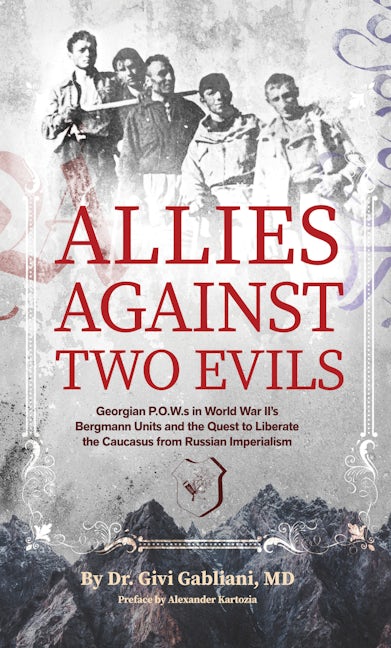
An eye-witness account of the Russian/European conflict at the heart of WWII, relevant today as war rages again along similar battle lines in Ukraine, Crimea and the Caucasus.
In a corner of 20th-century history almost unknown to the English-speaking public, anti-Stalinist Georgians and anti-Hitlerite Germans worked as an arm of the German Resistance, disavowing Hitler’s inhuman "East Policy" mandates and seeking to liberate Caucasian nations from Stalin. Allies Against Two Evils: Georgian P.O.W.s in WWII’s Bergmann Units and the Quest to Liberate the Caucasus from Russian Imperialism by exiled Georgian M.D. Givi Gabliani vividly recalls this time, the hopes of the Georgians who fought in World War II, their solidarity, their tribulations, their devotion to the Jewish people, and why they made the alliances they did.
Gabliani's memoir, written in English and published several years ago in Georgia, contrasts the vision of an ascendant Russian Empire and a decaying West with historical European-Georgian cooperation and the centuries-long quest of the Georgian people for self-determination.
The preface by Georgian-German scholar and former head of the Georgian National Library, Alexander Kartozia examines the legacy of Givi Gabliani and the Gabliani family from the highland province of Svaneti, keepers of 12th century artifacts from Georgia's Golden Age and leaders of the 1920s resistance insurgency against Soviet invasion.
Gabliani envisions a future Europe supporting a trans-Caucasian alliance with mixed races and religions living together equally in tolerance and prosperous harmony, as they had for millennia in Georgia. As a spokesman for the POWs, he coordinates with the Georgian exile government in occupied Paris and Berlin, finding a secret effort afoot in occupied France to save Georgian and other Eastern European Jews. Today, Gabliani's war memoir centers our attention on an active fault line. Across the great conflicts of the twentieth century that undergird and still define the region between Russia, with its imperialist ambitions, and the Black Sea, Georgia and the Georgian people appear as some of the most likely partners for international efforts toward peace.


“In 1921, the Soviets occupied Georgia by force. Givi Gabliani naturally opposed Soviet imperialistic and criminal rule. The German Resistance wanted — after the overthrow of Hitler — to liberate the different nations in the Soviet Union from Soviet dictatorship. Therefore, Givi Gabliani as a prisoner of war in 1941 decided to cooperate with the German Resistance. In 1942, he joined a Caucasian volunteer unit which was formed by Admiral Canaris, a leading member of the German Resistance executed in 1945. In 1943, Gabliani became a member of the Georgian liaison mission, which represented also the Georgian exile government in Paris. The Georgian liaison mission worked closely together with the German Resistance, especially with Colonel Count Stauffenberg and Ambassador von der Schulenburg, who both were the fathers of the Soviet volunteer [forces] in the German Army. The Bergmann military unit was created in 1941, composed of Georgian emigrants to the West as well as those who had stayed in their home country [and were conscripted to fight with the Red Army]. Givi Gabliani, in the frame of the Bergmann unit, and later as a member of the Georgian-National Committee had an important role in this period. His memoirs offer a rich source pertaining to German-Georgian history.”
— Hans von Herwarth, Former German Ambassador to Britain, January 18, 1988.
Dr. Givi Gabliani (1915–2001) was a general surgeon who practiced medicine for over 35 years in Quincy, Illinois. Gabliani came to the United States in 1950 and remained here in exile due to the fact his father Egnate Gabliani, governor of the Svaneti mountain region, was a resistance leader and political prisoner killed in Stalin's purges in the 1930s. Gabliani wrote his memoir in the optimism of the early 1990s as the Soviet Union was collapsing, and it looks forward to a future world without a Russian oppressor in the Caucasus.
Alexander Kartozia, former Minister of Education of Georgia and director of the National Parliamentary Library, is a widely published scholar awarded with research prizes from Germany and Georgia. He received the "Order of Merit" from the Federal Republic of Germany in 2022. His research includes German-Georgian cultural exchange and Georgian culture, literature, and language.
Hans-Heinrich Herwarth von Bittenfeld, also known as Johann von Herwarth, was a German diplomat in Moscow who provided the Allies with information prior to and during the Second World War. He revealed the secret pre-war pact made between Hitler and Stalin on how to divide Central Europe and continued to advise Western powers not to give in to Hitler's territorial demands. In 1955, Herwarth became the first post-war ambassador from Germany to London.
Preface to the Memoirs of Givi Gabliani
by Alexander Kartozia vii
Foreword by the author 1
Leaving Georgia for Russia 5
Entrance into World War II 33
A German P.O.W. Outside Prison Camp 36
Transfer to Germany 47
In the Bergmann Unit and Caucasus 77
Plot in Bergmann 112
To the Ukraine and Caucasus 131
Patriots and Defectors 146
In Crimea 171
Leaving Crimea for Germany; The Dresden Military School 188
The Georgian Liaison Staff—A Mission 204
In France and Holland 222
Report on the Three Bergmann Battalions 248
March–July 1944 264
Saving the Georgian Legionnaires 282
End of War 297
Displaced Persons 320
From Germany to America 335
Afterword by Gregory Gabliani 347
Appendices
Hans von Herwarth’s Introduction and Affidavit 353
The Brest-Litovsk Treaty 356
German Georgian Friendship Speech upon German Withdrawal in WW I 359
The Red Army Offensive in November 1942 362
Grigol (Grisha) Alshibaja 363
Kale Salia and The Georgian Destiny 367
Alexandre Manvelishvili 369
Alexandre Nikuradze 372
General Giorgi Kvinitadze 376
The Plot in “Bergmann” 378
Documents from the Author’s Archive 385
Maps 412
Photographs 417
Supporting Literature 431
Index 435