


Some error occured while loading the Quick View. Please close the Quick View and try reloading the page.
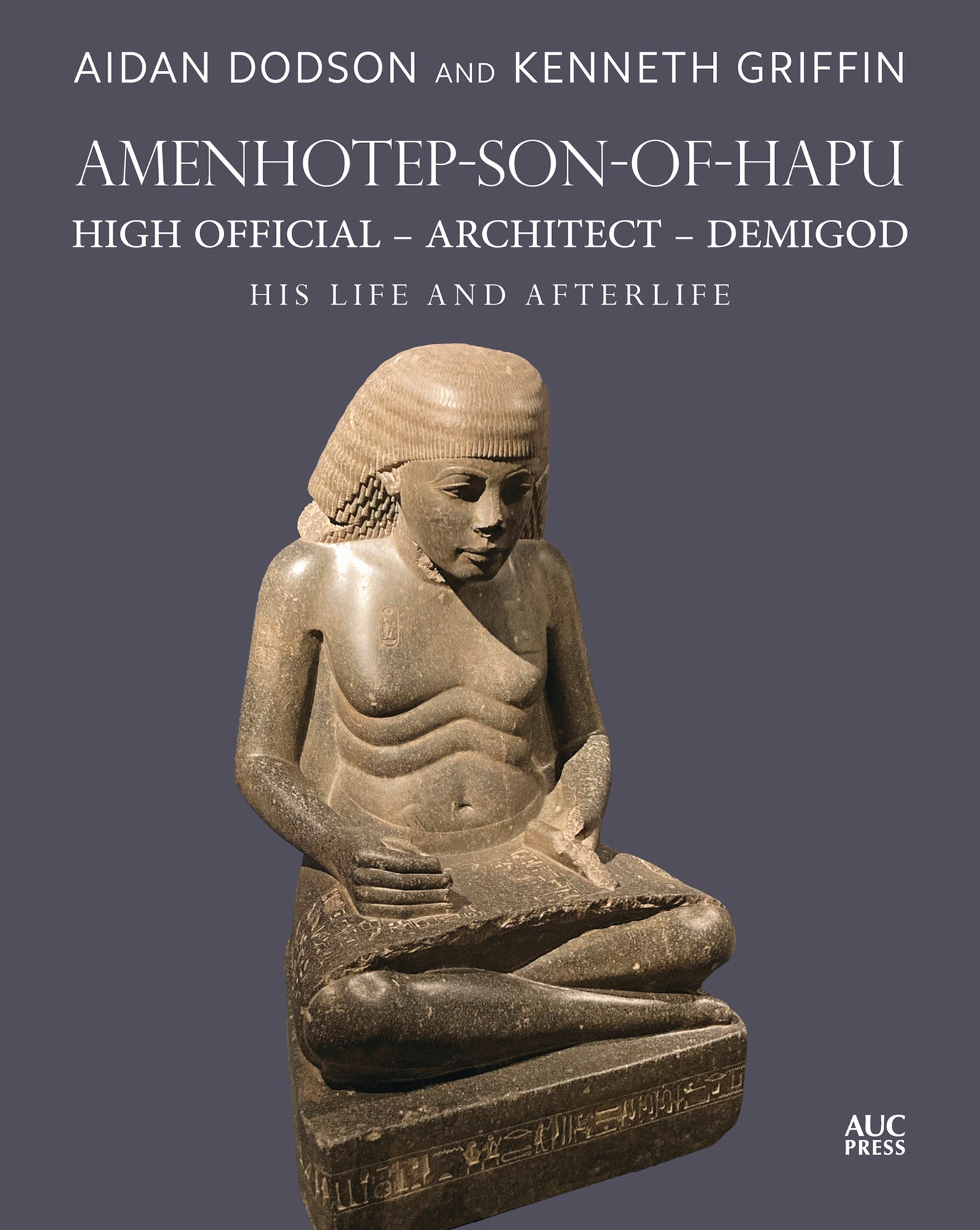
A compelling account of a unique New Kingdom figure, from his early life to the pinnacle of his power under Amenhotep III to his manifestation as a cult figure
Amenhotep-son-of-Hapu was one of the most remarkable non-royal figures in Egyptian history. In life, he was an official of Amenhotep III, of exceptional prominence, but apparently modest origins. Holding a vast array of titles, he was responsible for the management of the king’s principal works, and was honored with numerous statues and a unique mortuary temple in royal style. Then, a millennium after his death, we find him elevated to divine status, in conjunction with an even more ancient royal builder, Imhotep of the Third Dynasty. As such, he appears in temples around Thebes, even having a a colossal statue erected for his cult in front of the great temple at Karnak.
This is the first full-length book in English dedicated to him. It begins with an overview of the fourteenth century BC reign of Amenhotep III, during which the known events of Amenhotep-son-of-Hapu’s life took place. It then investigates what we know of Amenhotep-son-of-Hapu’s background, and reviews the material surviving from his lifetime to reconstruct his activities.
Also described are the funerary arrangements of Amenhotep-son-of-Hapu, in the context of contemporary practice, underlining how these were far more elaborate than those of any other official, and approaching royal standards. The authors then jump forward to the second century BC to explore how the cult of Amenhotep-son-of-Hapu was manifested, and the various monuments that were decorated in his honor. The final chapter describes the rediscovery of Amenhotep-son-of-Hapu and his monuments by modern scholarship.


“Pulling together evidence from largely vanished monuments, Dodson and Griffin offer readers a compelling glimpse into the life of Amenhotep-son-of-Hapu, the consummate scribe and chief of works under the mighty pharaoh Amenhotep III, grandfather of Tutankhamun.”—Stephen Harvey, Ahmose and Tetisheri Project, Abydos
“Dodson’s and Griffin’s remarkable study of one of ancient Egypt’s most fascinating personalities combines textual evidence, archaeology, and historical interpretation to reveal how Amenhotep-son-of-Hapu rose from provincial origins to become a trusted royal adviser, master architect, and a figure of religious devotion. This is a compelling and important contribution to our understanding of New Kingdom Egyptian society beyond the pharaohs.”—Troy Sagrillo, Swansea University
“Amongst the extraordinary people who inhabited the landscape of ancient Egypt, Amenhotep-son-of-Hapu is perhaps one of the most unusual: a bureaucrat, architect, and visionary, who became a sage, revered for centuries after his death. This richly illustrated and accessibly written book, using visual and textual evidence, outlines Amenhotep-son-of-Hapu’s career under King Amenhotep III and explores how he became a popular cult figure, possibly even outstripping the popularity of his royal master through the ages. A must-read for anyone interested in the creation of cult figures and the reign of Egypt’s Sun King, Amenhotep III.”—Salima Ikram, The American University in Cairo
“A fascinating biography of a unique individual, his remarkable accomplishments, and the cult which grew up around him after his death. Detailed and well-documented throughout. Highly recommended.”—Eric Cline, The George Washington University
PRAISE FOR THE LIVES AND AFTERLIVES SERIES:
"A wonderfully illustrated and detailed history."—Kara Cooney, author of Recycling for Death
"[C]omprehensive knowledge and exacting analysis."—Campbell Price, University of Manchester
"Comprehensive, well-written, and profusely illustrated . . . . Recommended"—CHOICE
"[An] objective and well-balanced summation."—Morris Bierbrier, Egyptian Archaeology
“Lavishly illustrated throughout.”—David Aston, Austrian Academy of Sciences
Aidan Dodson is honorary full professor of Egyptology in the Department of Anthropology and Archaeology at the University of Bristol, UK. He was also Simpson Professor of Egyptology at the American University in Cairo in 2013, and Chair of the Egypt Exploration Society during 2011–16. Awarded his PhD by the University of Cambridge in 2003, he was elected a Fellow of the Society of Antiquaries of London in 2003. He is the author of some thirty books, eight in the “Lives and Afterlives” series, including histories of Nefertiti, Tutankhamun, the first pharaohs, Thutmose III and Hatshepsut, and more.
Kenneth Griffin is curator of the Egypt Centre at Swansea University, UK. Prior to this role, he held the position of collections access manager at the same museum. He is the author of “All the Rḫyt-people Adore”: The Role of the Rekhyt-people in Egyptian Religion (2018). A frequent visitor to Egypt he has, since 2010, actively participated in archaeological fieldwork in both Egypt and Sudan.
Preface
Abbreviations and conventions
Introduction
1. Living in a Golden Age
2. Amenhotep-son-of-Hapu: High Official and Architect
3. Houses of Eternity
4. Amenhotep-son-of-Hapu: Demigod
5. Limbo to Resurrection
Appendices
Chronology of Ancient Egypt
Notes
Bibliography
Sources of Images
Index