


Some error occured while loading the Quick View. Please close the Quick View and try reloading the page.
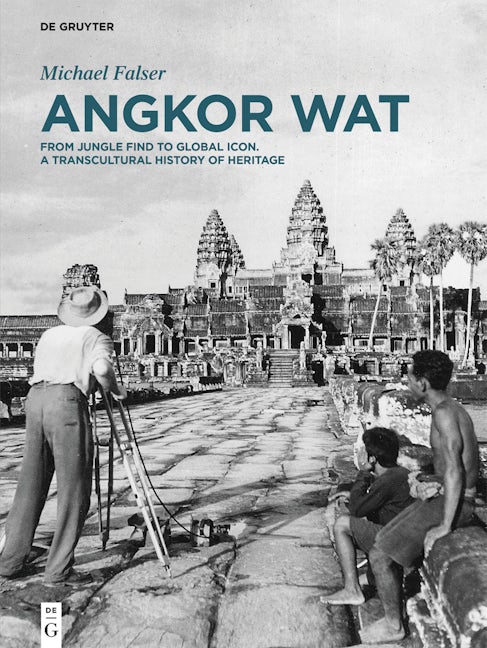
This book unravels the formation of the modern concept of cultural heritage by charting its colonial, postcolonial-nationalist and global trajectories. By bringing to light many unresearched dimensions of the twelfth-century Cambodian temple of Angkor Wat during its modern history, the study argues for a conceptual, connected history that unfolded within the transcultural interstices of European and Asian projects. With more than 1,400 black-and-white and colour illustrations of historic photographs, architectural plans and samples of public media, the monograph discusses the multiple lives of Angkor Wat over a 150-year-long period from the 1860s to the 2010s.
Volume 1 (Angkor in France) reconceptualises the Orientalist, French-colonial ‘discovery’ of the temple in the nineteenth century and brings to light the manifold strategies at play in its physical representations as plaster cast substitutes in museums and as hybrid pavilions in universal and colonial exhibitions in Marseille and Paris from 1867 to 1937.
Volume 2 (Angkor in Cambodia) covers, for the first time in this depth, the various on-site restoration efforts inside the ‘Archaeological Park of Angkor’ from 1907 until 1970, and the temple’s gradual canonisation as a symbol of national identity during Cambodia’s troublesome decolonisation (1953–89), from independence to Khmer Rouge terror and Vietnamese occupation, and, finally, as a global icon of UNESCO World Heritage since 1992 until today.


"Michael Falser has produced a splendid and doubt-less never-to-be-rivaled study of Angkor, its history, characterand design, and place in the European imagination. [...] Falser’s work is a treasure trove of new information and alternative ways to interpret and decipher the astonishing remains of an ancient culture."
Prof. William Chapman, School of Architecture, The University of Hawaii at Manoa. Book Review, Journal of Cultural Heritage, 11.2020
https://doi.org/10.1016/j.culher.2020.10.003
"Michael Falser’s comparably massive two-volume study [is] a dauntingly detailed magnum opus. Drawing upon a wide spectrum of theoretical, historical, anthropological and archaeological literature, as well as extensive new archival material, Falser provides an exhaustive history not of the building itself, [...] but of its colonial and postcolonial afterlife. This work immediately becomes the definitive source on the subject."
Prof. Gauvin Alexander Bailey, Queen's University, Ontario/Canada. Book Review: Unmasking Angkor Wat - A French-made Invention of Tradition. Kunstchronik, 12.2020, 604-611
https://www.zikg.eu/forschung/publikationen/laufende-publikationen/kunstchronik/inhaltsverzeichnisse/pdf/heft-12_dezember-2020
"A feast for the eyes of general readers as well as specialists are the approximately 1,400 illustrations of historic prohotohgraphs, architectural plans and samples of public media, carefully selected from different national and private archives in France and Cambodia, interwoven with photographs taken by the author himself during fieldwork in 2010."
Phuong Phan, Helmholtz-Zentrum für Kulturtechnik, Berlin. Asian Review of Books, 5.2020
https://asianreviewofbooks.com/content/angkor-wat-a-transcultural-history-of-heritage-by-michael-falser/
"It is astonishing that the 150-year-long-story on how Angkor Wat gradually mutated into a truly global icon of cultural heritage was never systematically written down. It is this book that presents this story of the first time in all its depth"
Niem Chheng, The Phom Penh Post and SEAArch/Southeasia Archaeology, 5.2020
https://www.phnompenhpost.com/national/german-author-sheds-new-light-recent-history-angkor-wat
"Ce livre est non seulement une contribution magistrale à l’histoire contemporaine d’Angkor, mais sur un plan épistémologique plus général, il est aussi voué à devenir une référence importante dans l’étude des processus transculturels de patrimonialisation."
Bernard Formoso, Moussons - Recherche en sciences humaines sur l'Asie du Sud-Est 36/2020 279-281
https://doi.org/10.4000/moussons.6978