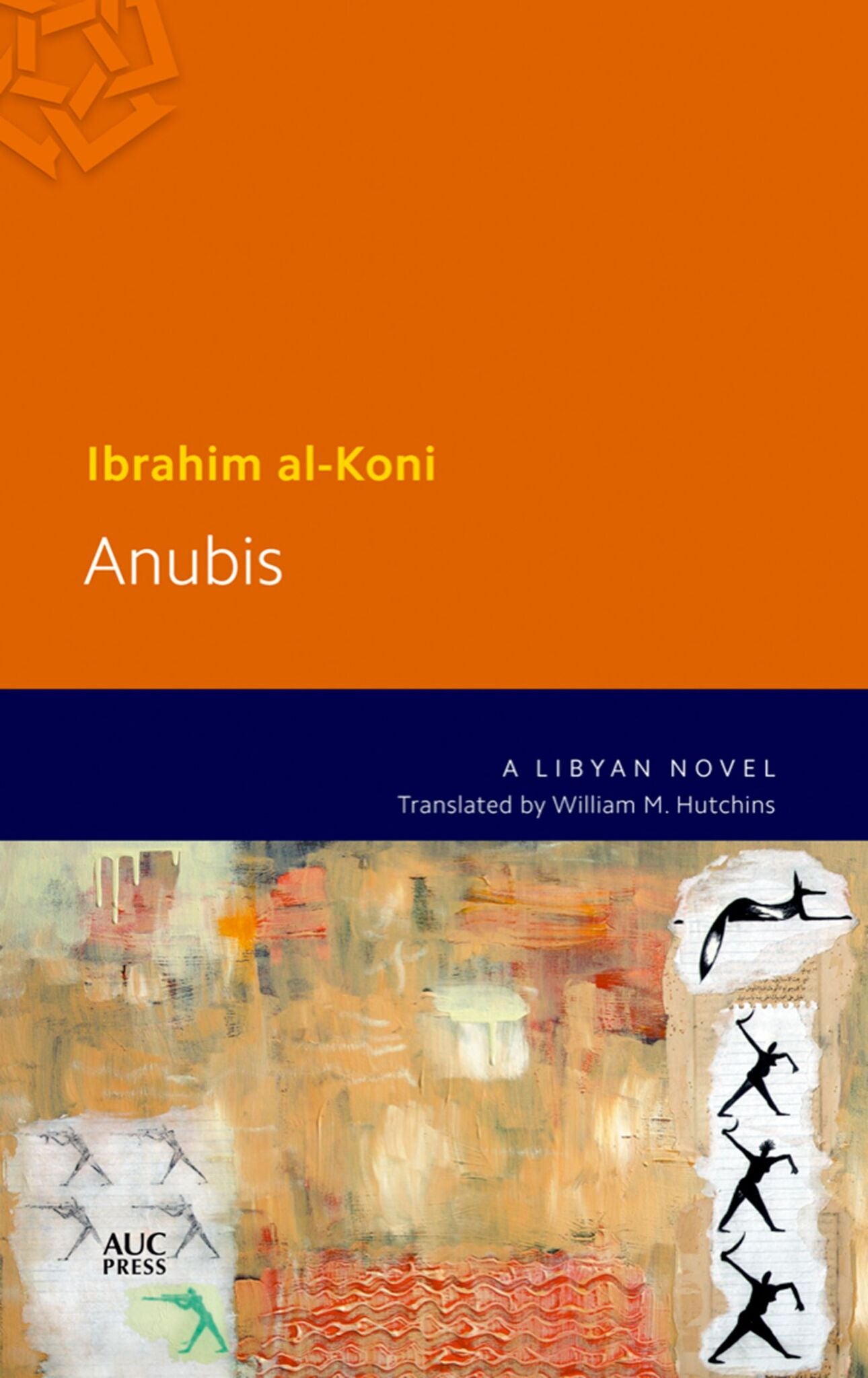
"A true journey into the human psyche."—Cairo Magazine
The tale of one man’s quest and survival in the Sahara Desert, set in the framework of Tuareg mythology
A Tuareg youth ventures into trackless desert on a life-threatening quest to find the father he remembers only as a shadow from his childhood, but the spirit world frustrates and tests his resolve. For a time, he is rewarded with the Eden of a lost oasis, but eventually, as new settlers crowd in, its destiny mimics the rise of human civilization. Over the sands and the years, the hero is pursued by a lover who matures into a sibyl-like priestess.
The Libyan Tuareg author Ibrahim al-Koni, who has earned a reputation as a major figure in Arabic literature with his many novels and collections of short stories, has used Tuareg folklore about Anubis, the ancient Egyptian god of the underworld, to craft a novel that is both a lyrical evocation of the desert’s beauty and a chilling narrative in which thirst, incest, patricide, animal metamorphosis, and human sacrifice are more than plot devices. The novel concludes with Tuareg sayings collected by the author in his search for the historical Anubis from matriarchs and sages during trips to Tuareg encampments, and from inscriptions in the ancient Tifinagh script in caves and on tattered manuscripts.
In this novel, fantastic mythology becomes universal, specific, and modern.
Price: $18.95
Pages: 208
Publisher: The American University in Cairo Press
Imprint: The American University in Cairo Press
Publication Date:
June 30, 2014
Trim Size: 8.00 X 5.00 in
ISBN: 9789774166365
Format: Paperback

"The novel has many levels, all attempting to unravel the complexities of obligation and customs that delineate how relationships are made between father and son, mother and son, then brother and sister, and man and woman, and how these relationships can prosper and endure with man living in a changing society. The desert setting is al-Koni's strength: its expanse, desolation and mystery is powerfully evoked. At once a personal story, the legend of a god-like mythical hero, a mystical tale of demons, dreams and metamorphosis, as well as a parable of human civilization."—BANIPAL
"A true journey into the human psyche."—Cairo Magazine
PRAISE FOR IBRAHIM AL-KONI
“A magnificent novelist”—Marilyn Booth, translator of the Man Booker International Prize Winner, Celestial Bodies
“One of the Arab world’s most innovative novelists”—Roger Allen, University of Pennsylvania
“Imagine Cormac McCarthy’s savage lyricism in a Paul Bowles desert landscape and you begin to enter the bleakly beautiful world of this mesmerizing, fable-like novel.”—The Independent
“Al-Koni's story, simply and elegantly told, has all the inevitability of a Greek tragedy—or, better, all the tribulations of Job.”—Kirkus Reviews
"Al-Koni's novels are aesthetic renderings of the passions of the desert and of the rich legends and cosmology of his people. An encyclopedic writer who has digested mythologies of the ancient world and literature of the modern world, al-Koni has both a poetic bent and a mystical inclination." —Ferial Ghazoul, Al Ahram Weekly
Ibrahim al-Koni was born in the northwest of the Sahara Desert in Libya in 1948 and learned to read and write Arabic at the age of twelve. He has been hailed a magical realist, a Sufi fabulist, and a poetic novelist, and his more than eighty books contain mythological elements, spiritual quests, and existential questions. His books have been translated into thirty-five languages and include Gold Dust, The Animist, The New Oasis, The Puppet, and many more. Among the many literary prizes to his name, he has been awarded the Sheikh Zayed Prize for Literature and was shortlisted for the International Booker Prize. He currently lives in Spain.
William M. Hutchins, professor in the Philosophy and Religion Department at Appalachian State University, is the translator of a number of works of Arabic fiction, including Fadhil al-Azzawi’s The Last of the Angels and Cell Block Five. He was awarded the 2013 Saif Ghobash Banipal Prize for Arabic Literary Translation for his translation of A Land without Jasmine by Wajdi al-Ahdal.