


Some error occured while loading the Quick View. Please close the Quick View and try reloading the page.
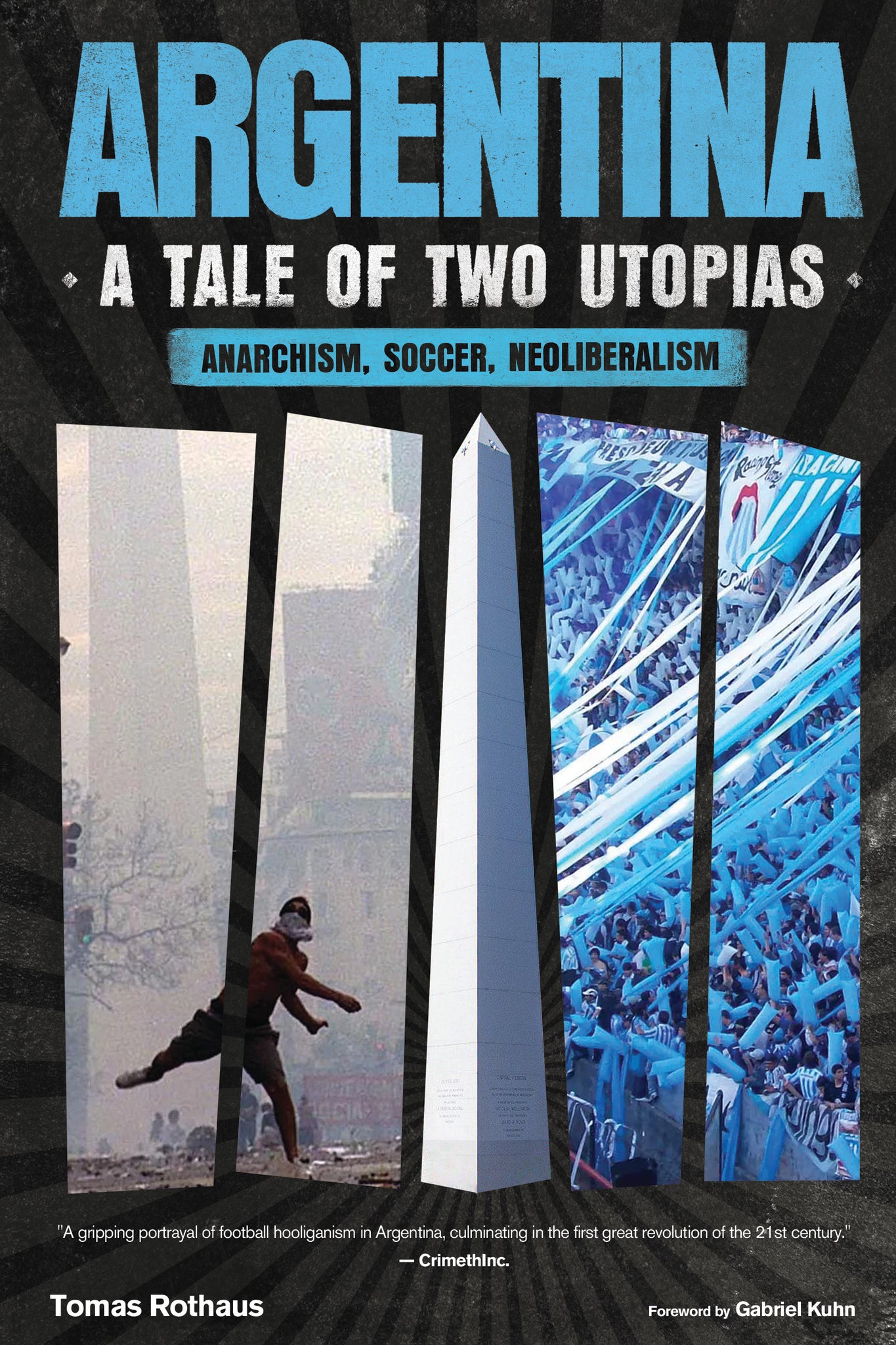
Argentina, a Tale of Two Utopias takes us through the outsized and unexpected remnants of the influence of anarchist ideas and practice on modern-day Argentina—from the names of popular pastries to the foundation of numerous soccer clubs—until we arrive at the explosive intersection of the two utopias of anarchism, football, against the crisis of neoliberalism.
This is a thrilling first-person account of the December 2001 uprising in Argentina that marked the end of the neoliberal experiment of the 1990s, narrated by an anarchist participant in the clashes that laid siege to the presidential palace and forced the president to resign and flee on a rooftop helicopter. A Tale of Two Utopias weaves together two simultaneous yet seemingly unrelated events of those “days which contain decades” of Buenos Aires in December 2001: the uprising and the first championship in 35 years of the popular football club Racing Club de Avellaneda.
Alternating between urgent narration and historical account, and accompanied by over 150 photos and illustrations, A Tale of Two Utopias leads the reader through the streets of a burning Buenos Aires while also finding the time to take us on a lovingly traced tour of the rich history of Argentina’s anarchist movement of the early twentieth century, then among the largest in the world. It is also a compelling account of the trauma inflicted by Argentina’s numerous dictatorships.


“Argentina, a Tale of Two Utopias weaves complicated histories of anarchism, football, resistance, and everyday life in Buenos Aires into an artful narrative of youthful exuberance and political turmoil. As opposition boils up again today in Argentina, this riveting snapshot of popular outrage from below presents readers with a fascinating point of inflection to connect general strikes and dreams of revolution, past and present.”
—Mark Bray, author of Antifa: The Anti-Fascist Handbook
“In this beautifully narrated book, Rothaus lovingly historicizes the development and violent suppression of anarchist movements, spaces, and traditions (from the names of pastries to storied prison breaks), the history of numerous football clubs and antifascist ultras who continue to keep those traditions alive, and the author’s own story of discovering radical politics. The histories of anarchist presses, social centers, and uprisings are told alongside the foundation of anarchist sports clubs like Club Atletico Libertad, El Porvenir, and (the GOAT) Diego Maradona’s first club Argentinos Juniors of La Paternal. From syndicalism to the touchline and back again.”
—Andreas Petrossiants, Stop Cop City United and coauthor of Diversity of Aesthetics
“A Tale of Two Utopias is a gripping, firsthand chronicle of resistance, rebellion, and the enduring influence of anarchist ideals in Argentina. Blending the fervor of urban battles with the collective, almost psychedelic, ecstasy of football triumph, this book unfurls the downtrodden radical history that shaped a nation’s struggles and dreams. With vivid storytelling and acerbic political insight, it offers a crucial lens on the 2001 uprising—an event that continues to echo in today’s fight against neoliberalism and its proto-fascist offspring. A must-read for anyone seeking to understand how the passions of the past inform the revolutions of the future.”
—Oli Mould, author of Against Creativity and Seven Ethics Against Capitalism
“Nothing excites stronger feelings than sports and politics. If you are passionate about one of them, read this book: it will help you understand why people are so passionate about the other."
—CrimethInc. Writers’ Bloc
“. . . A kind of ballet. When anarchists and socialists began to better understand football, they saw it as a collective effort to achieve victory. That’s what football was for me, art and socialist sport.”
—Osvaldo Bayer, author of La Patagonia Rebelde
“Emma Goldman said that if she couldn’t dance, it wouldn’t be her revolution. If we can’t play [soccer], then it also won’t be ours.”
—Autonomous Football Club, Sao Paulo, Brazil
“This book centers not only the history of the popular uprising against neoliberalism of 2001 from a revolutionary perspective, but also helps preserve the rich history of anarchism in Argentina, almost forgotten but once one of the world’s largest and most vibrant anarchist movements—and illustrates the unexpected and almost forgotten link between the anarchist movement and the nature of soccer clubs in Argentina today."
—Antifascist Action Buenos Aires
“Argentina serves a special place for the history anarchism, as well as fútbol (or soccer). Now, for the first time for English readers, we have a book that centers both in the same narrative. As those of us who lived and fought through the uprising that marked 2020 in the United States know, revolution is an unpredictable and mysterious creature, capable of appearing against the odds and then disappearing as quickly as it arrived. Fútbol in many ways is the same—the emotional roller coaster that takes hold of you as you follow your team through tournaments, good years and especially bad, can be taxing because we know the taste of victory and the extreme joy it brings. Tomas Rothaus has artfully crafted a narrative accounting of the volatile intersection of these two wild forces in Argentina: part memoir, part history, full-on immersing the reader in the streets of passion and violence in the pursuit of a better world. Rothaus understands the tensions that pull anarchists and anti-fascists away from the radical library and into the fútbol stadium, but also the radical compass that urges us to see those spaces used for liberation. Once you pick up this book, you won't put it down—until the final whistle.”
—1312 Press
1.December 27th, 2001. Early Afternoon. Amalfitani Stadium, Liniers, City of Buenos Aires. Racing Club vs Velez Sarsfield
2. Preface: The Twin Utopias
3. The Tides of Anarchy: The Anarchist Mass Movement of Late 19th Century Argentina
4. Villa Crespo, Buenos Aires. Sometime early 1997: Biblioteca Popular Jose Ingenieros
5. Villa Crespo, Buenos Aires. Saturday April 26th, 1997: “We’re Going to Kill Jews to Make Soap”
6. Villa Crespo, Buenos Aires. Saturday February 15th, 1997: Club Atletico Atlanta “El Barrio No Se Quiebra” (The Neighborhood Doesn’t Go Bankrupt)
7. An Unlikely Heritage: The Immigrant, Radical, and Anarchist Origins of Argentine Football Clubs
8. Racing Club de Avellaneda.“Solo Entiende Mi Locura Quien Comparte Mi Pasion” (“My Insanity can only be understood by those who share my passion”)
9. December 19th, 2001, 10am: Avellaneda, Greater Buenos Aires Region: The Golden Ticket
10. December 20th, 2001, 3am: Somewhere in Buenos Aires
11. While You Were Sleeping
12. December 20th, 2001: La Plaza es de las Madres (The Plaza Belongs to the Mothers)
13. December 20th, 2001: Congress, Approximately 12:30pm. The Long Shadow of the Past.
14. December 20th, 2001: Primera Junta (Roque Saenz Peña?!), Approximately 2:00pm. The Day of Revolution, Part 1: Rage: We Are The Children of Those You Killed
15. December 20th, 2001: Avenida Corrientes, Nightfall. The Day of Revolution, Part 2: At the Intersection of Life and Death
16. After the Fall
17. April 27th, 2003: The Kirchnerist Era
18. Villa Crespo, Buenos Aires. November 15th, 2018. Las Balas No Podrán Frenar el Viento (Bullets Can’t Stop the Wind)—Club Social y Deportivo la Cultura del Barrio
19. Epilogue: December 20th, 2022. 3pm. Downtown Buenos Aires: “No te lo Puedo Explicar, Porque no vas a Entender” (I can’t Explain, Because You Wouldn’t Understand)
20. Appendix: November 26th, 2023: Back to the Future: The Return of the Ultraliberal Right in Argentina
21. Appendix 2: June 17th, 2024: Six Months in a Neoliberal Dystopia: Social Cannibalism versus Mutual Aid in Argentina
Notes
Index