


Some error occured while loading the Quick View. Please close the Quick View and try reloading the page.
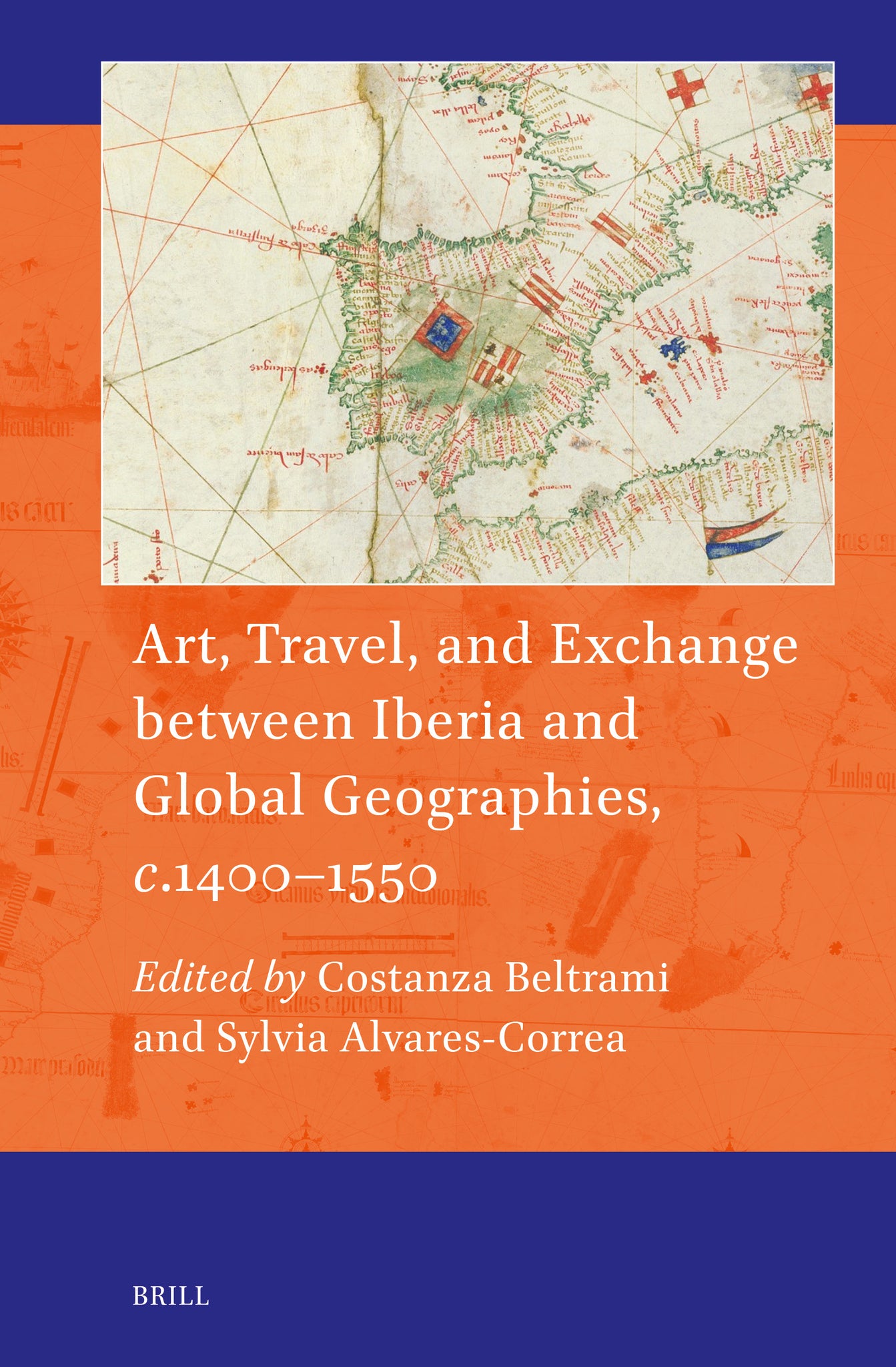
Traditional narratives hold that the art and architecture of the Iberian Peninsula in the late 15th century were transformed by the arrival of artists, objects, and ideas from northern Europe. The year 1492 has been interpreted as a radical rupture, marking the end of the Islamic presence on the peninsula, the beginning of global encounters, and the intensification of exchange between Iberia and Renaissance Italy.
This volume aims to nuance and challenge this narrative, considering the Spanish and Portuguese worlds in conjunction, and emphasising the multi-directional migrations of both objects and people to and from the peninsula. This long-marginalised region is recast as a ‘diffuse artistic centre’ in close contact with Europe and the wider world. The chapters interweave varied media, geographies, and approaches to create a rich tapestry held together by itinerant artworks, artists, and ideas.
Contributors are Luís Urbano Afonso, Sylvia Alvares-Correa, Vanessa Henriques Antunes, Piers Baker-Bates, Costanza Beltrami, António Candeias, Ana Cardoso, Maria L. Carvalho, Maria José Francisco, Bart Fransen, Alexandra Lauw, Marta Manso, Eva March, Encarna Montero Tortajada, Elena Paulino Montero, Fernando António Baptista Pereira, Joana Balsa de Pinho, María Sanz Julián, Steven Saverwyns, Marco Silvestri, Maria Vittoria Spissu, Sara Valadas, Céline Ventura Teixeira, Nelleke de Vries, and Armelle Weitz.
This volume aims to nuance and challenge this narrative, considering the Spanish and Portuguese worlds in conjunction, and emphasising the multi-directional migrations of both objects and people to and from the peninsula. This long-marginalised region is recast as a ‘diffuse artistic centre’ in close contact with Europe and the wider world. The chapters interweave varied media, geographies, and approaches to create a rich tapestry held together by itinerant artworks, artists, and ideas.
Contributors are Luís Urbano Afonso, Sylvia Alvares-Correa, Vanessa Henriques Antunes, Piers Baker-Bates, Costanza Beltrami, António Candeias, Ana Cardoso, Maria L. Carvalho, Maria José Francisco, Bart Fransen, Alexandra Lauw, Marta Manso, Eva March, Encarna Montero Tortajada, Elena Paulino Montero, Fernando António Baptista Pereira, Joana Balsa de Pinho, María Sanz Julián, Steven Saverwyns, Marco Silvestri, Maria Vittoria Spissu, Sara Valadas, Céline Ventura Teixeira, Nelleke de Vries, and Armelle Weitz.

Price: $165.00
Pages: 448
Publisher: Brill
Imprint: Brill
Series: Art and Material Culture in Medieval and Renaissance Europe
Publication Date:
19 December 2024
ISBN: 9789004547162
Format: Hardcover

“Taken as a whole, this volume represents a monumental undertaking in understanding the reach and connections that Iberia had during the fifteenth and sixteenth centuries. Considering the movement of artists first, then the movement of objects, and finally less traditional ways of thinking about and analyzing artistic exchange, the volume offers a thoughtful and well-researched exploration of artistic connections.”
Emily D. Kelley in The Medieval Review, 26.04.01 (https://scholarworks.iu.edu/journals/index.php/tmr/article/view/43221)
“The volume succeeds in its aim to transcend narratives confined to formalistic analysis. It does so by repositioning art historical inquiry within a broader global framework – prompting a reassessment of the discipline’s methods and a re-evaluation of its questions – that reflects Iberia’s role in the Early Modern world.”
Caterina Fioravanti in The Burlington Magazine 168:1476 (March 2026), pp. 283–284)
‘The editorial organization of the volume is another of its strengths. The chapters are thoughtfully grouped, and complementary essays work together to paint a complex portrait of artistic movement into and out of the Iberian world. Costanza Beltrami and Sylvia Alvares-Correa’s Introduction is excellent, bringing these diffuse studies together into a coherent whole. This volume is immediately accessible to scholars unfamiliar with scholarship on late-medieval Iberia, with succinct interrogations of many pressing historiographic concepts such as composite monarchies, polycentrism, and shifting definitions of Iberia. As one would hope in a book about art and exchange, the volume is beautifully illustrated and includes maps, and other images that help the reader to better understand the entangled geographies under discussion.”
Kai R. Werner in Terrae Incognitae: The Journal of the Society for the History of Discoveries (2025)
Emily D. Kelley in The Medieval Review, 26.04.01 (https://scholarworks.iu.edu/journals/index.php/tmr/article/view/43221)
“The volume succeeds in its aim to transcend narratives confined to formalistic analysis. It does so by repositioning art historical inquiry within a broader global framework – prompting a reassessment of the discipline’s methods and a re-evaluation of its questions – that reflects Iberia’s role in the Early Modern world.”
Caterina Fioravanti in The Burlington Magazine 168:1476 (March 2026), pp. 283–284)
‘The editorial organization of the volume is another of its strengths. The chapters are thoughtfully grouped, and complementary essays work together to paint a complex portrait of artistic movement into and out of the Iberian world. Costanza Beltrami and Sylvia Alvares-Correa’s Introduction is excellent, bringing these diffuse studies together into a coherent whole. This volume is immediately accessible to scholars unfamiliar with scholarship on late-medieval Iberia, with succinct interrogations of many pressing historiographic concepts such as composite monarchies, polycentrism, and shifting definitions of Iberia. As one would hope in a book about art and exchange, the volume is beautifully illustrated and includes maps, and other images that help the reader to better understand the entangled geographies under discussion.”
Kai R. Werner in Terrae Incognitae: The Journal of the Society for the History of Discoveries (2025)
Costanza Beltrami, Ph.D. (2020), Courtauld Institute of Art, is Senior Lecturer in Art History at the University of Stockholm. Her research focuses on gothic architecture in the late 15th and early 16th centuries. Recent publications include ‘Memory, Modernity, and Anachronism at the Convent of San Juan de Los Reyes, Toledo’, in Lateness and Modernity in Medieval Architecture, edited by Alice Isabella Sullivan and Kyle G. Sweeney (Brill, 2023).
Sylvia Alvares-Correa, Ph.D. (2023), University of Oxford, is Junior Research Fellow at Christ Church College, Oxford. Her research focuses on cultural exchange between the Netherlands and Portugal in the 15th and early 16th centuries. Recent publications include ‘Crusading in a Lisbon Convent: The Making and Meaning of The Passion of Christ in Jerusalem (Lisbon, ca. 1500)’, Journal of Historians of Netherlandish Art, 15/2 (2023).
Sylvia Alvares-Correa, Ph.D. (2023), University of Oxford, is Junior Research Fellow at Christ Church College, Oxford. Her research focuses on cultural exchange between the Netherlands and Portugal in the 15th and early 16th centuries. Recent publications include ‘Crusading in a Lisbon Convent: The Making and Meaning of The Passion of Christ in Jerusalem (Lisbon, ca. 1500)’, Journal of Historians of Netherlandish Art, 15/2 (2023).