


Some error occured while loading the Quick View. Please close the Quick View and try reloading the page.
CHOICE: OUTSTANDING ACADEMIC TITLE
A scholarly and thought-provoking work that places Jewish humor at the center of a discourse about Jewish and German relations through most of the twentieth century.
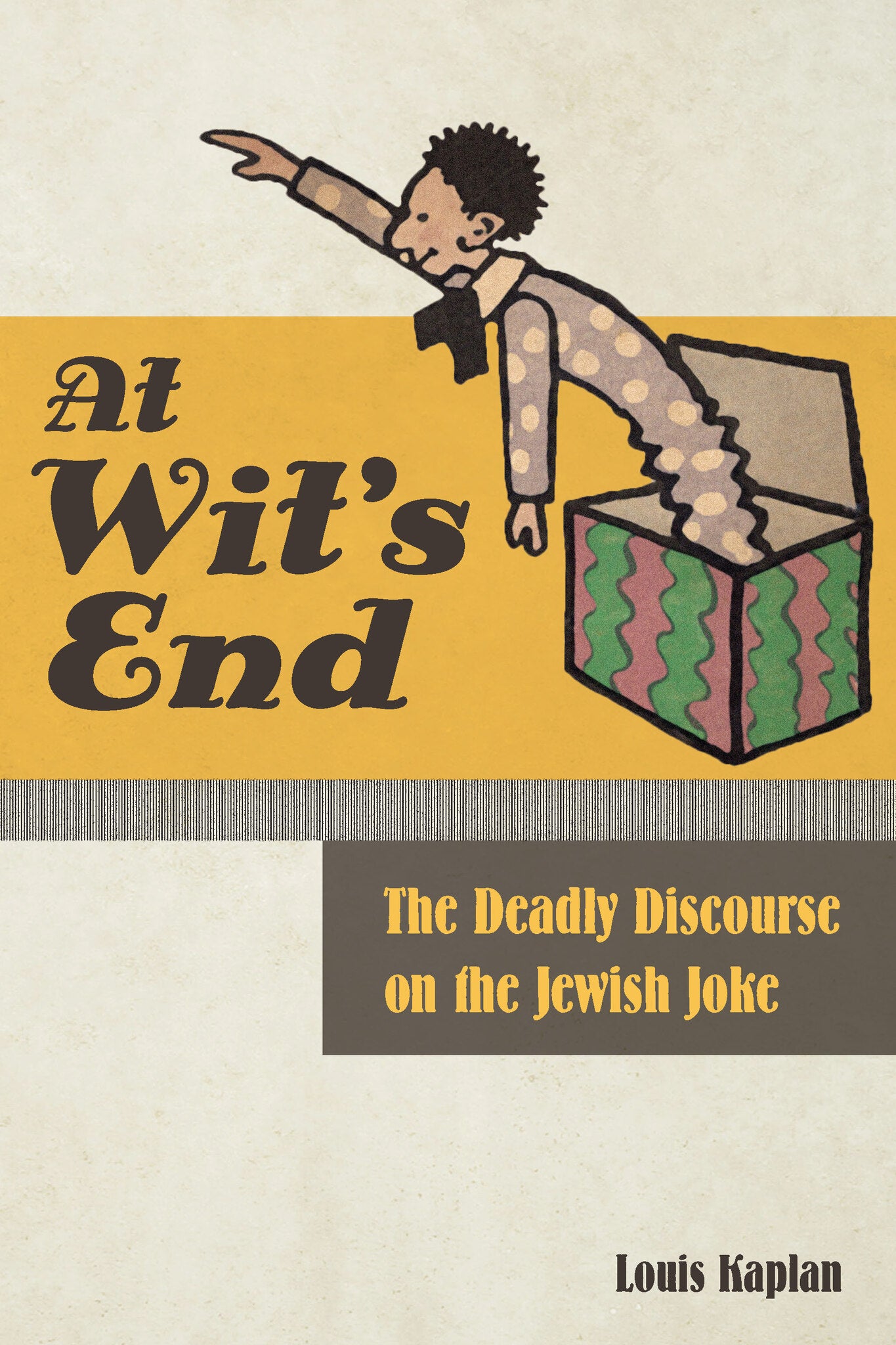
At Wit’s End explores the fascinating discourse on Jewish wit in the twentieth century when the Jewish joke became the subject of serious humanistic inquiry and inserted itself into the cultural and political debates among Germans and Jews against the ideologically charged backdrop of anti-Semitism, the Jewish question, and the Holocaust.
The first in-depth study to explore the Jewish joke as a crucial rhetorical figure in larger cultural debates in Germany, author Louis Kaplan presents an engrossing and lucid work of scholarship that examines how “der jüdische Witz” (referring to both Jewish wit and jokes) was utilized differently in a number of texts, from the Weimar Republic to the rise of National Socialism, and how it was re-introduced into the public sphere after the Holocaust with the controversial publication of Salcia Landmann’s collection of Jewish jokes in the reparations era (Wiedergutmachung). Kaplan reviews the claims made about the Jewish joke and its provocative laughter by notable writers from a variety of ideological perspectives, demonstrating how their reflections on this complex cultural trope enable a better understanding of German–Jewish intercultural relations and their eventual breakdown in the Third Reich. He also illustrates how selfcritical and self-ironic Jewish Witz maintained a fraught and ambivalent relationship with anti-Semitism.
In reviewing this critical and traumatic moment in modern German–Jewish history through the deadly discourse on the Jewish joke, At Wit’s End includes chapters on the virulent Austrian anti-Semitic racial theorist Arthur Trebitsch, the Nazi racial propagandist Siegfried Kadner, the German Marxist cultural historian Eduard Fuchs, the Jewish diasporic historian Erich Kahler, and the Jewish cabaret impresario Kurt Robitschek, among others. Shedding new light on anti-Semitism and on the Jewish question leading up to the Holocaust, At Wit’s End provides readers with a unique perspective by which to gain important insights about this crucial historical period that reverberates into the present day, when potentially offensive humor coupled with a toxic political climate and xenophobia can have deadly consequences.


With insight and incisiveness, a steady hand and a clear eye, Kaplan navigates through the most treacherous of comedic waters - the role of the Jewish joke in Germany through much of the twentieth century and beyond. Jokes have sharp and manifold edges, and Kaplan is a clear and brilliant guide to explaining how they bite as well as bind.---Jeremy Dauber, author, Jewish Comedy: A Serious History
Not a book about Jewish jokes but rather a metacritcal analysis of the discourse on Jewish humor in Germany in
the first half of the 20th century, this insightful and incisive volume ultimately explores the link between Jewish
self-irony and its appropriation in anti-Semitic humor... Highly recommended.
At Wit’s End is valuable reading for any scholar interested in a sophisticated approach to the subject of how the various manifestations of Jewish/ethnic humor can become part of destructive rhetoric.
Kaplan’s book proves that not only are there still new things to be written about Jewish humor, but also that “Jewish humor” as a topic defies easy classification within a specific field or discipline.
In this insightful book, Louis Kaplan shows how important it is to take seriously what societies think about humour... By unpacking essentialising appropriations that denied the inherently unstable character of identity projections, Kaplan impressively shows how the toxic misuse of Jewish wit as a key concept reflected the desire to determine Jewish identity.
. . . [A] fascinating and challenging book. . .
All told, At Wit’s End is a model of cultural history—an original, sophisticated, and often scintillating contribution from an oblique angle to our comprehension of non-Jews’ contorted rationale prior to and under Nazism for expelling Jews from, to borrow from Helen Fein, German (and Austrian) society’s ‘universe of obligation.’
Introduction: The Joke and Its Questions | 1
1 Secondary Moves: Arthur Trebitsch and the Jewish Joke | 24
2 Of Caricatures, Jokes, and Anti- Semitism: The Case of Eduard Fuchs | 60
3 Of Watchmen and Comedians: Jewish Jokes and Free Speech in Weimar Germany | 95
4 “Far from where?”: Erich Kahler and the Jewish Joke of Exile | 119
5 Of Jokes and Propaganda: The Mobilization of the Jewish Joke in the Nazi Era | 153
6 Jewish Joke Reparations and Mourning in Post- Holocaust Germany | 182
Conclusion: Final Thoughts and Last Laughs | 219
Afterword: The Jewish Joke in Trump’s America | 224
Acknowledgments | 231
Notes | 235
Index | 299