


Some error occured while loading the Quick View. Please close the Quick View and try reloading the page.
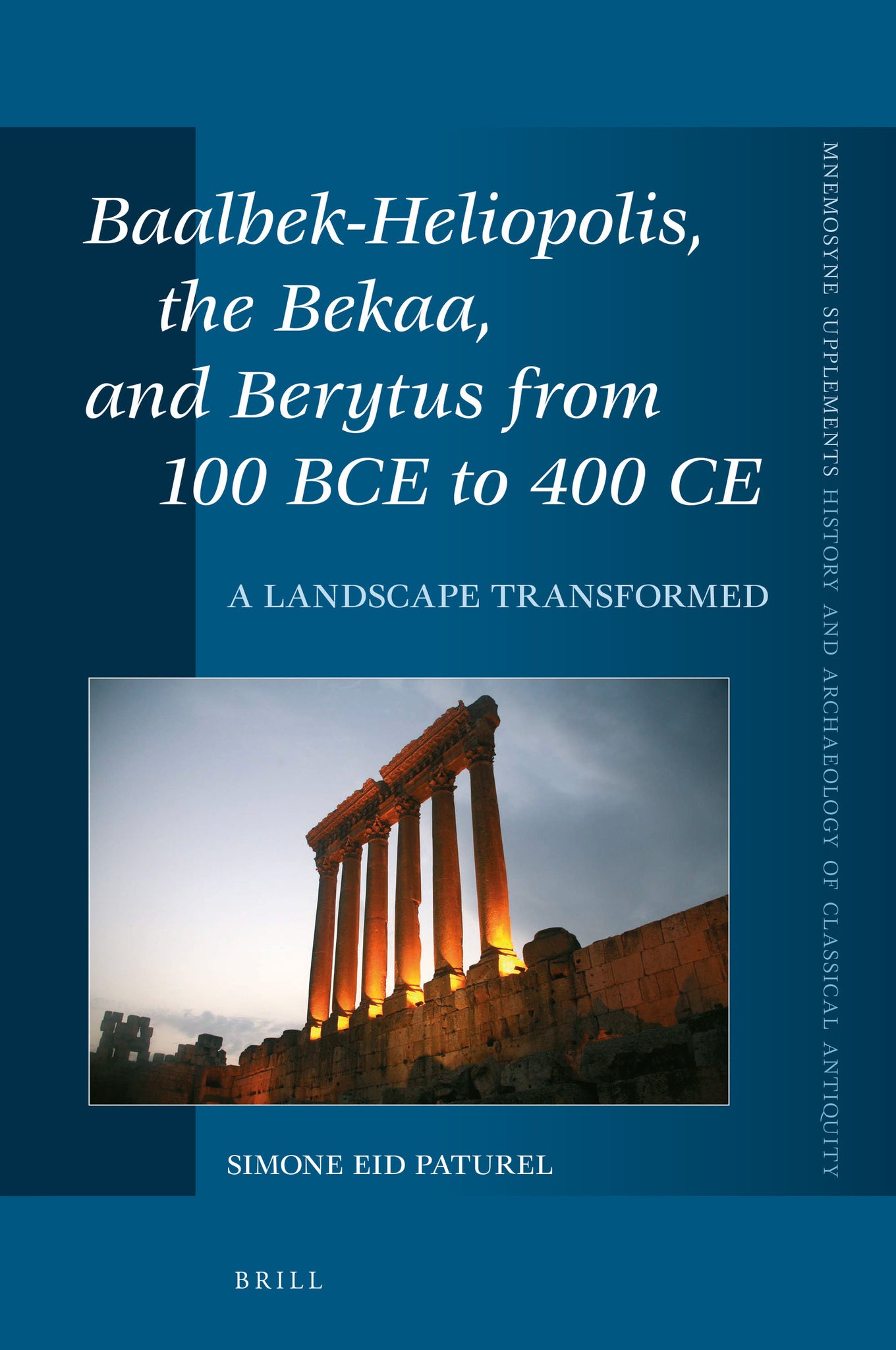
The aim of this monograph is to understand the extent to which the landscape of Roman Berytus and the Bekaa valley is a product of colonial transformation following the foundation of Colonia Iulia Augusta Felix Berytus in 15 BCE. The book explores the changes observed in the cities of Berytus and Heliopolis, as well as the sites at Deir el-Qalaa, Niha, and Hosn Niha. The work fundamentally challenges the traditional paradigm, where Baalbek-Heliopolis is seen as a religious site dating from as early as the Bronze Age and associated with the worship of a Semitic or Phoenician deity triad and replaces it with a new perspective where religious activity is largely a product of colonial change.

Price: $232.00
Pages: 343
Publisher: Brill
Imprint: Brill
Publication Date:
11 July 2019
ISBN: 9789004400580
Format: Hardcover

'To sum up, the book provides a very useful overview of the history of Roman Berytus including the Bekaa valley, which before could only be gained by extensive reading of the scattered literature. (...) Thus, the book is highly recommended for every scholar interested in the late Hellenistic and Roman Levant." - Winfried Held, Philipps-Universität Marburg, Archäologisches Seminar, in: Bryn Mawr Classical Review 2020.11.35
Simone Eid Paturel studied Spanish and Latin American literature at Paris-Sorbonne University, Egyptology at the Institut Kheops in Paris, History and Archaeology (BA) and Philosophy (MA) at the University of London. She completed her PhD in 2014 at the University of Newcastle. Her research is focused on the landscape archaeology of the ancient city of Baalbek-Heliopolis and its environs from 100 BCE to 400 CE.