


Some error occured while loading the Quick View. Please close the Quick View and try reloading the page.
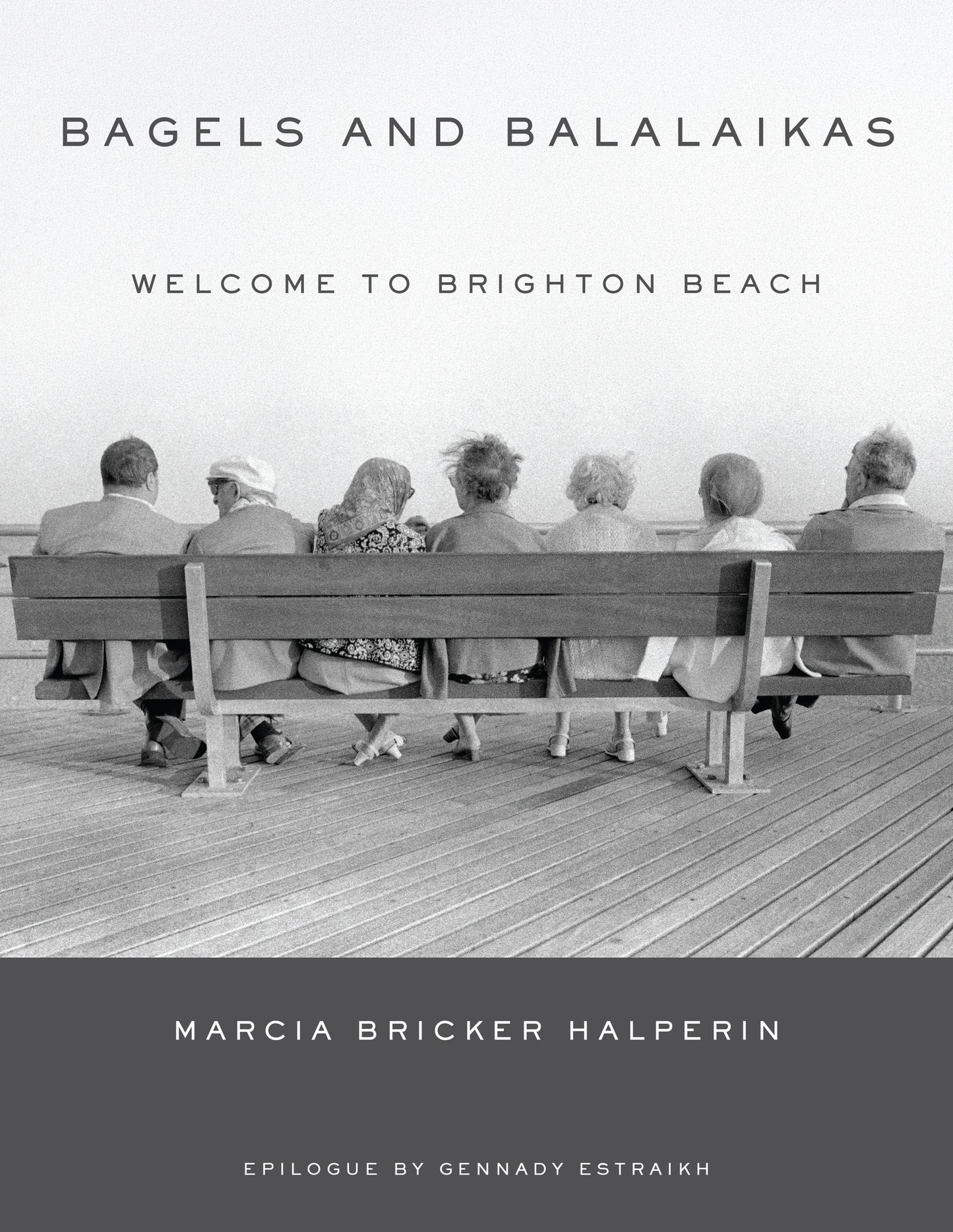
A vivid photographic portrait of Brighton Beach across more than forty years of immigration, memory, and change
In 1980, photographer Marcia Bricker Halperin was assigned through the federally funded CETA Artists’ Project to document Brighton Beach. Her knowledge of a bit of Yiddish helped lead to the assignment: recording a Brooklyn neighborhood being remade by the arrival of Soviet Jewish émigrés, who joined older Jewish residents in the seaside community known for its boardwalk, markets, and restorative ocean air.
Halperin’s photographs capture Brighton Beach at a turning point. Elderly residents gather on benches and sidewalks. Families shop, talk, and move through streets where familiar traditions meet the textures of late-twentieth-century New York. The work also carries a personal connection: the neighborhood recalled Halperin’s own Eastern European immigrant grandparents, who found comfort in the sea air and water.
Four decades later, during the pandemic, Halperin returned with her camera. The Brighton Beach she found was still recognizable but transformed. The neighborhood had become home to an intertwined Russian-speaking community, including immigrants from Uzbekistan, Georgia, Azerbaijan, and Ukraine, as well as Central Asian Muslims. A caviar store with velvet ropes shared a block with discount stores. A Georgian flag flew beside an American one. Sidewalk displays, restaurants, markets, and the continuing rhythms of the boardwalk revealed a neighborhood in constant motion.
Bringing together color and black-and-white photographs from 1980 and 2020–2026, Bagels and Balalaikas offers an intimate record of change without reducing Brighton Beach to nostalgia. Halperin’s portraits and street scenes show how successive generations of immigrants have preserved traditions, adapted to new circumstances, and reshaped one of New York City’s most distinctive neighborhoods.
In an epilogue combining history and memoir, Gennady Estraikh, Professor of Hebrew and Judaic Studies at New York University, places the photographs within Brighton Beach’s long Jewish history. His account gives context to Halperin’s images of “Little Odessa” as both a remembered place and a living immigrant community.


Marcia Bricker Halperin is a New York–based photographer who has spent more than fifty years documenting the changing life of the city. Her work has been exhibited at the Brooklyn Museum and the International Center of Photography. Her first book, Kibbitz & Nosh, received a National Jewish Book Award and a PX3 Prix de la Photographie gold award.
Gennady Estraikh (Epilogue By)
Gennady Estraikh is a Clinical Associate Professor of Hebrew and Judaic Studies and Rauch Associate Professor of Yiddish Studies at New York University, as well as a staff writer for The Yiddish Daily Forward (Forverts). From 1988-1991, Gennady was Managing Editor of the Moscow-based Yiddish literary monthly Sovetish Heymland. From 1995-2002, he worked at the Oxford Institute for Yiddish Studies and London University’s School of Oriental and African Studies. Gennady holds a PhD from the University of Oxford and has written and edited over a dozen publications on Yiddish language and culture.