


Some error occured while loading the Quick View. Please close the Quick View and try reloading the page.
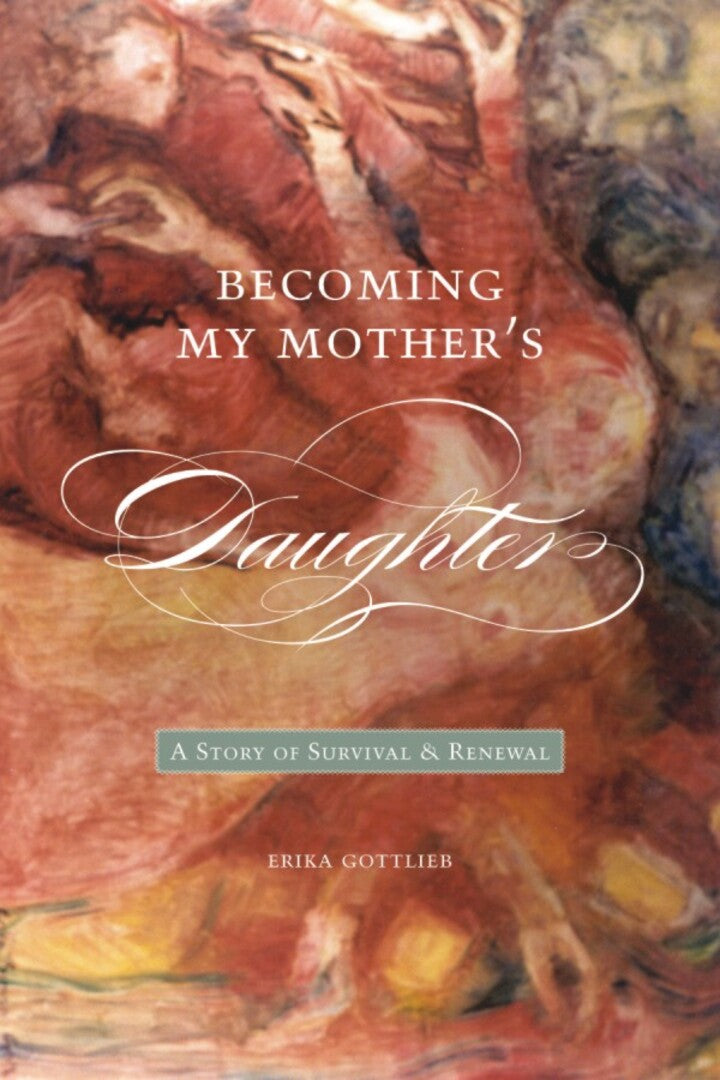
Becoming My Mother’s Daughter: A Story of Survival and Renewal tells the story of three generations of a Jewish Hungarian family whose fate has been inextricably bound up with the turbulent history of Europe, from the First World War through the Holocaust and the communist takeover after World War II, to the family’s dramatic escape and emmigration to Canada. The emotional centre and narrative voice of the story belong to Eva, an artist, dreamer, and writer trying to work through her complex and deep relationship with her mother, whose portrait she cannot paint until she completes her journey through memory.
The core of the book is Eva’s riveting recollection of the last months of World War II in Budapest, seen through a child’s eyes, and is reminiscent in its power of scenes in Joy Kogawa’s Obasan. Exploring the bond between generations of mothers and daughters, the book illustrates the struggle between the need for independence and the search for continuity, the significant impact of childhood on adult life, the reshaping of personality in immigration, the importance of dreams in making us face reality, and the redemptive power of memory. Illustrations by the author throughout the book, some in colour, enhance the story.


— Adreinne Kertzer, Canadian Literature, 200, Spring 2009, 2009 September
Gottlieb's memoir is tender, sad and touching.... The book is...enhanced with reproductions of sketches and paintings of Gottlieb's family, and of the scenes she depicts so vividly.
— Catherine Thompson, The Record (Kitchener-Waterloo), June 14, 2008, 2008 June
Despite the immediacy of its content the narrative has a complex structure, operating on several differect time levels and employing...a number of recurrent symbols.... [and it] give[s] an insight into one of the lesser-known aspects of the Holocaust. In Hungary the `Final Solution' started late and took an exceptionally brutal course. Within four months of the German invasion in March 1944, nearly 450,000 of Hungary's 750,000 Jews were deported from the provinces to perish in Auschwitz, while 100,000 men were being decimated in the lethal forced-labour service and 200,000 men, women and children remained in Budapest at the mercy of the bloodthirsty Arrow Cross thugs. What Eva, with her sister and mother, suffers in Budapest--with their father and husband on the run--is typical of the ordeal of those who were spared Auschwitz but little else. However, the Holocaust is only one of the two central themes of the book. The other is Eva's--or the author's--personal development, determined mainly by the impact of her mother. The two themes are closely connected, and the relationship of mother and daughter is intensified far beyond the norm by the extraordinary conditions of the Holocaust. Eva's dependence on her mother for her survival against extraordinary odds imposes on her an unusual sense of obligation, but if she is to develop her own individuality she must liberate herself.... Whether [the resolution she achieves] is a profound piece of psychological wisdom or a counsel of despair is for the reader to decide.
— Ladislaus Löb, University of Sussex, East European Jewish Affairs, Vol. 39, #2, July 2009, 2009 July
Table of Contents for Becoming My Mother’s Daughter: A Story of Survival and Renewal by Erika Gottlieb
The Bridge
The Maze
The Tunnel, 1913–1944
The Tunnel, 1944–1945
The Tunnel, 1952–1982
The Handbag