


Some error occured while loading the Quick View. Please close the Quick View and try reloading the page.
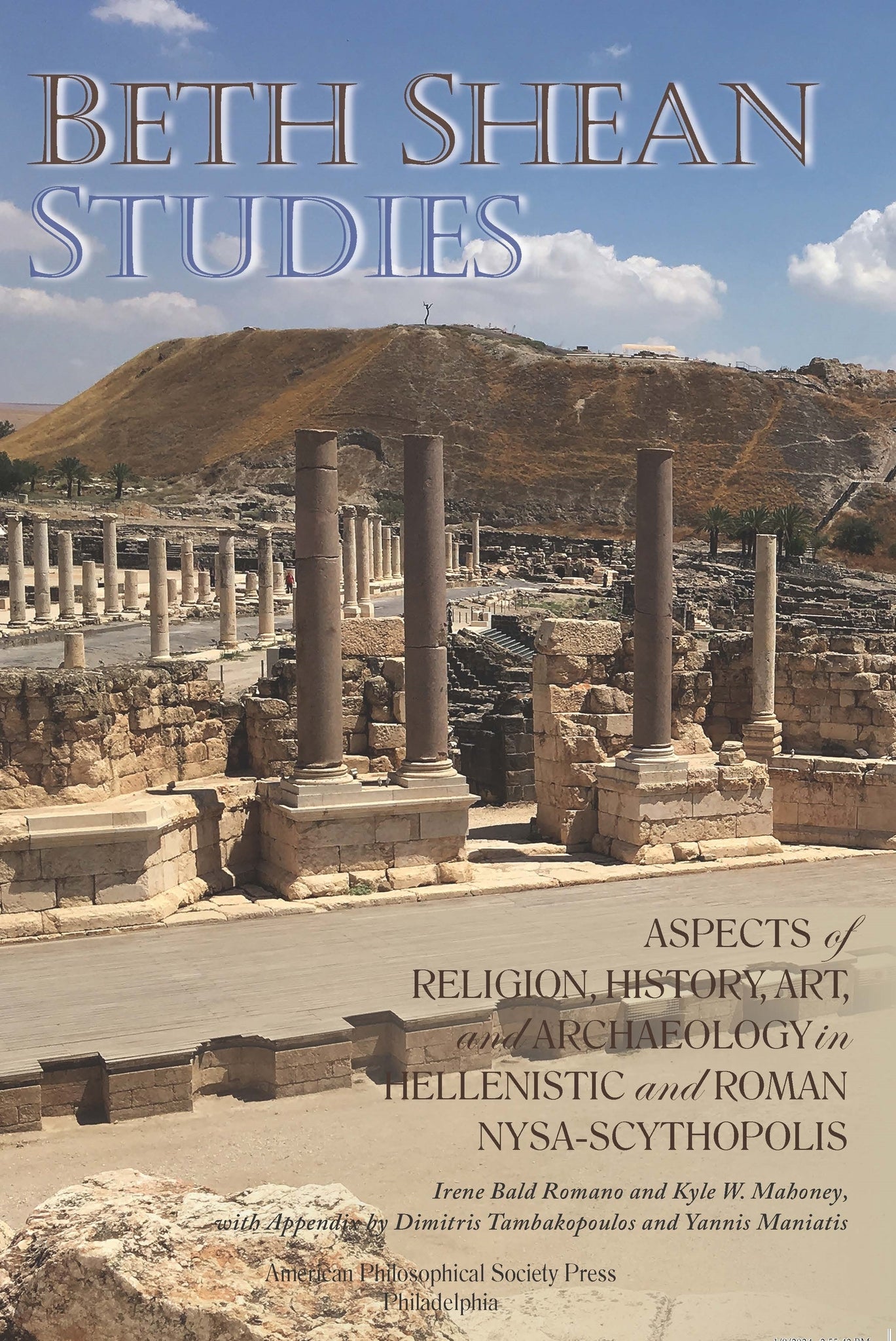
Scythopolis, or Nysa-Scythopolis, as Beth Shean was called during the Hellenistic and Roman periods, is located on the western bank of the Jordan River. Ancient historians Pliny and Solinus record that the site was founded by Dionysos when he stopped there to bury his nursemaid, the nymph Nysa. As a result of this myth, Dionysos became the patron deity of the city and his presence manifests iconographically and epigraphically throughout the region.
In 1925, a Hellenistic inscribed stele fragment and a Roman marble portrait of Alexander the Great were excavated at the site of Beth Shean (Israel), ancient Nysa-Scythopolis, in 1925 by the Palestine Expedition of the University of Pennsylvania Museum. Both objects were found in a cistern on the tel, just south of a Roman temple, probably dumped there in the fifth or early sixth century CE. Though the Penn Museum’s Beth Shean excavations were a model of rigorous methodology for their time, the focus of the excavators—and of the museum and its donors—was on the very important Bronze Age–Early Iron Age levels of the tel and the site’s biblical connections, and not especially on its Hellenistic, Roman, Byzantine, or Islamic periods.
In Beth Shean Studies, Irene Bald Romano and Kyle W. Mahoney focus their analysis on these two artifacts—until now, neither had received the attention it deserved as important evidence for the Hellenistic and Roman history and cult activities of the region. Mahoney’s interpretation of the stele’s inscription provides a detailed historical narrative of Scythopolis in the politically fraught second century BCE. He finds that the name of the Seleucid King Demetrios II was erased and thus exhibits an early example of damnatio memoriae, a tradition whose history is further explored here. Romano probes the various ways the image and myths associated with Alexander the Great were manipulated and appropriated long after his death. Using an object-biography approach, she traces the modern history of the portrait of Alexander, showing how its movements mirror the history of the creation of museums in Jerusalem.


Irene Bald Romano, PhD, holds joint positions as Professor of Art History in the School of Art and Professor of Anthropology in the School of Anthropology at the University of Arizona; she is also Curator of Mediterranean Archaeology at the Arizona State Museum. Dr. Romano is an archaeologist with broad interests in research on Mediterranean archaeological objects, especially Greek and Roman sculpture.
Kyle W. Mahoney, PhD, teaches at Swarthmore College in the Department of Classics. He is an ancient historian and archaeologist specializing in the study of ancient Greek inscriptions and is engaged more broadly in the study of ancient Mediterranean religions.
Dimitris Tambakopoulos, PhD, is a former postdoctoral fellow and research associate at the Laboratory of Archaeometry of the National Centre for Scientific Research “Demokritos.” His main research interests and expertise focus on the scientific determination of provenance and movement of marble in antiquity as well as statistical techniques.
Yannis Maniatis, PhD, is Research Director Emeritus at the National Centre for Scientific Research “Demokritos.” He is an archaeological scientist, creator, and former Director of the Laboratory of Archaeometry. His main research interests and expertise are the provenance and movement of marble in antiquity, radiocarbon dating, and ceramic technology.
Contributors
Acknowledgments
Illustrations
Abbreviations
1. Introduction
2. The Hellenistic Catalogue of Priests from Nysa-Scythopolis/Beth Shean: Supplementum Epigraphicum Graecum 8 33
3. A Portrait of Alexander the Great from Ancient Nysa-Scythopolis: An Object Biography
Appendix: Marble Provenance Investigation of the Head of Alexander the Great and a Hand Fragment from Ancient Nysa-Scythopolis, Israel
Bibliography
Index