


Some error occured while loading the Quick View. Please close the Quick View and try reloading the page.
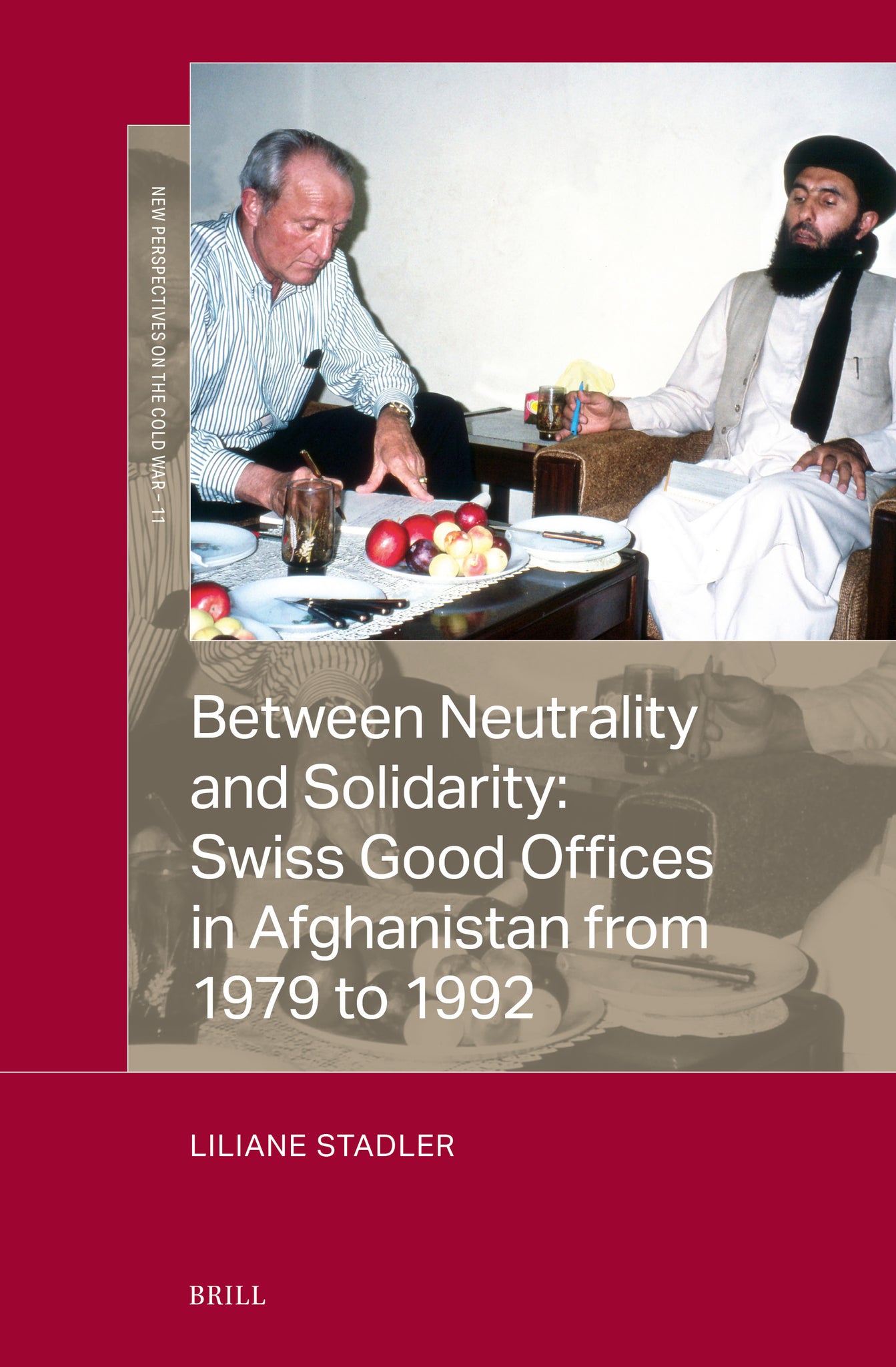
After 1979, Switzerland became increasingly involved in Soviet-occupied Afghanistan as a provider of humanitarian aid and good offices. It delivered aid to the region, hosted Soviet prisoners of war and eventually mediated between the Afghan regime and the mujahideen. What is puzzling about this development is that initially, following the Soviet invasion, both government and parliament refused to become diplomatically involved in Afghanistan on account of Swiss neutrality.
The present study investigates how and why this changed between 1979 and 1992. While the practical impact of Switzerland’s good offices was modest, the crisis revealed that Switzerland continued to struggle to balance the competing imperatives of permanent neutrality and international solidarity in an increasingly multilateral world.
The present study investigates how and why this changed between 1979 and 1992. While the practical impact of Switzerland’s good offices was modest, the crisis revealed that Switzerland continued to struggle to balance the competing imperatives of permanent neutrality and international solidarity in an increasingly multilateral world.

Price: $125.00
Pages: 240
Publisher: Brill
Imprint: Brill
Series: New Perspectives on the Cold War
Publication Date:
21 February 2024
ISBN: 9789004690653
Format: Hardcover

“For historians and students of Cold War studies, Stadler’s volume is an indispensable resource which has opened new avenues for research on the intersections of diplomacy, humanitarianism, and the agency of smaller states in international relations.”
Professor Sandra Bott, University of Lausanne, a H-Diplo Roundtable Review.
“Liliane Stadler has produced an outstanding study of Switzerland’s diplomatic involvement in the Soviet-Afghan War and its aftermath (1979-1992). It is masterfully researched, elegantly laid out, and thoughtful in its analysis. Between Neutrality and Solidarity contributes not only to our knowledge about Swiss diplomacy during the late Cold War but also to our understanding of international diplomacy more broadly during the war in Afghanistan.”
Dr Markus Balázs Göransson, Swedish Defence University, a H-Diplo Roundtable Review.
“Stadler’s book offers more than just an Afghanistan case study to trace Swiss diplomatic changes emerging from the post-World War II “struggle to balance the competing imperatives of permanent neutrality and international solidarity in an increasingly multilateral world.” Stadler provides new insight on the complex dynamics that preceded and followed the 1988 Geneva Accords on Afghanistan. And the slow Swiss adaptation over 1979 to1992 to a much messier diplomatic world involving non-state combatants, non-government organizations, Track-Two diplomacy, and individual diplomatic entrepreneurs, offers a wider case study for multiple global states that are in need of diplomatic flexibility as they address intractable conflicts after the end of the Cold War.”
Professor Robert Nichols, Stockton University, a H-Diplo Roundtable Review.
"Thoroughly researched, compellingly argued, and well-situated within the literature on Cold War-era neutrality, Stadler’s fascinating account has much to offer students of the Afghan war, neutrality, and Swiss history."
Robert Rakove, Stanford University, in Cambridge Review of International Affairs (29 Aug 2025): DOI: 10.1080/09557571.2025.2552050
Professor Sandra Bott, University of Lausanne, a H-Diplo Roundtable Review.
“Liliane Stadler has produced an outstanding study of Switzerland’s diplomatic involvement in the Soviet-Afghan War and its aftermath (1979-1992). It is masterfully researched, elegantly laid out, and thoughtful in its analysis. Between Neutrality and Solidarity contributes not only to our knowledge about Swiss diplomacy during the late Cold War but also to our understanding of international diplomacy more broadly during the war in Afghanistan.”
Dr Markus Balázs Göransson, Swedish Defence University, a H-Diplo Roundtable Review.
“Stadler’s book offers more than just an Afghanistan case study to trace Swiss diplomatic changes emerging from the post-World War II “struggle to balance the competing imperatives of permanent neutrality and international solidarity in an increasingly multilateral world.” Stadler provides new insight on the complex dynamics that preceded and followed the 1988 Geneva Accords on Afghanistan. And the slow Swiss adaptation over 1979 to1992 to a much messier diplomatic world involving non-state combatants, non-government organizations, Track-Two diplomacy, and individual diplomatic entrepreneurs, offers a wider case study for multiple global states that are in need of diplomatic flexibility as they address intractable conflicts after the end of the Cold War.”
Professor Robert Nichols, Stockton University, a H-Diplo Roundtable Review.
"Thoroughly researched, compellingly argued, and well-situated within the literature on Cold War-era neutrality, Stadler’s fascinating account has much to offer students of the Afghan war, neutrality, and Swiss history."
Robert Rakove, Stanford University, in Cambridge Review of International Affairs (29 Aug 2025): DOI: 10.1080/09557571.2025.2552050
Liliane Stadler, Ph.D. (2021), University of Oxford, is a lecturer in History of International Relations at the University of Utrecht. Her research revolves around neutral states in multilateral diplomacy and conflict resolution.