


Some error occured while loading the Quick View. Please close the Quick View and try reloading the page.
CHOICE Outstanding Academic Title 2014
Library Journal Best Print Reference Selection 2014
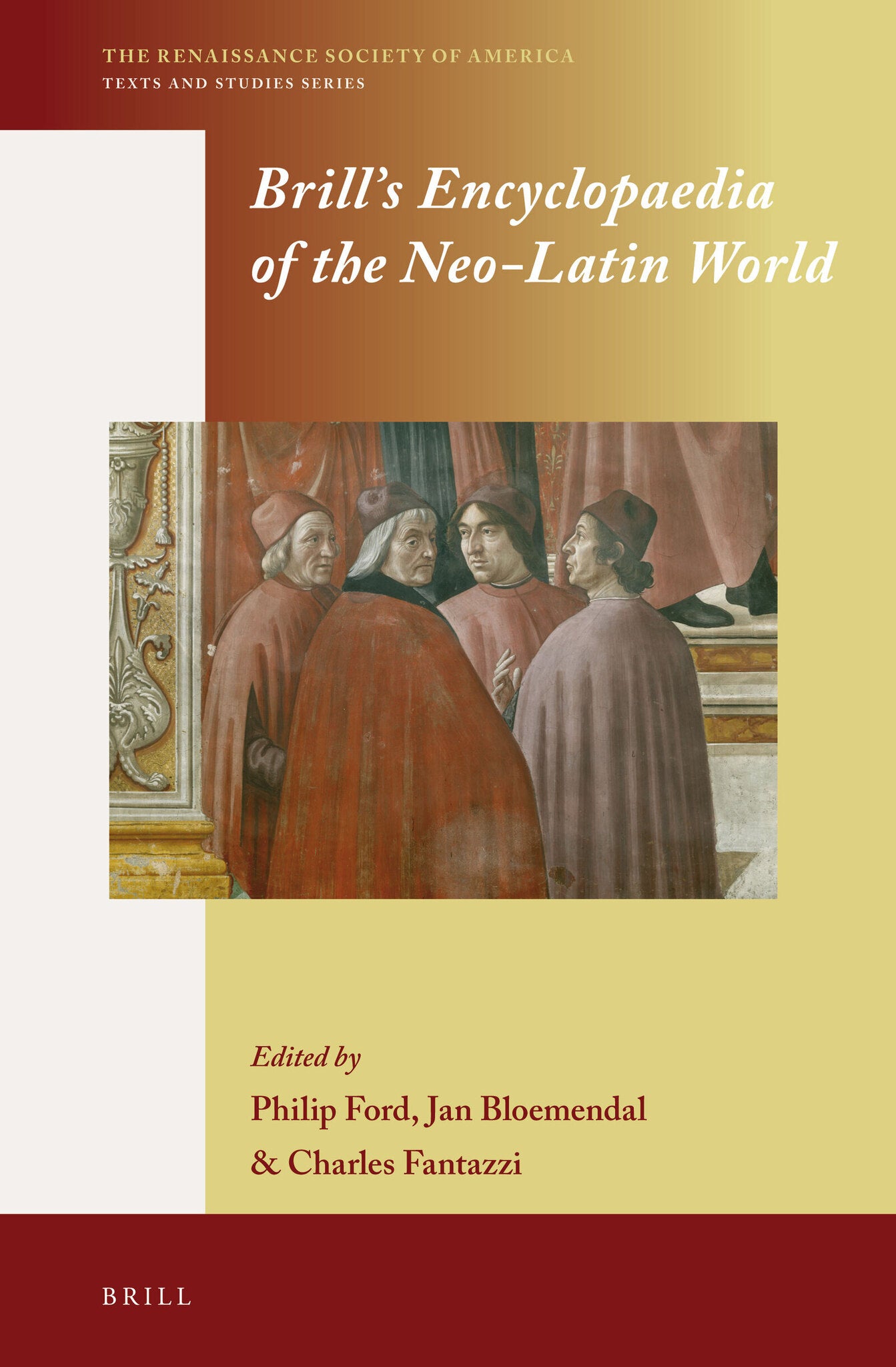
With its striking range and penetrating depth, Brill’s Encyclopaedia of the Neo-Latin World traces the enduring history and broad cultural influence of Neo-Latin, the form of Latin that originated in the Italian Renaissance and persists to the modern era. Featuring original contributions by a host of distinguished international scholars, this 800,000 word two-volume work explores every aspect of the civilized world from literature and law to philosophy and the sciences. An invaluable resource for both the advanced scholar and the graduate student.
The Encyclopaedia is also available ONLINE.
Contributors are: Monica Azzolini, Irena Backus, Jon Balserak, Ann Blair, Jan Bloemendal, David Butterfield, Isabelle Charmantier, John Considine, Alejandro Coroleu, Ricardo da Cunha Lima, Susanna de Beer, Erik De Bom, Jeanine De Landtsheer, Tom Deneire, Ingrid De Smet, Karl Enenkel, Charles Fantazzi, Mathieu Ferrand, Roger Fisher, Philip Ford, Raphaele Garrod, Guido Giglioni, Roger Green, Yasmin Haskell, Hans Helander, Lex Hermans, Louise Hill Curth, Leofranc Holford-Strevens, Brenda Hosington, Erika Jurikova, Craig Kallendorf, Jill Kraye, Andrew Laird, Han Lamers, Marc Laureys, Jeltine Ledegang-Keegstra, Jan Machielsen, Peter Mack, David Marsh, Dustin Mengelkoch, Milena Minkova, David Money, Jennifer Morrish Tunberg, Adam Mosley, Ann Moss, Monique Mund-Dopchie, Colette Nativel, Lodi Nauta, Henk Nellen, Gideon Nisbet, Richard Oosterhoff, Marianne Pade, Jan Papy, David Porter, Johann Ramminger, Jennifer Rampling, Rudolf Rasch, Karen Reeds, Valery Rees, Bettina Reitz-Joosse, Stella Revard, Dirk Sacré, Gerald Sandy, Minna Skafte Jensen, Carl Springer, Gorana Stepanić, Harry Stevenson, Jane Stevenson, Andrew Taylor, Nikolaus Thurn, Johannes Trapman, Terence Tunberg, Piotr Urbański, Wiep van Bunge, Harm-Jan van Dam, Demmy Verbeke, Zweder von Martels, Maia Wellington Gahtan, and Paul White.
Library Journal Best Print Reference Selection 2014
With its striking range and penetrating depth, Brill’s Encyclopaedia of the Neo-Latin World traces the enduring history and broad cultural influence of Neo-Latin, the form of Latin that originated in the Italian Renaissance and persists to the modern era. Featuring original contributions by a host of distinguished international scholars, this 800,000 word two-volume work explores every aspect of the civilized world from literature and law to philosophy and the sciences. An invaluable resource for both the advanced scholar and the graduate student.
The Encyclopaedia is also available ONLINE.
Contributors are: Monica Azzolini, Irena Backus, Jon Balserak, Ann Blair, Jan Bloemendal, David Butterfield, Isabelle Charmantier, John Considine, Alejandro Coroleu, Ricardo da Cunha Lima, Susanna de Beer, Erik De Bom, Jeanine De Landtsheer, Tom Deneire, Ingrid De Smet, Karl Enenkel, Charles Fantazzi, Mathieu Ferrand, Roger Fisher, Philip Ford, Raphaele Garrod, Guido Giglioni, Roger Green, Yasmin Haskell, Hans Helander, Lex Hermans, Louise Hill Curth, Leofranc Holford-Strevens, Brenda Hosington, Erika Jurikova, Craig Kallendorf, Jill Kraye, Andrew Laird, Han Lamers, Marc Laureys, Jeltine Ledegang-Keegstra, Jan Machielsen, Peter Mack, David Marsh, Dustin Mengelkoch, Milena Minkova, David Money, Jennifer Morrish Tunberg, Adam Mosley, Ann Moss, Monique Mund-Dopchie, Colette Nativel, Lodi Nauta, Henk Nellen, Gideon Nisbet, Richard Oosterhoff, Marianne Pade, Jan Papy, David Porter, Johann Ramminger, Jennifer Rampling, Rudolf Rasch, Karen Reeds, Valery Rees, Bettina Reitz-Joosse, Stella Revard, Dirk Sacré, Gerald Sandy, Minna Skafte Jensen, Carl Springer, Gorana Stepanić, Harry Stevenson, Jane Stevenson, Andrew Taylor, Nikolaus Thurn, Johannes Trapman, Terence Tunberg, Piotr Urbański, Wiep van Bunge, Harm-Jan van Dam, Demmy Verbeke, Zweder von Martels, Maia Wellington Gahtan, and Paul White.

Price: $608.00
Publisher: Brill
Imprint: Brill
Publication Date:
17 March 2014
ISBN: 9789004265721
Format: Hardcover

“The 1,240 pages of Brill’s Encyclopaedia have entries, by nearly eighty contributors, for almost all conceivable aspects of Neo-Latin language, literature and culture. … It will be an indispensable starting point for future students and scholars, at a time when the vast and largely unexplored continent of early modern Neo-Latin is becoming increasingly accessible.”
Philip Hardie, University of Cambridge. In: The Times Literary Supplement, 13 February 2015.
“The longer essays provide excellent overviews of major topics; the short entries offer basic reference information. Both include bibliographies for further reading. Anyone interested in the Latin language, early modern history and literature, classical studies, book history, theology, or legal history will find this an indispensable reference work. Summing up: Essential. Upper-division undergraduates through researchers/faculty.”
Fred W. Jenkins, University of Dayton, Ohio. In: CHOICE, Vol. 52, No. 2 (October 2014).
“Brill’s Encyclopaedia of the Neo-Latin World is a marvel. A collaborative reference work featuring contributions from seventy-nine different scholars, it manages both to provide an overview of the complex (and to our minds, frequently alien) world of Latin culture and scholarship from the Renaissance down to the present day, and to create a repository of historical, contextual, and literary research that will shape the direction of international Neo-Latin studies for the foreseeable future. […] What has been created by the editors is nothing short of the defining work of a field in rude health, and a marker that will direct the future of the discipline.”
Steven J. Reid, University of Glasgow. In: Renaissance Quarterly, Vol. 68, No. 2 (Summer 2015), pp. 625-627.
“Brill’s Encyclopaedia of the Neo-Latin World represents a substantial and substantive publication. Those new to the vibrant and vital world of neo-Latin culture will find it an encouraging and accessible starting point for an array of subjects. For more hardened scholars, it will serve as a ready and practical source of reference.”
Patrick J. Murray, University of Glasgow. In: Sixteenth Century Journal, Vol. 46, No. 2 (2015), pp. 444-446.
“Brill’s Encyclopaedia of the Neo-Latin World is a splendid resource and will be of enormous benefit to everyone working in this field, as well as—perhaps even more so—to many students and scholars of the Renaissance and early modern period who do not consider themselves Neo-Latinists. Immediately upon publication it has become the inevitable starting-point for any fresh project, and an essential purchase for research libraries.”
Victoria Moul, King’s College, London. In: Neo-Latin News, Vol. 63, Nos. 3 & 4 (Fall-Winter 2015), pp. 199-203.
“The amount of information brought together here on a vast breadth of subjects over long periods of history is prodigious. […] what is presented here is information and scholarship of a very high value across a very wide range of disciplines”.
Stuart James, formerly University Librarian, University of Paisley, UK. In: Reference Reviews, Vol. 29, No. 2 (2015), pp. 25-26.
“The Brill Encyclopaedia of the Neo-Latin World is a heavyweight contender […]. It is judiciously arranged, opening with clear discussions on the grammatical and linguistic character of neo-Latin, devoting a section to issues of transmission and editing in early print culture, and then progressing by discipline and genre. Space is also given to the spread of neo-Latin beyond Europe.”
David Rundle, University of Oxford. In: Renaissance Studies, Vol. 31, No. 1 (February 2017), pp. 146-148. First published online 7 September 2015.
“a monumental achievement … In an age of numerous handbooks and encyclopedias of questionable value, this contribution to the field of Neo-Latin is an outstanding resource for both students and scholars.“
John T. Slotemaker, Fairfield University. In: Religious Studies Review, Vol. 41, No. 2 (June 2015), pp. 86-87.
“one cannot but praise the enthusiasm and expertise of the many scholars involved [...]. The Encyclopaedia is a great work“.
Reinhold F. Glei, Ruhr-Universität Bochum. In: Medievalia et Humanistica, New Series, No. 42 (2017), pp. 94-97.
“In 1973 the late Jozef IJsewijn met with a group of like-minded scholars in Louvain and founded the International Association of Neo-Latin Studies. He also edited the first Companion to Neo-Latin Studies, which was published in 1977 and revised in 1990 and 1998. This new reference builds on that tradition and with 800,000 words is almost double the size of the last revision. ... Influenced by the rediscovery of ancient texts, especially Cicero’s letters, Neo-Latin was an attempt to write Latin as it was written by the 'best authors of antiquity.' It began to lose its position as a universal language at the end of the 17th century, although it continued to be used in the Catholic Church until 1962.”
Brian E. Coutts & Cynthia Etkin, in: Library Journal, February 25, 2015.
“Brill’s Encyclopaedia of the Neo-Latin World is an ambitious and welcome work, surpassing in both extent and quality all previous scholarly companions for Neo-Latin studies. […] This is now the definitive and indispensable scholarly reference publication on all subjects germane to Neo-Latin and its literature. […] Every library should get hold of this publication.”
Patrick M. Owens, Calvin College. In: The Journal of Roman Studies, Vol. 107 (November 2017), pp. 435-437.
“Brill’s Encyclopaedia of the Neo-Latin World is an essential reference work for anyone interested in discovering how the Latin language continued to be an important medium for intellectual treatises, creative writing, and cultural transmission throughout Europe and beyond in the centuries since Petrarch. Sixty-six large survey articles offer fresh perspectives on a wide range of topics, including conversational Latin, women’s education, and Latin law. More than twice as many shorter entries focus on diverse subjects such as major writers, Latin literature written in various countries, centers of printing and publishing, and the pioneering work done by modern scholars in what was then the emerging field of Neo-Latin Studies. The encyclopaedia continues the Neo-Latin tradition of international collaboration, scholarship, and publishing.”
Anne-Marie Lewis, York University, Canada. President, American Association for Neo-Latin Studies.
“Brill’s Encyclopaedia of the Neo-Latin World is both an excellent guide for further research and an imposing statement of what has so far been achieved.”
Per Pippin Aspaas, The Arctic University of Norway. In: Sjuttonhundratal: Nordic Yearbook for Eighteenth-Century Studies, Vol. 12 (2015), pp. 257-259.
“Ein monumentales Unternehmen […]. Die Vielfalt der präsentierten Ansätze [ist] beeindruckend, der ambitionierte Versuch, in Quer- und Längsschnitten die Welt des Neu-Lateins möglichst vollständig zu erfassen, ist rundum geglückt. Viele Themenbereiche laden ein zum Nachschlagen, Staunen und Schmökern, sie machen neugierig auf bislang wenig erforschte oder gar neu zu entdeckende Wissenskontinente. Studierenden, Forschern und wißbegierigen Lesern aller Arten bieten die kürzeren, essayistischen Texte ebenso wie die umfangreichen Abhandlungen konkrete Fakten, präzise Entwürfe und reichlich Gedankenfutter.”
Elisabeth Stein, Bergische Universität Wuppertal. In: Archiv für Reformationsgeschichte, Jg. 45 (2016), pp. 28-29.
Philip Hardie, University of Cambridge. In: The Times Literary Supplement, 13 February 2015.
“The longer essays provide excellent overviews of major topics; the short entries offer basic reference information. Both include bibliographies for further reading. Anyone interested in the Latin language, early modern history and literature, classical studies, book history, theology, or legal history will find this an indispensable reference work. Summing up: Essential. Upper-division undergraduates through researchers/faculty.”
Fred W. Jenkins, University of Dayton, Ohio. In: CHOICE, Vol. 52, No. 2 (October 2014).
“Brill’s Encyclopaedia of the Neo-Latin World is a marvel. A collaborative reference work featuring contributions from seventy-nine different scholars, it manages both to provide an overview of the complex (and to our minds, frequently alien) world of Latin culture and scholarship from the Renaissance down to the present day, and to create a repository of historical, contextual, and literary research that will shape the direction of international Neo-Latin studies for the foreseeable future. […] What has been created by the editors is nothing short of the defining work of a field in rude health, and a marker that will direct the future of the discipline.”
Steven J. Reid, University of Glasgow. In: Renaissance Quarterly, Vol. 68, No. 2 (Summer 2015), pp. 625-627.
“Brill’s Encyclopaedia of the Neo-Latin World represents a substantial and substantive publication. Those new to the vibrant and vital world of neo-Latin culture will find it an encouraging and accessible starting point for an array of subjects. For more hardened scholars, it will serve as a ready and practical source of reference.”
Patrick J. Murray, University of Glasgow. In: Sixteenth Century Journal, Vol. 46, No. 2 (2015), pp. 444-446.
“Brill’s Encyclopaedia of the Neo-Latin World is a splendid resource and will be of enormous benefit to everyone working in this field, as well as—perhaps even more so—to many students and scholars of the Renaissance and early modern period who do not consider themselves Neo-Latinists. Immediately upon publication it has become the inevitable starting-point for any fresh project, and an essential purchase for research libraries.”
Victoria Moul, King’s College, London. In: Neo-Latin News, Vol. 63, Nos. 3 & 4 (Fall-Winter 2015), pp. 199-203.
“The amount of information brought together here on a vast breadth of subjects over long periods of history is prodigious. […] what is presented here is information and scholarship of a very high value across a very wide range of disciplines”.
Stuart James, formerly University Librarian, University of Paisley, UK. In: Reference Reviews, Vol. 29, No. 2 (2015), pp. 25-26.
“The Brill Encyclopaedia of the Neo-Latin World is a heavyweight contender […]. It is judiciously arranged, opening with clear discussions on the grammatical and linguistic character of neo-Latin, devoting a section to issues of transmission and editing in early print culture, and then progressing by discipline and genre. Space is also given to the spread of neo-Latin beyond Europe.”
David Rundle, University of Oxford. In: Renaissance Studies, Vol. 31, No. 1 (February 2017), pp. 146-148. First published online 7 September 2015.
“a monumental achievement … In an age of numerous handbooks and encyclopedias of questionable value, this contribution to the field of Neo-Latin is an outstanding resource for both students and scholars.“
John T. Slotemaker, Fairfield University. In: Religious Studies Review, Vol. 41, No. 2 (June 2015), pp. 86-87.
“one cannot but praise the enthusiasm and expertise of the many scholars involved [...]. The Encyclopaedia is a great work“.
Reinhold F. Glei, Ruhr-Universität Bochum. In: Medievalia et Humanistica, New Series, No. 42 (2017), pp. 94-97.
“In 1973 the late Jozef IJsewijn met with a group of like-minded scholars in Louvain and founded the International Association of Neo-Latin Studies. He also edited the first Companion to Neo-Latin Studies, which was published in 1977 and revised in 1990 and 1998. This new reference builds on that tradition and with 800,000 words is almost double the size of the last revision. ... Influenced by the rediscovery of ancient texts, especially Cicero’s letters, Neo-Latin was an attempt to write Latin as it was written by the 'best authors of antiquity.' It began to lose its position as a universal language at the end of the 17th century, although it continued to be used in the Catholic Church until 1962.”
Brian E. Coutts & Cynthia Etkin, in: Library Journal, February 25, 2015.
“Brill’s Encyclopaedia of the Neo-Latin World is an ambitious and welcome work, surpassing in both extent and quality all previous scholarly companions for Neo-Latin studies. […] This is now the definitive and indispensable scholarly reference publication on all subjects germane to Neo-Latin and its literature. […] Every library should get hold of this publication.”
Patrick M. Owens, Calvin College. In: The Journal of Roman Studies, Vol. 107 (November 2017), pp. 435-437.
“Brill’s Encyclopaedia of the Neo-Latin World is an essential reference work for anyone interested in discovering how the Latin language continued to be an important medium for intellectual treatises, creative writing, and cultural transmission throughout Europe and beyond in the centuries since Petrarch. Sixty-six large survey articles offer fresh perspectives on a wide range of topics, including conversational Latin, women’s education, and Latin law. More than twice as many shorter entries focus on diverse subjects such as major writers, Latin literature written in various countries, centers of printing and publishing, and the pioneering work done by modern scholars in what was then the emerging field of Neo-Latin Studies. The encyclopaedia continues the Neo-Latin tradition of international collaboration, scholarship, and publishing.”
Anne-Marie Lewis, York University, Canada. President, American Association for Neo-Latin Studies.
“Brill’s Encyclopaedia of the Neo-Latin World is both an excellent guide for further research and an imposing statement of what has so far been achieved.”
Per Pippin Aspaas, The Arctic University of Norway. In: Sjuttonhundratal: Nordic Yearbook for Eighteenth-Century Studies, Vol. 12 (2015), pp. 257-259.
“Ein monumentales Unternehmen […]. Die Vielfalt der präsentierten Ansätze [ist] beeindruckend, der ambitionierte Versuch, in Quer- und Längsschnitten die Welt des Neu-Lateins möglichst vollständig zu erfassen, ist rundum geglückt. Viele Themenbereiche laden ein zum Nachschlagen, Staunen und Schmökern, sie machen neugierig auf bislang wenig erforschte oder gar neu zu entdeckende Wissenskontinente. Studierenden, Forschern und wißbegierigen Lesern aller Arten bieten die kürzeren, essayistischen Texte ebenso wie die umfangreichen Abhandlungen konkrete Fakten, präzise Entwürfe und reichlich Gedankenfutter.”
Elisabeth Stein, Bergische Universität Wuppertal. In: Archiv für Reformationsgeschichte, Jg. 45 (2016), pp. 28-29.
Philip Ford, Ph.D. (1977), University of Cambridge, was Professor of French and Neo-Latin Literature at Clare College. He published five monographs, two critical editions, and numerous articles; he was also the editor or co-editor of a staggering fourteen collective volumes, including the Cambridge French Colloquia series. His last monograph is The Judgment of Palaemon: The Contest between Neo-Latin and Vernacular Poetry in Renaissance France (Brill, 2013). From 2006 to 2009, he served as President of the International Association for Neo-Latin Studies. He died on 8 April 2013.
Jan Bloemendal, Ph.D. (1997) in Classics, Utrecht University studied Classics, Dutch literature and theology. He is a Senior Researcher at the Huygens Institute of the Royal Netherlands Academy of Arts and Sciences, The Hague. He has published on Neo-Latin and Dutch drama, classical reception, poetics, emblems, and Erasmus. Recently he edited, with Howard B. Norland, Neo-Latin Drama and Theatre in Early Modern Europe (Brill, 2013).
Charles Fantazzi, Ph.D. (1964) in Comparative Literature, Harvard University, is Thomas Harriot Distinguished Professor Emeritus of Classics, East Carolina University. He has published several critical editions and translations of Juan Luis Vives and is translator and editor for the Toronto Collected Works of Erasmus.
Jan Bloemendal, Ph.D. (1997) in Classics, Utrecht University studied Classics, Dutch literature and theology. He is a Senior Researcher at the Huygens Institute of the Royal Netherlands Academy of Arts and Sciences, The Hague. He has published on Neo-Latin and Dutch drama, classical reception, poetics, emblems, and Erasmus. Recently he edited, with Howard B. Norland, Neo-Latin Drama and Theatre in Early Modern Europe (Brill, 2013).
Charles Fantazzi, Ph.D. (1964) in Comparative Literature, Harvard University, is Thomas Harriot Distinguished Professor Emeritus of Classics, East Carolina University. He has published several critical editions and translations of Juan Luis Vives and is translator and editor for the Toronto Collected Works of Erasmus.