


Some error occured while loading the Quick View. Please close the Quick View and try reloading the page.
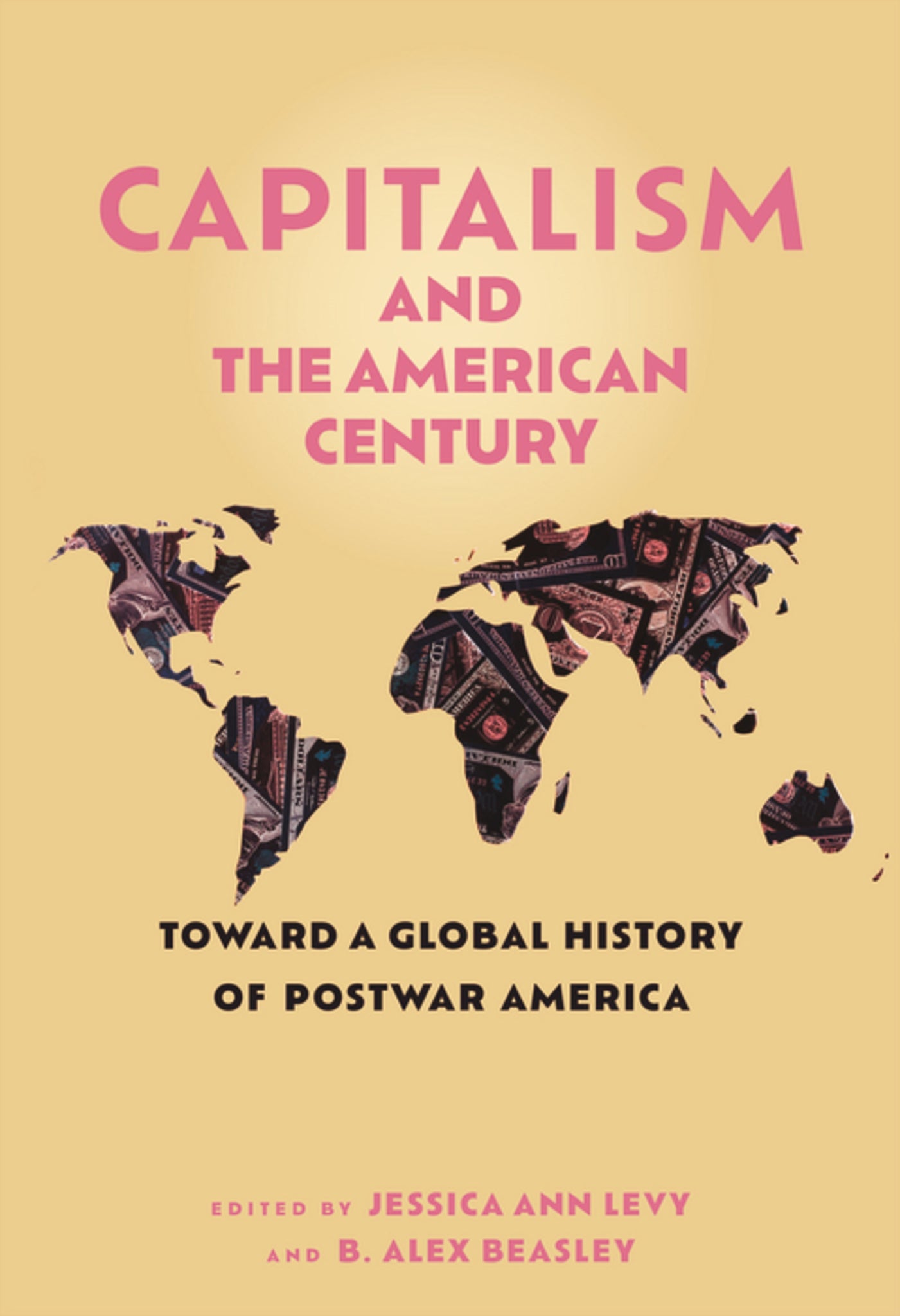
This volume examines how post–World War II US political economy was forged through international collaborations and conflicts
Capitalism and the American Century argues that post–World War II, labor, business, and consumption in the United States cannot be understood as purely, or even primarily, domestic stories. US capitalism evolved not only in an international context, but through transnational networks and against the backdrop of international competition. The contributors to this volume show that treating postwar US capitalism as a global story transforms our narratives of the period’s political, social, and cultural life.
Recasting US political economy in its global context highlights crucial continuities through the second half of the twentieth century. Rather than emphasize the mid-1970s as a point of fundamental rupture, the volume’s attention to people and businesses more directly engaged in capitalist enterprises across borders makes clear that throughout the twentieth century, US political economy was built through the nation’s continual efforts to influence international affairs and shape the global economy. Moreover, placing postwar US history in an international framework shows how present-day US political economy was forged, not simply through domestic contestations over taxation, federalism, and capital flight, but also through regional efforts to control international investment; the actions of corporations, workers, and consumers in places far from the US metropole; and the complex negotiations between executives and heads of state that were not always visible to ordinary Americans.
In addition, this volume suggests that narratives of globalization-as-domestic-crisis do not adequately consider American power in the late twentieth century, including the power of US capitalists. Instead of understanding the late twentieth century as a period of decline for American capitalism at home and abroad, the book highlights how particular groups of Americans retained, and even expanded, their power and influence. Contributors demonstrate how the United States remained a model for aspiring capitalists around the world well into the late twentieth and early twenty-first centuries.
Contributors: B. Alex Beasley, Peter Cole, Christopher R. W. Dietrich, Jeannette Alden Estruth, Elizabeth O’Brien Ingleson, Jessica Ann Levy, Sarah Nelson, Vyta Pivo, David A. Rahimi, Bradley R. Simpson, Sarah Sklaw.


"An engaging and thought-provoking read that offers a fresh perspective on how American firms shaped our global economy from the Great Depression to today.Capitalism and the American Century covers the globe, showing how Cold War economic imperatives shaped the networks of power that still wield so much control over our twenty-first century world."
Jessica Ann Levy is Assistant Professor of History at Lehigh University and the author of Black Power, Inc.: Corporate America and the Rise of Multinational Empowerment Politics, also available from the University of Pennsylvania Press.
B. Alex Beasley is Assistant Professor of American Studies at the University of Texas at Austin. He has previously published with Diplomatic History and the Radical History Review.