


Some error occured while loading the Quick View. Please close the Quick View and try reloading the page.
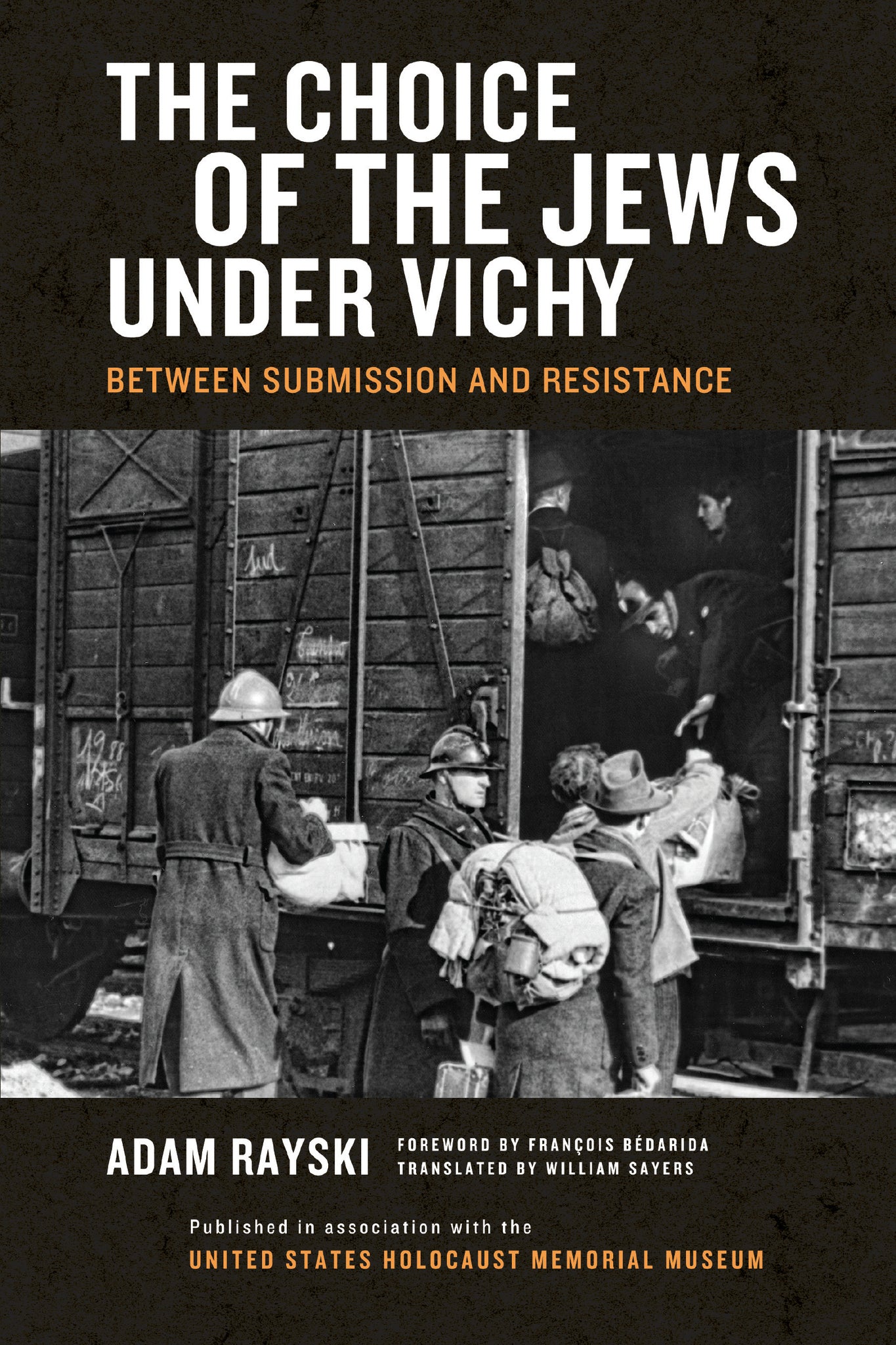
In The Choice of the Jews under Vichy, Adam Rayski buttresses his analysis of war-era archival materials with his own personal testimony. His research in the archives of the military, the Central Consistory of the Jews of France, the police, and Philippe Pétain demonstrates the Vichy government’s role as a zealous accomplice in the Nazi program of genocide. He documents the efforts and absence of efforts of French Protestant and Catholic groups on behalf of their Jewish countrymen; he also explores the prewar divide between French-born and immigrant Jews, manifested in cultural conflicts and mutual antagonism as well as in varied initial responses to Vichy’s antisemitic edicts and actions. Rayski reveals how these Jewish communities eventually set aside their differences and united to resist the Nazi threat.


“The strength of the book, particularly taking its original publication date into consideration, lies in its ability to portray Jews not as passive victims but as active resisters and to emphasize a collective consciousness of self-affirmation.” — H-Net Reviews
“Reading the excellent English-language version of Rayski's original study is unsettling. Rayski is concerned first and foremost with erecting a pantheon for heroes of the war-Jewish activists on the Left in the Resistance-and condemning those elements in the French Jewish community who, in his estimation, blindly acceded to Vichy pressure and irresponsibly maintained the officially mandated stance throughout most of the war. If read as a testament by a significant representative of Eastern European Jewry to try to make sense of the world in which he lived and the decisions which he took, Rayski's book provides a viewpoint that will enrich the future historian's analysis of the ways that many survivors of the Holocaust in France interpreted their past.” —Journal of Modern History
“One of the most informed memoirs of the Occupation, the book is also a shrewd and detailed analysis. It is nuanced in its approach and yet ready to be decisive and provocative in its judgments. Anyone searching for context as well as narrative will be richly rewarded by a thematic concentration on the multiple constraints which faced the Jews in Vichy France… This is both witness and history of exceptional provenance and quality.” —The English Historical Review
"This highly recommended book is suitable for anyone concerned with resistance, the Holocaust, Jewish studies, or the history of the Jews under Vichy." —History: Reviews of New Books
"[Rayski] pieces together the 'hidden face' of daily Jewish life under the Occupation and relates the experiences of those who went underground—an especially rich and valuable discussion as this phenomenon has rarely been studied." —Library Journal
"[A] rich and detailed description of the challenges faced by French Jewry during World War II. . . . This complex . . . important book is recommended for scholars of French history and Jewish and Holocaust studies." —Library Journal
“Rayski, who served as an official of an important Jewish resistance organization under Vichy, examines Jewish responses to Vichy policy as a series of choices. . . . Rayski's approach effectively portrays French Jews as much more than passive victims of an oppression imposed on them from above; rather, through oral and written testimonies and extensive archival research, he conveys the Jews' involvement in their own collective destiny. . . . Recommended.” —Choice
"Well researched and forcefully argued, . . . Adam Rayski's book describes not only what the Jews did, but makes a case for what they should have done. As such, whatever the viewpoint of the reader, this is a valuable contribution to our understanding of the mentalities of the time, and also a testament to some activists' faith in human solidarity." —Times Literary Supplement
"The publication of an English translation of Adam Rayski's book ... is a welcome addition.... Rayski's book remains valuable largely for the valuable primary source material it brings to the fore.... [T]he University of Notre Dame Press with the United States Holocaust Memorial Museum should be commended for having made this work available in an excellent English translation.” —American Historical Review
"Rayski renders justice to the numerous French Jews who joined the resistance. . . . [He] gives us for the first time a comprehensive picture of the collective attitudes of the Jews of France from 1939 to 1944." —L'Arche
Adam Rayski (1913–2008) left Poland in 1932 for Paris, where he became a full-time journalist working for the Neie Presse, a leftist Yiddish-language daily newspaper. From July 1941 until the end of World War II he served as national secretary of the Jewish Section of the French Communist Party and headed the Union des Juifs pour la Résistance et l'Entraide, in which he played a major part in Jewish survival in France.
Foreword by François Bédarida
Acknowledgments
Introduction
Prologue
Part 1. 1940 –1942: The Logic of Persecution
1. The First Anti-Jewish Measures: Dark Forebodings
- “Who Is a Jew?”
- Who Went Back to Paris?
- A Shattered Community
- The First Internments
- The Question of Final Objective ( Endziel)
2. The Consistory between Religion and Politics
- First Message of Allegiance
- Helbronner’s Counter-Proposal
- How to Manage Misfortune?
- Confronting the Second Anti-Jewish Law
- The Census and the Honor of Being Jewish
- The Experience of the Belgian Consistory
- Pétain and the “Huge Jewish Fortune”
- De Gaulle to Cassin: “You’ve come at just the right time”
3. Preliminaries to a Massacre
- A Ghetto without Walls
- First Refusal of the Directive
- Nazi Propaganda Exploits Address Lists Concentrate and Isolate
- Social Assistance and Resistance Protests by the Wives of the Interned
- The Appeal from Moscow
4. The Creation of the UGIF, the “Compulsory Community”
- Vallat’s “Worst Case Scenario”: Blackmail
- Marc Bloch and the Letter of the Twenty-Nine
- Must We Break with Pétain?
- “They are ruining the Jews”
- How to Save Honor?
5. The Yellow Star: Stigmatize, Humiliate, and Isolate the Jews
- “Support the wearers of the yellow badge!”
- Protestants and Catholics Begin to Question Reactions and Exemptions
- Deport 1,000 to 5,000 Jews per Month The Eve of the Great Roundup
6. July 1942: The Great Roundup and the First Acts of Resistance
- A Difficult Secret
- Resonance of the Appeal against the Raids Communications from Headquarters
- The Hidden Face of the Raids
- Röthke’s Deficient Numbers A Double Turning Point
- A Letter to the Marshal from a Jewish Child
7. The Inhuman Hunt in the Southern Zone
- Collecting the Trash
- Playing the American Card
- “Shades of Melancholy” in the Skies of France Rabbi Hirschler in the Field
- The Law of Numbers, or “Screening” The Perverse Effects of Social Action
- Laval Washes His Hands File under “Vichy, Responsibility of”
- Bishops’ Crosses Are Raised The Secret Letter from de Gaulle to Saliège
- The Children of Vénissieux
8. Drancy: The Last Circle before Hell
- The Lawyers Take Charge
- “News” from Drancy
- A Life That Was Vanishing A Bundle of Yellowed Letters
- The Spiral of Anguish
- Escape: The Tunnel The Jewish Administration
- Attack the Convoys of Deportees? The “Reserves” in the Camp Annexes
Part 2. 1942 –1944: To Resist or Submit?
9. “Night and Fog”: The Battle against Silence
- Evidence from the Red Cross
- The Consistory Knew, But . . .
- The Chief Rabbi’s About-Face Revelations of a German Industrialist
- Should We Talk about the Gas Chambers? To Know: A Moral Obligation
- Writing: The Beginning of Memory In Gestapo and Vichy Archives
10. People of the Shadows
- Clandestinity: The Condition of Survival
- The Hidden Face of Daily Life An Unknown Page from the Life of Isaac Schneerson The Void around Legal Organizations
- The Strange Underground Universe of Children Keeping the Faith
- Real and False Baptisms
11. Do Not Forget the Children
- The Inevitable Turning Point
- Formal Notice by Vaad Hatsala
- Memories of . . . Childhood The Protestant Plateau
- A Sanctuary for the Persecuted? Other Rescue Organizations
- An Assessment of the War on Children
12. “Intermezzo,” or the Italian Reprieve
- From Refuge into Trap
- Berlin and Vichy Take Aim at Count Ciano Twenty Thousand Jews To Be Evacuated
- The Brunner Commando in Action
- The Agencies Caught Unprepared
- Jewish Youth React Testimony of the First Escapee from Auschwitz
13. Jewish Perceptions of the War
- A Jewish State without Territory
- A “Greater Israel” with the Aid of Nazi Germany Vichy and the Zionist Cause
- For a “Christian Antisemitism” Polemics on the Nature of the War
- Translating Perceptions into Strategy
14. 1943: By the Light of Flames from the Ghetto
- The Raid on Rue Sainte-Catherine in Lyon
- The Warsaw Ghetto Uprising Uprisings in Jewish History
- Reorganization of the “Jewish Section” The UGIF: To Be or Not to Be
- Recognition of Failure
- Vichy’s Last Hope: The Milice New Methods for Jew-Hunting
- Himmler: Put an End to the “Foreign Jewish Resistance” From the Perspective of the End of the War
- The Marcel Langer Brigade
- Combat Groups in Lyon
15. Jews, French and Resistant
- Vichy’s Intentional Ambivalence
- Abandoned by Their Brothers?
- From Mistrust to Resistance Lucien Vidal-Naquet: A Bourgeois Republican
- The Jewish Identity of Marc Bloch Georges Friedmann: The Shock of October 1940
- “Israelite” and Jew: Denise Baumann and Other Rebels The MOI: A Hand Outstretched to French Jews
- How Vichy Is Ruining French Jews Days of Joy and Sadness in Algiers
- History’s Lesson
16. The Jewish Scouts Take Up Arms
- The Origins of the Jewish Army
- The “Blue and White” Squadron
- “Cooperate and Infiltrate” The Visionaries of the Jewish Army
- The Collapse of the MLN
- Why Go to London?
17. The Jewish Resistance in All Its Variety
- The Common Ground of the Jewish Resistance
- Rewriting the History of the Resistance? The Various Functions of Armed Struggle
- The Weight of the Past Portrait of a Jew in the Resistance: Vladimir Jankélévitch
18. CRIF: Constructing the Future in the Shadow of Death
- Vichy Does Not Respond
- Orders from Berlin: Arrest Helbronner The Outline of the Postwar Community
- Seven Versions of the “Charter” The Transformation of Israelite into Jew
- The New Face of the Community
19. A Time for All Fears and All Hopes
- The Crime at Rillieux
- The Massacre at Guerry
- The Testament of Samy Klein The Charnel Pits of Bron
- In Paris, Brunner Liquidates the UGIF Children’s Centers Inquest into the Drama
- Suicidal Behavior
- The End: “Remove your stars!”
Conclusion: The Weight of the Present and of the Future
Afterword: The Twenty-First Century Interviews and Testimony
Acronyms of Agencies, Organizations, and Movements
Notes
Index