


Some error occured while loading the Quick View. Please close the Quick View and try reloading the page.
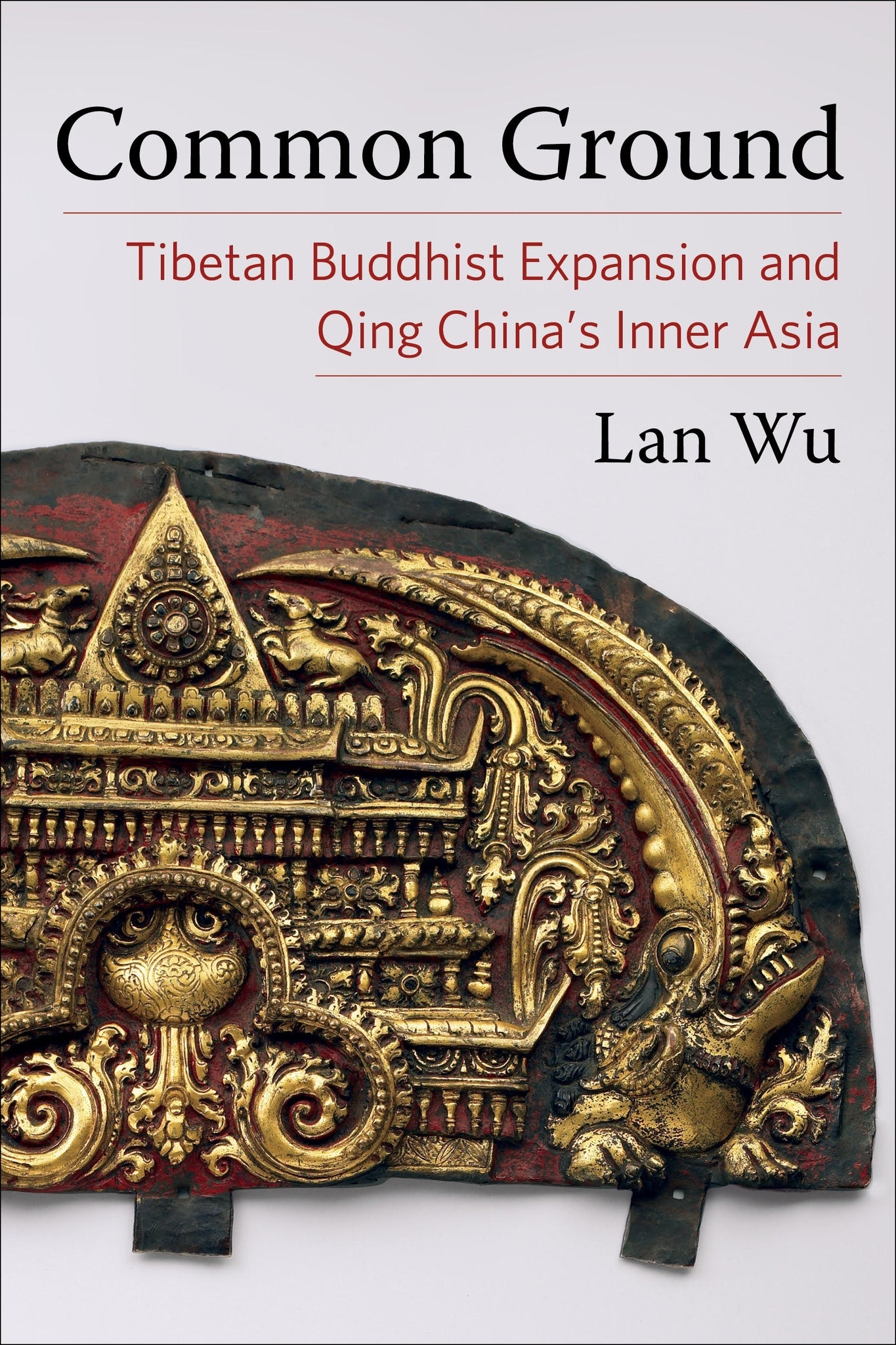
The Qing empire and the Dalai Lama-led Geluk School of Tibetan Buddhism came into contact in the eighteenth century. Their interconnections would shape regional politics and the geopolitical history of Inner Asia for centuries to come. In Common Ground, Lan Wu analyzes how Tibetan Buddhists and the Qing imperial rulers interacted and negotiated as both sought strategies to expand their influence in eighteenth-century Inner Asia. In so doing, she recasts the Qing empire, seeing it not as a monolithic project of imperial administration but as a series of encounters among different communities.
Wu examines a series of interconnected sites in the Qing empire where the influence of Tibetan Buddhism played a key role, tracing the movement of objects, flows of peoples, and circulation of ideas in the space between China and Tibet. She identifies a transregional Tibetan Buddhist knowledge network, which provided institutional, pragmatic, and intellectual common ground for both polities. Wu draws out the voices of lesser-known Tibetan Buddhists, whose writings and experiences evince an alternative Buddhist space beyond the state. She highlights interactions between Mongols and Tibetans within the Qing empire, exploring the creation of a Buddhist Inner Asia. Wu argues that Tibetan Buddhism occupied a central—but little understood—role in the Qing vision of empire. Revealing the interdependency of two expanding powers, Common Ground sheds new light on the entangled histories of political, social, and cultural ties between Tibet and China.


— Isabelle Charleux, author of Nomads on Pilgrimage: Mongols on Wutaishan (China), 1800–1940
Common Ground is a significant addition to the study of late imperial China and Inner Asia. Reconfiguring the terms of the imperial encounter between Qing rulers and Tibetan lamas, it provides a critical contribution to discussions and interpretations of Buddhism as a rhetorical, intellectual, and political space.
— Nicola Di Cosmo, Institute for Advanced Study
Common Ground delivers fresh perspectives on the formation of the Qing Empire from the vantage of its swelling Inner Asian frontier. Admirably, Lan Wu decenters court narratives in favor of “negotiated platforms” through which Tibetans, Mongols, Manchus, and Chinese actors made (and unmade) visions of sovereignty, territoriality, and belonging.
— Matthew King, author of Ocean of Milk, Ocean of Blood: A Mongolian Monk in the Ruins of the Qing Empire
Lan Wu’s engaging and erudite study tours the key nodes of Buddhist Inner Asia, from Lhasa to Beijing. Each stop offers vivid insight into the social, intellectual, and institutional networks built by the Qing state and Buddhist clergy as they competed and cooperated – shaping in the process the trajectories of China, Mongolia, and Tibet.
— Matthew Mosca, author of From Frontier Policy to Foreign Policy: The Question of India and the Transformation of Geopolitics in Qing China
This study by Lan Wu breaks important new ground, conceptually as well as historically. It focuses on the various ways in which the Gelukpa school of Tibetan Buddhism's Ganden Podrang government in Lhasa negotiated a political and a religious status quo with the Qing court in Beijing and vice versa. The book makes good on the promise that it seeks to capture "the changing dynamics in the space between the two epicenters of Beijing and Lhasa," the space being occupied by Tibetan Buddhist Inner Asia. The two principals were hardly equals, and Lan Wu deftly analyses the mise en scène of this "common ground" in which there was an obvious give and take by both parties, even if this was not always readily acknowledged by either one. This is a riveting book and a welcome addition to the growing number of studies
that deal with the relationships that were forged between different Tibetan Buddhist and Manchu actors during the late seventeenth and eighteenth centuries in which of necessity the Mongols played an important if not a central role.
— Leonard W.J. van der Kuijp, Harvard University
Provides a unique perspective for understanding the flexible geopolitics strategy of the Qing dynasty.
This book is one of the most original and important recent studies of the Qing empire.
This book is one of the most original and important recent studies of the Qing empire (1636–1912)...a brilliant study.
— C. Patterson Giersch, , Wellesley College
Acknowledgments
Note on Transliteration and Translation
Introduction: Buddhist Inner Asia
1. Campaigns
2. Manufacturing
3. Assemblies
4. Governance
Epilogue: A Balancing Act
Notes
Bibliography
Index