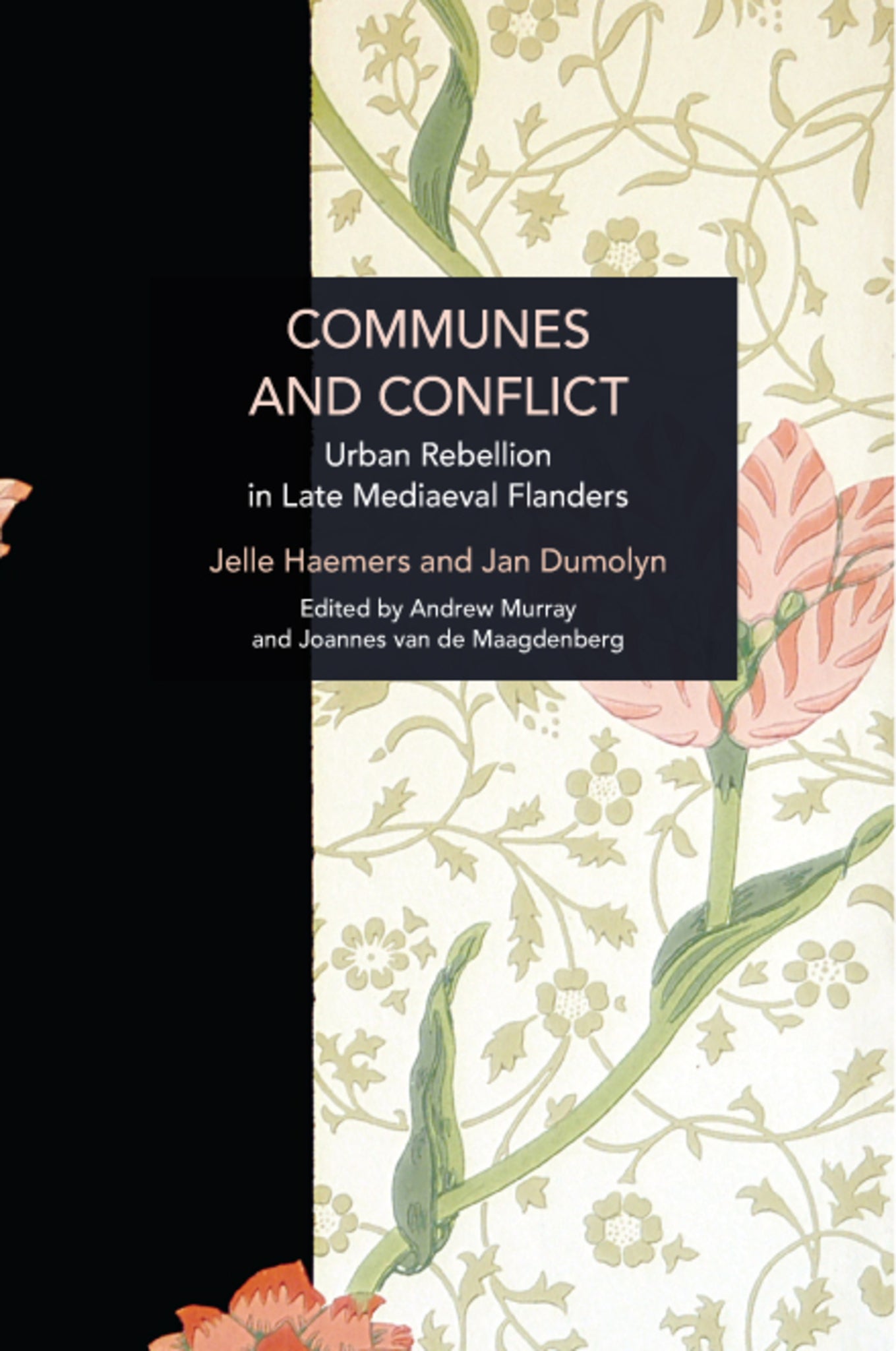
In Communes and Conflict, Jan Dumolyn and Jelle Haemers deftly explore the urban rebellions that regularly erupted in Flanders between the thirteenth and sixteenth centuries. They analyse not only how these rebellions were sparked and repressed, but also how they shaped the culture and identity of Flemish townspeople.
Drawing from a wide range of theoretical methods and concepts, including those of discourse analysis, semiotics, speech acts, collective memory and material cultural studies, the authors return to key Marxist questions on ideology, labour and class interest to map the perspectives of the rebels, the urban patriciate and the Flemish and Burgundian nobility.
Price: $40.00
Publisher: Haymarket Books
Imprint: Haymarket Books
Series: Historical Materialism
Publication Date:
24 September 2024
Trim Size: 9.00 X 6.00 in
ISBN: 9798888903285
Format: Paperback
BISACs:
HISTORY / Europe / Medieval, European history, HISTORY / Social History, PHILOSOPHY / Movements / Deconstruction, POLITICAL SCIENCE / Political Ideologies / Communism, Post-Communism & Socialism, History and Archaeology, European history: medieval period, middle ages
"Strictly speaking, [Communes and Conflict] is not a new monograph ... but it is a remarkably coherent whole. Due to its quality, it certainly makes an important contribution to the urban history of the Low Countries, social groups in Flanders (with interesting digressions on the rural classes) and phenomena such as opposition and revolt ... Because the book brings together fifteen years of publications, it is methodologically very valuable. It is like a flower that slowly opens until the petals show all their splendor. It is fascinating and instructive to see how the authors' conceptual foundation, based on archive material, is strengthened and expanded with each new contribution."
—Michel de Waha, The Low Countries Journal of Social and Economic History