


Some error occured while loading the Quick View. Please close the Quick View and try reloading the page.
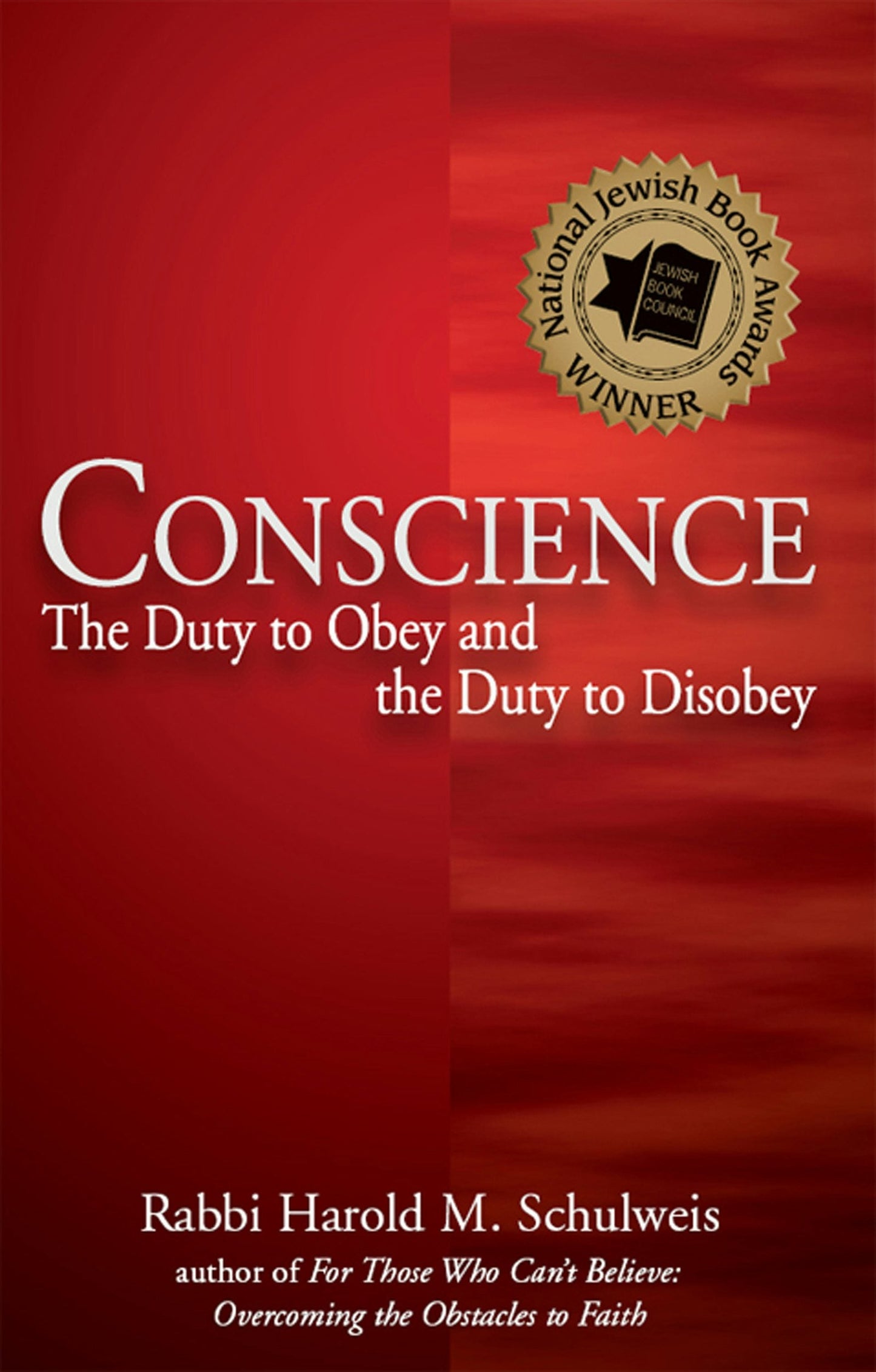
A Profound and Stirring Call to Action in Our Troubled World—from One of America's Great Religious Leaders
"Conscience may be understood as the hidden inner compass that guides our lives and must be searched for and recovered repeatedly. At no time more than our own is this need to retrieve the shards of broken conscience more urgent."
—from the Introduction
This clarion call to rethink our moral and political behavior examines the idea of conscience and the role conscience plays in our relationships to government, law, ethics, religion, human nature and God—and to each other. From Abraham to Abu Ghraib, from the dissenting prophets to Darfur, Rabbi Harold Schulweis probes history, the Bible and the works of contemporary thinkers for ideas about both critical disobedience and uncritical obedience. He illuminates the potential for evil and the potential for good that rests within us as individuals and as a society.
By questioning religion's capacity—and will—to break from mindless conformity, Rabbi Schulweis challenges us to counter our current suppressive culture of obedience with the culture of moral compassion, and to fulfill religion's obligation to make room for and carry out courageous moral dissent.


It doesn't take a genius to figure out when one receives a letter from a charity informing one that whether they had two million or ninety million invested with Madoff that something is wrong with our world. One of the wisest men I have met, Rabbi Harold M. Schulweis has written Conscience: The Duty to Obey and the Duty to Disobey (Jewish Lights $19.99). It is pertinent today as it is in discussing the Old Testament.
Oddly enough, Hebrew had no word for "conscience", modern Hebrew has the word “matzpun” which is derived from the Hebrew “tzafun” which connotes hiddenness. The major question Schulweis addresses is “What is the appropriate response to divine laws that run against the grain of conscience? He points out Abraham's dialogue with God over God’s intention to kill all of Sodom. God is not the implacable authoritarian commander whose plans cannot be questioned. Rabbi Schulweis points to Moses convinces God that the second commandment to visit the sins of the father on the next generation was wrong. As we talked, I did ask Rabbi Schulweis, “Does God have a conscience?”
In the light of torture at Abu Ghraib in our days, one can use the question, “Must an immoral law, divinely given, be observed?” God’s Law or Halacha must have conscience, and yet changing times can have their affect. By what sort of logic are divine laws overturned? In the case of a wife suspected of adultery, she was to drink the waters of bitterness and hear the priest give a horrible curse. If she was guilty, her body would swell and her thighs would “fall away”. To change a bad law requires compassionate conscience and moral courage.
Conscience allows us to tell truth to power, which is the irony that Eli Weisel’s Foundation should have lost so much money in the Madoff debacle. Where were those who questioned the man’s investing policies who did not speak up? Does greed overcome conscience? He quotes Thomas Malthus and Herbert Spencer that attend the voice of conscience and our economy will be drained and our energy exhausted.
Rabbi Schulweis told me about his foundation, the Jewish Foundation for the Righteous, dedicated to the study and recognition of the phenomenon of Christian rescuers and to raise funds so that in their waning years they have some security, recognition and material help. So far they have given help to over 2,000. He includes in the book the remarkable help given to the Jews in the Holocaust by diplomats who gave over and above documents to rescue them from the Naziis. Among those mentioned are Aristides de Sousa Mendes of Portugal and Sempo Sugihara of Japan.
Rabbi Schulweis ends the book with the thought that we are frozen in the overwhelming bias toward the duty to obey without question. A fact that has led us to war in Iraq and blind belief in an economic fantasy led by a duplicitous Pied Piper.
Acknowledgments xiii
Introduction 1
Judaism and Conscience 3
A Word about Conscience 5
1. Conscience Confronts God 7
Abraham and Moral Audacity 8
Moses Nullifies God's Law 10
Moses Cites Scripture to God 12
Moses Frees God 14
Four Dissenting Prophets 16
Hannah Hurls Words Toward Heaven 17
The Psalmist Awakes the Slumbering 19
Natural Moral Sensibility 20
2. Human Conscience and Divine Legislation 23
Rabbinic Legal Conscience 26
Laws That Never Were and Never Will Be 27
The Rebellious Son 28
Idolatrous Cities, Leprous Houses 30
Capital Punishment 30
Sotah: The Ordeal of Jealousy 31
Illegitimacy: When Conscience Fails 32
The Chained Woman 33
Maimonides: Within the Letter of the Law 34
The Myth of Absolute Immutability 35
Moral Relativism 36
The Fear of God and the Fear of Torah 38
What Is Meant by Conscience as "Fear of God" 40
Matters of Temperament 42
3. Conscience and Covenant:
Vertical and Horizontal 45
The God of the Philosophers 45
The Duality in One Covenant 46
The Vertical Covenant 48
Statutes 50
The Consolations of Obedience 52
The Horizontal Covenant of Conscience 53
Legends of Conscience 54
4. Against Conscience 59
The Myth of Gyges 61
Freud: The Truth about Human Nature 62
Nietzsche: The Craftiness of Conscience 63
Social Darwinism and Conscience 64
Theological Suspicions 66
Judaism: The Morality of Theistic Humanism 68
5. Witness to Goodness 71
Ben Gurion's Search for Morale 73
To Discover Conscience in Hell 75
An Entire Village: The Conspiracy of Goodness 77
Stefa Krawkowska: The Heroism of Hiding 78
Seven Sisters and a Mother Superior 79
Diplomat Rescuers 80
Aristides de Sousa Mendes: Undiplomatic Diplomacy 82
Sempo Sugihara 85
Conversation with a German Pastor 87
6. The Conscience of an Anti-Semite 91
The Enigma of Anti-Semitic Rescuers 92
Zophia and Zegota 94
Motivations for Altruism 96
The Ambiguity of Good and Evil 97
Capturing the Evil Tempter 98
7. Cultivating Conscience 101
Obedience and Authority 101
Abu Ghraib and the "Prison" of Stanford 103
The Milgram Experiment 106
8. The Bridge across the Rivers of “Either-Or” 109
Either-Or: The Way Options Are Shared 110
Not in Heaven But on Earth 112
Abraham Isaac Kook: The Art of Reconciliation 114
Facing God 115
What Can Religion Do? 118
The Pedagogy of Conscience 119
The Habit of Conscience 120
Heroes of Conscience 121
Transmitting Conscience 123
The Many Faces of Conscience 124
The Pendulum of Duty 126
Notes 127