


Some error occured while loading the Quick View. Please close the Quick View and try reloading the page.
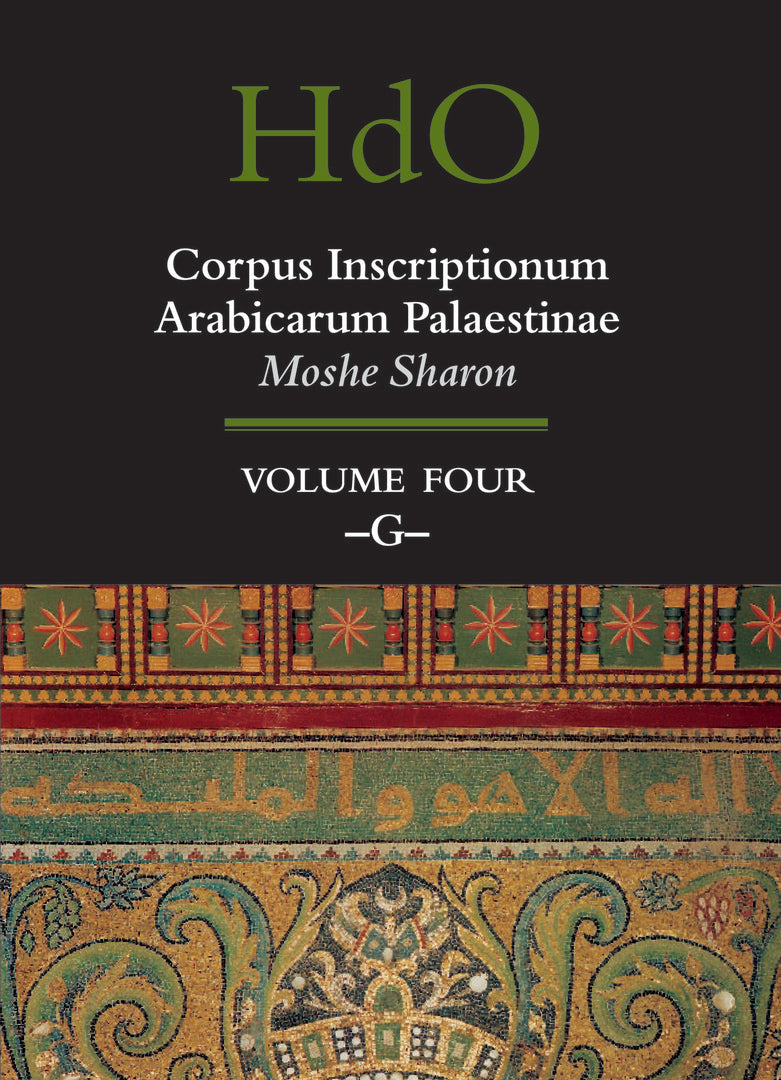
Western Palestine is extremely rich in Arabic inscriptions, whose dates range from as early as CE 150 until modern times. Most of the inscriptions date from the Islamic period, for under Islam the country gained particular religious and strategic importance, even though it made up only part of the larger province of Syria.
This historical importance is clearly reflected in the hundreds of inscriptions, the texts of which cover a variety of topics: construction, dedication, religious endowments, epitaphs, Qur'anic texts, prayers and invocations, all now assembled in the Corpus Inscriptionum Arabicarum Palaestinae (CIAP).
The CIAP follows the method established at the end of the 19th century by Max van Berchem, namely, the studying of the Arabic inscriptions 'in context'. Van Berchem managed to publish two volumes of the inscriptions from Jerusalem: the CIAP covers the entire country. The inscriptions are arranged according to site, and are studied in their respective topographical, historical and cultural context. In this way the CIAP offers more than a survey of inscriptions: it represents the epigraphical angle of the geographical history of the Holy Land.
Volume One: (A) was published in 1997, Volume Two: (B-C) in 1999, Volume Three: (D-F) in 2004, Volume Four: (G) in 2008, an Addendum in 2007, Volume Five: (H-I) in 2013, Volume Six: J (1) in 2016 and Volume Seven: J (2) Jerusalem 1 in 2021. All volumes are still available.
This historical importance is clearly reflected in the hundreds of inscriptions, the texts of which cover a variety of topics: construction, dedication, religious endowments, epitaphs, Qur'anic texts, prayers and invocations, all now assembled in the Corpus Inscriptionum Arabicarum Palaestinae (CIAP).
The CIAP follows the method established at the end of the 19th century by Max van Berchem, namely, the studying of the Arabic inscriptions 'in context'. Van Berchem managed to publish two volumes of the inscriptions from Jerusalem: the CIAP covers the entire country. The inscriptions are arranged according to site, and are studied in their respective topographical, historical and cultural context. In this way the CIAP offers more than a survey of inscriptions: it represents the epigraphical angle of the geographical history of the Holy Land.
Volume One: (A) was published in 1997, Volume Two: (B-C) in 1999, Volume Three: (D-F) in 2004, Volume Four: (G) in 2008, an Addendum in 2007, Volume Five: (H-I) in 2013, Volume Six: J (1) in 2016 and Volume Seven: J (2) Jerusalem 1 in 2021. All volumes are still available.

Price: $317.00
Pages: 308
Publisher: Brill
Imprint: Brill
Publication Date:
27 November 2008
ISBN: 9789004170858
Format: Other

Moshe Sharon, Ph.D. (1971) in Islamic Studies. Professor of Islamic History, and Chair in Bahāʿī Studies, The Hebrew University, Jerusalem. His major publications are in Arabic Epigraphy - Corpus Inscriptionum Arabicarum Palaestinae (Brill 1997-2004), Islamic Medieval history and the Bahāʿī faith.