


Some error occured while loading the Quick View. Please close the Quick View and try reloading the page.
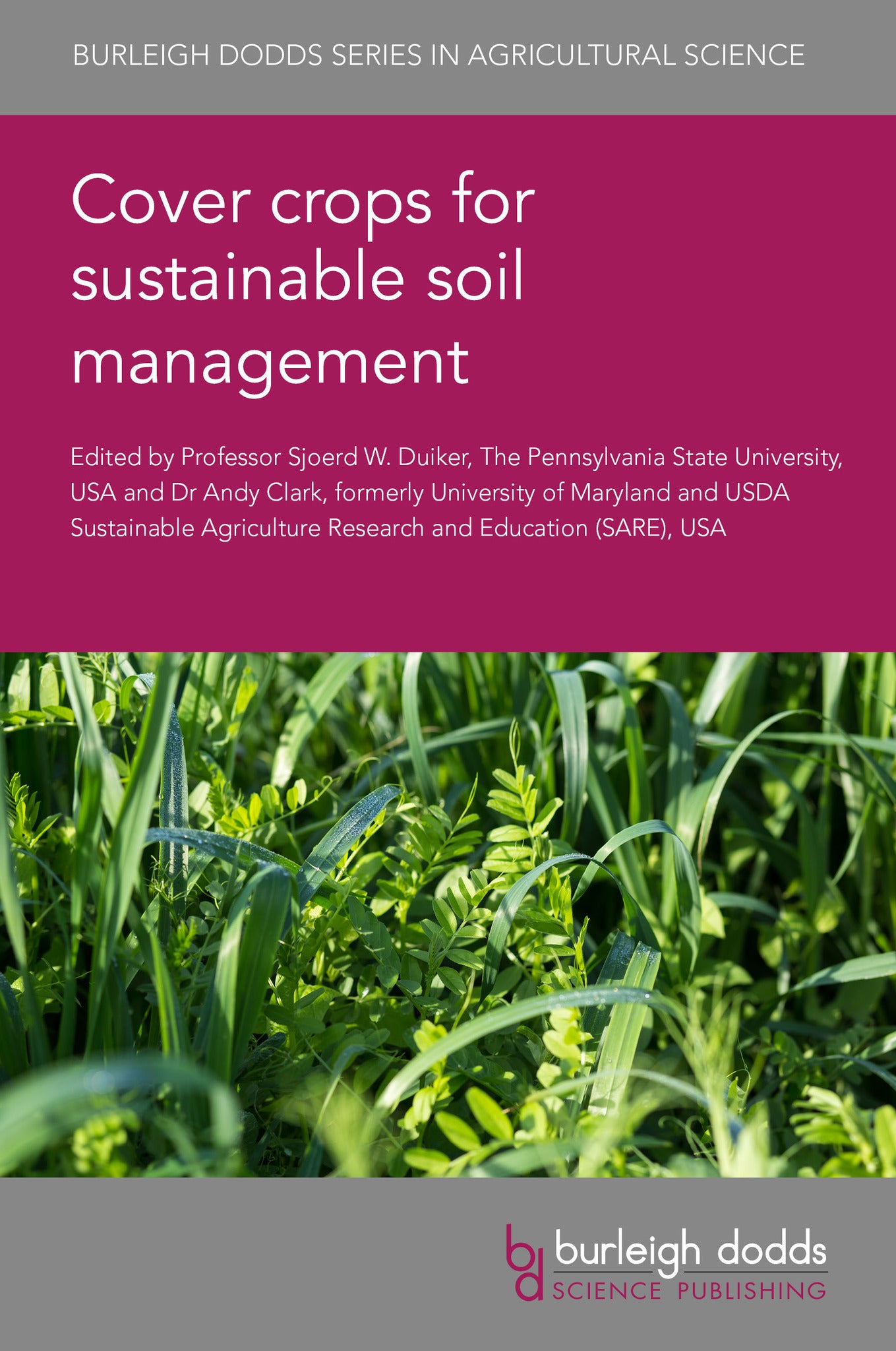
There is a growing body of research on cover crops as a key tool in regenerative agriculture, including their multifunctional role in making agricultural systems more resilient in the face of climate change.
Cover crops for sustainable soil management provides a comprehensive review of the varied roles of cover crops in promoting soil health, how best to deploy them, as well as optimising use of different classes of cover crops in promoting soil health. The book also discusses the use of different classes of cover crops, including cool and warm season leguminous and gramineous cover crops, as well as non-leguminous broadleaf cover crops.


Dr Sjoerd W. Duiker is Professor of Soil Management and Applied Soil Physics at The Pennsylvania State University, USA. He has made significant contributions to both research and extension in developing more sustainable soil management practices in such areas as no-till systems, the use of cover crops, mulches and more diverse crop rotations. He is a member of the Governing Board of the Northeast Cover Crops Council which brings together universities, farmers, government agencies and others to optimise cover crop use in the north-eastern states of the USA.
Dr Andy Clark recently retired as National Communications Director of the USDA Sustainable Agriculture Research and Education (SARE) Program. The SARE Program operates under cooperative agreements between the University of Maryland, USA and the USDA’s National Institute of Food and Agriculture. Dr Clark led the communications arm of the SARE Program that was instrumental in developing and disseminating sustainable crop and livestock management practices in the United States. As Communications Director, Dr Clark oversaw the development of more than 40 publications, including editing the Third Edition of the SARE publication Managing Cover Crops Profitably, widely regarded as the standard reference for farmers, agronomists and others interested in adoption of cover crops on farms in the United States.
Part 1 Understanding the role of cover crops
- 1.The role of cover crops in optimizing nutrient cycles: Yajun Peng, Claudia Wagner-Riddle and Laura L. Van Eerd, University of Guelph, Canada;
- 2.The role of cover crops in improving soil biological health: Michelle Wander, University of Illinois, USA;
- 3.The role of cover crops in improving biodiversity: Deirdre A. Prischmann-Voldseth and Keiran Hyte, North Dakota State University, USA; Rachel Mallinger, University of Florida, USA; and Jarrad Prasifka, USDA-ARS-ETSARC, USA;
- 4.Cover crops for arthropod pest management: Nicola A. Irvin, University of California-Riverside, USA; Ivan Milosavljević, University of California-Riverside and Citrus Research Board, USA; and Mark S. Hoddle, University of California-Riverside, USA;
- 5.Revisiting the contribution of cover crops to weed management in Conservation Agriculture: John M. Wallace and Laurel Wellman, The Pennsylvania State University, USA;
- 6.The role of cover crops in forage production: Heather Darby, Claire Benning and John Bruce, University of Vermont, USA; Kurt Cotanch, Barn Swallow Consulting, USA; and Ivy Krezinski, Amber Machia, Lindsey Ruhl, Jeffrey Sanders, Elizabeth M. Seyler, Laura Sullivan and Sara Ziegler, University of Vermont, USA;
- 7.Assessing the effects of cover crops on cash crop yields: Inderjot Chahal, University of Guelph, Canada; Yvonne Lawley, University of Manitoba, Canada; Alex L. Woodley, North Carolina State University, USA; Maryse Bourgault, University of Saskatchewan, Canada; and Laura L. Van Eerd, University of Guelph, Canada;
Part 2 Managing cover crops
- 8.Cover crop decision support tools: Victoria J. Ackroyd, University of Maryland, USA; Heather Darby, University of Vermont, USA; Mikah Pinegar and S. Chris Reberg Horton, North Carolina State University; and Steven B. Mirsky, USDA-ARS, USA;
- 9.Cover crop establishment: Andy Clark, formerly University of Maryland and USDA Sustainable Agriculture Research and Education (SARE), USA; and Sjoerd W. Duiker, The Pennsylvania State University, USA;
- 10.Key challenges in terminating cover crops: Alyssa Essman and Ramawatar Yadav, The Ohio State University, USA; and Travis Legleiter, University of Kentucky, USA;
Part 3 Cover crop species
- 11.Cool season leguminous cover crops: Artie Siller, Neda Nikpour-Rashidabad and Masoud Hashemi, University of Massachusetts Amherst, USA;
- 12.Warm season leguminous cover crops: Gourav Chahal, Auburn University, USA; and Andrew Price, USDA-ARS National Soil Dynamics Laboratory, USA;
- 13.Cool season grass cover crops: H. Blanco-Canqui, University of Nebraska-Lincoln, USA; S. J. Ruis, USDA-ARS National Laboratory for Agriculture and the Environment, USA; H. Klopp, South Dakota State University, USA; and A. Jhala, J. McMechan, C. Proctor and V. de Sousa Ferreira, University of Nebraska-Lincoln, USA;
- 14.Warm season grass cover crops: A. Sophie Westbrook, Kansas State University, USA; Jaya Nepal, The Pennsylvania State University, USA; and Matthew R. Ryan, Cornell University, USA;
- 15.Non-leguminous broadleaf cover crops: Christina Curell and Madelyn Celovsky, Michigan State University, USA;
Part 4 The future of cover crops
- 16.Strategies to increase cover crop adoption: Ken Staver, University of Maryland, USA;
- 17.The future of cover crops: opportunities, challenges and R&D needs: Sjoerd W. Duiker, The Pennsylvania State University, USA; and Andy Clark, formerly University of Maryland and USDA Sustainable Agriculture Research and Education (SARE), USA;