


Some error occured while loading the Quick View. Please close the Quick View and try reloading the page.
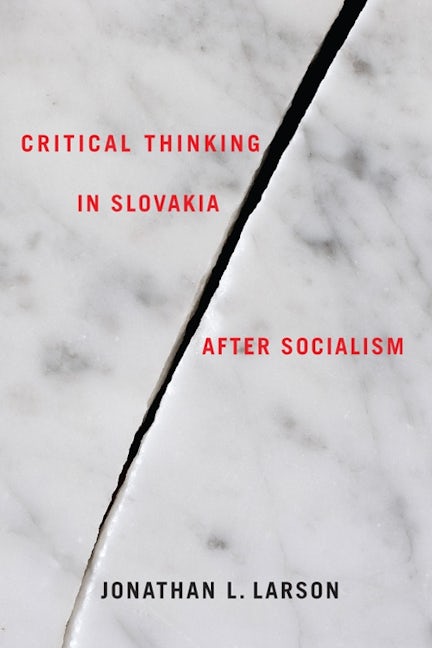
Critical Thinking in Slovakia after Socialism interrogates the putative relationship between critical thought and society through an ethnographic study of civic discourse in post-1989 Slovakia.
Critical thinking is the civic virtue of a liberal democracy. Citizens who think for themselves, cooperate, and can agree to disagree are the hallmark of a self-governing society. People from undemocratic societies, however, are often believed to lack this virtue, because authoritarian regimes smother critical discourse through fear and dull critical thought through the control of information and propaganda. After the end of Communist rule in 1989, Westernagents of democratization and educational development chided the residents of the former Czechoslovakia for this deficiency, claiming that the Slovaks' inability to think critically was the reason the nation struggled to integrate with Western Europe.
Critical Thinking in Slovakia after Socialism examines this putative relationship between critical thought and society through an ethnographic study of post-1989 Slovakia. Drawing on original fieldwork and anthropological theories of language and culture, Jonathan Larson uncovers patterns of social analysis and criticism in Slovak political discourse. He exposes ways in which these discursive practices have been misinterpreted and explains their underlying dynamics in Slovak society. This important volume, bringing together scholarship on East Central Europe, liberalism, education, and the public sphere, gives students of modern history, politics,and culture a fresh perspective on a skill essential to civil society.
JONATHAN L. LARSON is Assistant Professor of Education at Grinnell College, IA.
Critical thinking is the civic virtue of a liberal democracy. Citizens who think for themselves, cooperate, and can agree to disagree are the hallmark of a self-governing society. People from undemocratic societies, however, are often believed to lack this virtue, because authoritarian regimes smother critical discourse through fear and dull critical thought through the control of information and propaganda. After the end of Communist rule in 1989, Westernagents of democratization and educational development chided the residents of the former Czechoslovakia for this deficiency, claiming that the Slovaks' inability to think critically was the reason the nation struggled to integrate with Western Europe.
Critical Thinking in Slovakia after Socialism examines this putative relationship between critical thought and society through an ethnographic study of post-1989 Slovakia. Drawing on original fieldwork and anthropological theories of language and culture, Jonathan Larson uncovers patterns of social analysis and criticism in Slovak political discourse. He exposes ways in which these discursive practices have been misinterpreted and explains their underlying dynamics in Slovak society. This important volume, bringing together scholarship on East Central Europe, liberalism, education, and the public sphere, gives students of modern history, politics,and culture a fresh perspective on a skill essential to civil society.
JONATHAN L. LARSON is Assistant Professor of Education at Grinnell College, IA.

Price: $130.00
Pages: 260
Publisher: Boydell & Brewer Inc.
Imprint: University of Rochester Press
Publication Date:
15 April 2013
Trim Size: 9.00 X 6.00 in
ISBN: 9781580464376
Format: Hardcover
BISACs:
HISTORY / Europe / Eastern, European history, HISTORY / Modern / 20th Century / General, POLITICAL SCIENCE / Political Ideologies / Communism, Post-Communism & Socialism, General and world history

[T]his sophisticated and unique work is a great accomplishment . . . Larson's work should be of great interest to scholars in anthropology and beyond.
Introduction
Separation, Judgment, and Laments of Civic Criticism
Civility and Crisis in the Slovak Public Sphere
Sentimental Kritika
Love, L'udskost' and Education for Democracy
Young Literary Critics
Conclusion
Notes
Bibliography
Index
Separation, Judgment, and Laments of Civic Criticism
Civility and Crisis in the Slovak Public Sphere
Sentimental Kritika
Love, L'udskost' and Education for Democracy
Young Literary Critics
Conclusion
Notes
Bibliography
Index